Quick Answer
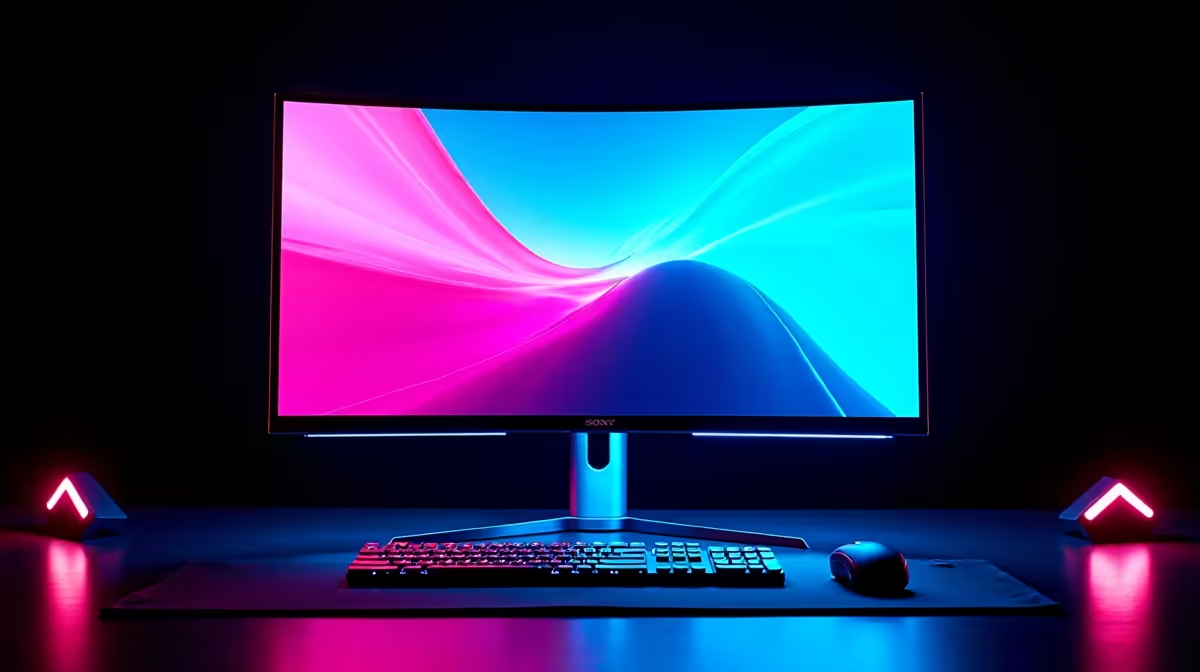
For under R15,000, a 250Hz gaming monitor should have a 1ms GtG response time, FreeSync Premium or G-Sync Compatible certification, 1440p or 1080p resolution, and a Fast-IPS or Fast-VA panel. At this budget you can find 27-inch 1440p 240Hz to 280Hz IPS monitors from ASUS, LG, and MSI that represent excellent value for competitive gaming in South Africa.
Resolution and Refresh Rate Trade-Offs 🎮
At a R15,000 monitor budget you face a meaningful choice: a 1080p panel hitting 280Hz to 360Hz for the lowest per-frame latency in competitive titles, or a 1440p panel at 240Hz to 250Hz for sharper image quality with nearly equivalent high-frame-rate performance. For CS2 and Valorant where sustaining 300-plus fps is achievable with a mid-range GPU, a 1080p 360Hz IPS panel maximises that frame delivery advantage. For SA gamers who also play story games where visual fidelity matters, a 1440p 240Hz panel provides the better all-rounder experience. A 27-inch 1440p 240Hz IPS monitor sits around R8,000 to R12,000 locally, leaving headroom for a quality stand or VESA arm, while a 360Hz 1080p panel of similar build quality competes in the R10,000 to R14,000 range.
Response Time and Certification Labels 🔧
The 1ms response time printed on boxes is typically the GtG at the fastest overdrive setting, often with inverse ghosting at that level. A more useful metric is MPRT (Moving Picture Response Time): some monitors publish both, and a 0.5ms MPRT paired with 1ms GtG indicates effective backlight strobing. Strobing and FreeSync/G-Sync cannot typically run simultaneously, so choose: if gaming at fps near the refresh ceiling, FreeSync is more valuable. If chasing maximum motion clarity at a fixed high fps, MPRT strobing is the better tool. FreeSync Premium at this budget is broadly available and requires a minimum 120Hz FreeSync range with LFC support.
Build Quality Checks for SA Buyers 💡
For a R15,000 monitor purchase, inspect three practical items. First, confirm warranty is handled by a local SA distributor rather than an international return process. Second, check stand adjustability: a monitor at R15,000 should include full ergonomic adjustment, not just tilt. Third, confirm DisplayPort 1.4 is included in the cable bundle: DisplayPort is required for VRR at 250Hz-plus on most panels, and a replacement cable locally adds R100 to R250 of avoidable cost.
Enable Enhanced Sync, Not Maximum Overdrive ⚡
When setting up a 250Hz monitor, enable FreeSync or G-Sync Compatible in the GPU driver, then test overdrive at the second-fastest setting rather than maximum. Most panels at 250Hz produce inverse ghosting on maximum overdrive but run clean one step down. This single OSD adjustment is the most impactful setup step for motion quality.
FAQ
Is a 250Hz monitor useful if my GPU only hits 150 fps in most games?
Yes. FreeSync or G-Sync eliminates screen tearing and smooths frame pacing even without reaching 250 fps. A 150 fps session on a 250Hz VRR panel is noticeably smoother and cleaner than 150 fps on a 60Hz panel with V-Sync.
What is the minimum GPU to justify a 250Hz monitor?
An RTX 5060 Ti or RX 9070 sustains 200-plus fps in CS2 and Valorant at 1080p, making a 250Hz panel fully utilised. At 1440p these GPUs deliver 150 to 200 fps in competitive titles, still meaningfully feeding a 250Hz FreeSync display.
Do all 250Hz monitors require DisplayPort or does HDMI 2.1 work?
HDMI 2.1 supports 250Hz at 1080p and 1440p with bandwidth to spare. DisplayPort 1.4 handles both resolutions equally. Avoid HDMI 2.0, which caps at 144Hz on many 1440p panels.
Shopping for a competitive gaming monitor under R15,000?
Evetech stocks 240Hz and 250Hz gaming monitors from ASUS, MSI, LG, and more, all with local SA warranty and delivery across South Africa.