Quick Answer
Before buying a DisplayPort cable in South Africa, verify four things: the DisplayPort version (1.4 or 2.1), the cable length versus your actual desk routing path, whether the cable is VESA-certified, and whether the retailer offers a local return policy. Missing any one of these steps risks buying a cable that throttles your display performance or fails without a warranty path.
Matching the DP Version to Your Hardware 🔧
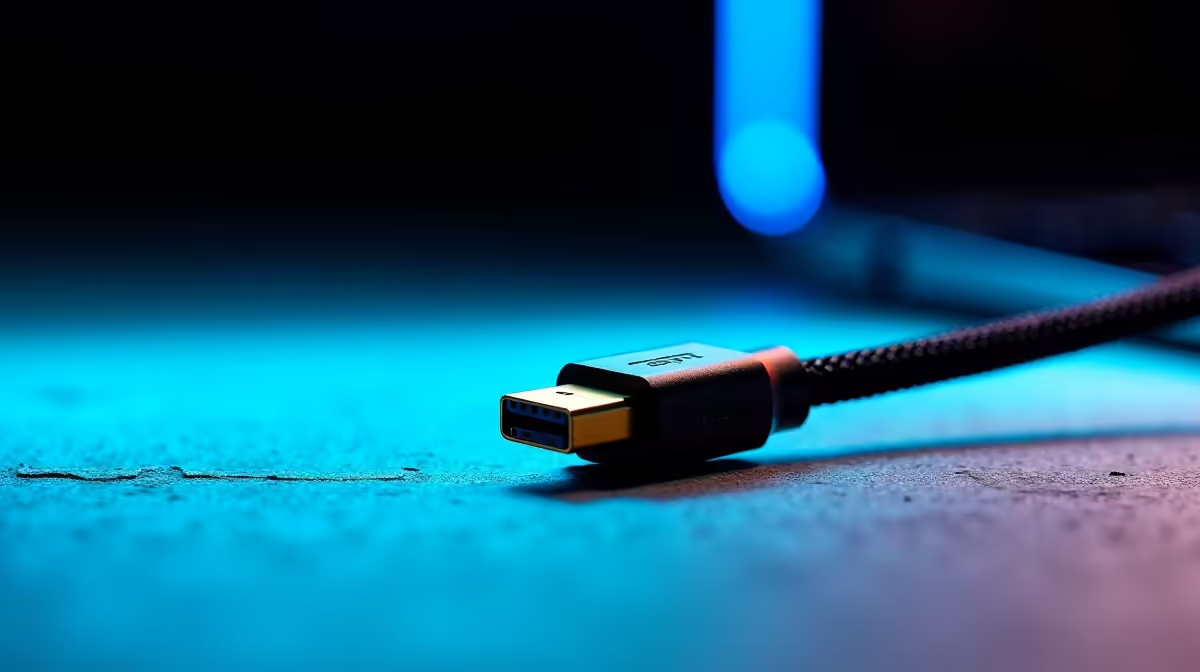
DisplayPort version determines maximum bandwidth and therefore the highest resolution and refresh rate your cable can carry. DP 1.4 (HBR3) handles 4K/144Hz or 1440p/240Hz, covering the vast majority of South African gaming monitor purchases in 2026. DP 2.1 UHBR10 is needed for 4K/240Hz or 8K/60Hz and is required if you are running an RTX 5080 or RTX 5090 at the top of its capability. DP 1.2 cables, still widely available in SA, are limited to 4K/60Hz or 1440p/75Hz and should be avoided for any modern GPU and high-refresh monitor pairing. Check your GPU's output spec (printed on the box or in the spec sheet) and match it to the cable version.
Measuring the Real Cable Path in Your Setup 📐
South African desk setups vary widely, from compact student rooms in digs near Wits or UJ to spacious home office gaming rooms in the suburbs. Measure the actual routing path your cable will take, not the straight-line distance from PC to monitor. Route the string through cable management clips, down the back of your desk, and up to the monitor arm or stand mount. Add 15 to 20 cm for connector bend radius at each end. Most standard South African desk setups need a 1.5 to 2 metre cable. Buying a 5 metre cable for a 1 metre run creates messy cable management with no benefit.
Checking Certification and Retailer Warranty 🛡️
The South African grey-market imports channels sometimes carry cables labelled "8K cable" or "high speed DisplayPort" with no verifiable certification. A genuine VESA-certified cable will have the DisplayPort version printed on the connector boot, the packaging, or both. For peace of mind in South Africa's return environment, buy through a local retailer who stocks the product physically: you get a local invoice for warranty claims, access to CPA-backed returns within 6 months for defective goods, and no overseas shipping hassles if the cable develops a fault. Evetech stocks certified cables with local warranty support.
Do a Link-Rate Check After Installing Your Cable ⚡
After connecting a new DisplayPort cable, right-click the desktop, open Display Settings, and verify your monitor is running at its rated refresh rate. On Nvidia GPUs, open Nvidia Control Panel and check the resolution panel. If the refresh rate is lower than expected, the cable may be negotiating a lower link rate due to signal quality issues.
FAQ
Is there a difference between a male-to-male DisplayPort cable and a DisplayPort adapter cable?
Yes. A native male-to-male DP cable carries the full DP bandwidth end-to-end. An adapter cable (DP to HDMI or DP to DVI) is limited by the target standard's bandwidth, not the DisplayPort spec. For best performance, always use native DP to DP cables between your GPU and monitor when both support DisplayPort.
Will a DisplayPort cable from a South African grey-market import work reliably?
Sometimes, but without VESA certification there is no guarantee of sustained bandwidth. Grey-market cables may pass casual use at 1080p/60Hz but fail under sustained 4K/144Hz signal loads. The lack of local warranty path is an additional risk.
Can I use the same DisplayPort cable if I upgrade my GPU later?
If your current cable is DP 2.1 UHBR10, yes: it will work with any GPU that outputs DP 2.1. If your cable is DP 1.4, upgrading to an RTX 5080 and a 4K/240Hz monitor will require a DP 2.1 cable to reach the monitor's full capability.
Not sure which DisplayPort cable fits your setup?
Evetech stocks certified DisplayPort 1.4 and 2.1 cables alongside GPUs and gaming monitors, all with local warranty support and no grey-market risk.