Quick Answer
Before buying an SD card for 4K recording, check your camera's minimum card requirement in its manual, confirm the card's V-class rating (V30 for standard 4K, V60 for high-bitrate), verify the form factor (standard SD or microSD), and buy from a South African retailer with local warranty support to protect against counterfeits.
Step 1: Read Your Camera's Manual for Card Requirements 📋
Every mirrorless or DSLR body that shoots 4K documents its minimum SD card requirements in the manual or on the manufacturer's support page. The Sony ZV-E10, for example, recommends UHS-I U3 or V30 for its 4K recording modes. The Nikon Z30 specifies V30 minimum for 4K/30fps. The Lumix S5 II requires V60 for its All-Intra 4K modes. Buying without checking this is how South African creators end up with V30 cards that stall mid-recording on a camera that needs V60. A five-minute check before purchase prevents this entirely.
Step 2: Verify the V-Class and Form Factor 🔬
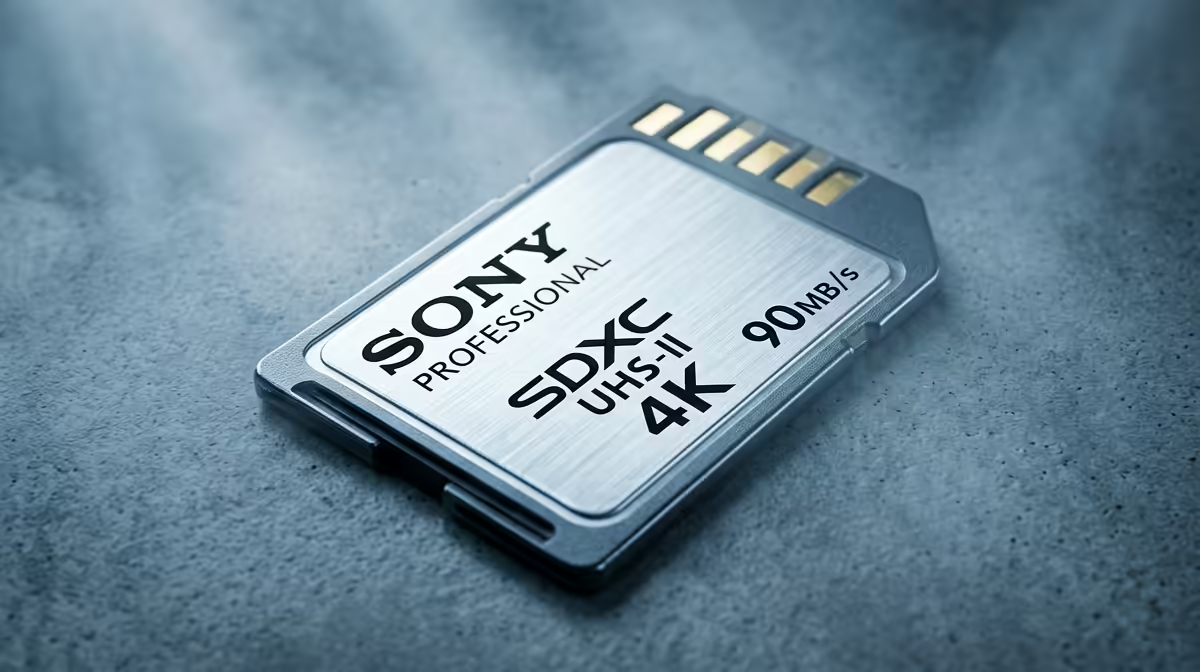
Once you know the minimum V-class your camera requires, check the physical marking on the card. The V-class number appears in a V-shaped icon on the card face (V30, V60, or V90). The UHS class U3 (the number 3 inside a U shape) also guarantees 30MB/s and is equivalent to V30 for recording purposes. For form factor: mirrorless cameras and DSLRs use full-size SD. DJI drones (Mini 4 Pro, Air 3) use microSD. GoPro and Insta360 action cameras use microSD. A microSD-to-SD adapter allows a microSD to function in a full-size SD slot at UHS-I speeds without signal degradation.
Step 3: Buy Locally and Verify on Arrival 🛡️
South Africa has a documented counterfeit SD card problem in informal markets and some online platforms. A fake 256GB card may show the correct capacity on initial scan but write corrupted data when the card fills past its actual storage limit. Buying from a reputable local retailer with a returns policy provides recourse if the card underperforms. On arrival, run a capacity check confirming approximately 238GB available on a 256GB card, and then record at least 15 continuous minutes of 4K footage at full bitrate to confirm the card sustains its rated V-class write speed throughout.
Keep Your Camera Manual's Card Recommendation Page Bookmarked ⚡
Camera manufacturers update their recommended card lists occasionally as new card models launch. Bookmarking the support page for your specific camera model lets you check if a specific card has been tested and approved before purchase. This is especially useful before buying less common brands at a lower price point in the SA market.
FAQ
Does it matter if the card is made specifically for video versus general use?
Cards marketed as video-specific typically emphasise sustained write performance and temperature tolerance. For 4K recording these are exactly the properties that matter. A general-purpose card with the same V-class rating performs similarly, but video-labelled cards sometimes carry higher endurance ratings suited for continuous recording.
How do I know if my 4K recording failure is the card or the camera?
Insert a different card that is known-good and meets your camera's V-class requirement. Record the same 4K clip. If the failure disappears, the original card is the problem. If it persists, the issue is in the camera body itself.
Is it safe to buy SD cards through online classifieds in South Africa?
The risk of counterfeit or misrepresented cards is significantly higher through classifieds and second-hand channels than through formal retail. For a camera card holding client work, the risk is not worth the saving.
Buying your first or next SD card for 4K recording?
Browse the SD card range at Evetech, check V-class options that match your camera's requirements, and buy with a local warranty for peace of mind.