Quick Answer
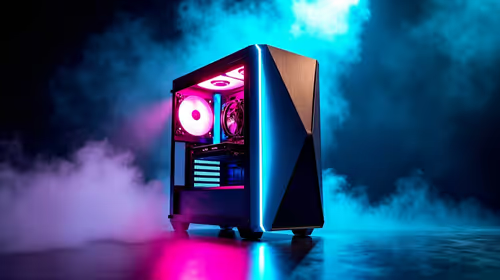
South African PC builders choosing a high-airflow E-ATX case should prioritise front mesh porosity above 40%, at least three 140mm fan mount positions, top radiator support for 360mm or 420mm AIOs, and sufficient drive bays for local storage needs. Budget R3,500 to R7,000 for a full-size E-ATX enclosure that balances these features with build quality.
Why Airflow Priorities Differ in South Africa 🌡️
South Africa's climate adds a thermal variable that builders in cooler European markets rarely face. Summer ambient temperatures in Gauteng regularly reach 32 to 38 degrees Celsius, compressing the thermal margin between component operating temperatures and safe maximums. An RTX 5080 with a GPU hot-spot limit of 110 degrees Celsius has only 72 degrees of headroom at 38 degrees ambient, versus 80 degrees at 30 degrees. Choosing a case with genuinely high front-panel porosity rather than a mesh-look grille with low open area is a direct mitigation for South African summer heat. This is not marketing: the temperature difference between a high-porosity and a low-porosity front panel is 5 to 10 degrees Celsius under sustained load.
Fan Mount Requirements for SA Builders 💨
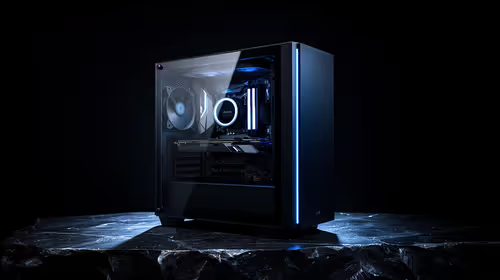
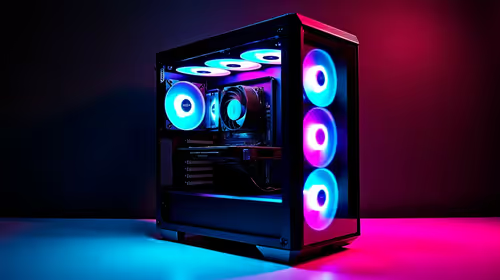
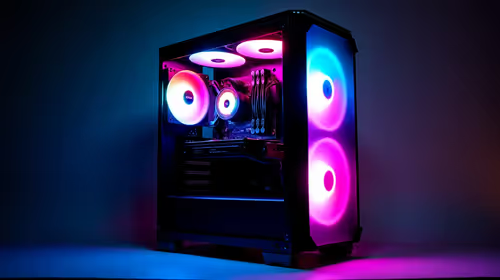
For South African builders, the minimum acceptable fan mount count in an E-ATX case is five: two front 140mm intakes, two top 140mm exhausts, and one rear 140mm exhaust. This five-fan layout creates consistent positive pressure across all seasons including mid-summer. Cases with bottom fan mounts add a sixth position that helps cool the PSU and GPU power delivery area, useful for multi-GPU or 450W-class GPU builds. The Phanteks Enthoo Pro 2 and Fractal Define 7 XL meet these requirements and have confirmed full E-ATX dimension support.
Storage and Practical Build Features 🗄️
South African builders often face longer delivery lead times for replacement components than builders in Europe or North America. An E-ATX case selected for a high-end rig should provide at minimum four 3.5-inch HDD positions and four 2.5-inch SSD mounts, supporting NAS-adjacent workstation use cases without external enclosures. A case with at least 25mm of cable management channel depth behind the motherboard tray and a full-length PSU shroud prevents cable clutter from interfering with airflow between the PSU shroud and GPU area.
Confirm Local Stock Before Speccing Your Build ⚡
Full-size E-ATX cases are occasionally out of stock from South African distributors. Factor in import duties, VAT, and shipping insurance before considering imports from overseas. For most cases in the R4,000 to R7,000 range, local warranty support through Evetech makes the in-stock local purchase significantly lower risk than an imported unit with no local warranty path.
FAQ
What is the best E-ATX case for a hot climate like South Africa?
Cases with a fully open front mesh, at least three 140mm intake positions, and no glass front panel perform best in high ambient conditions. The Fractal Design Torrent XL, with its large bottom intake and open mesh front, is among the strongest thermal performers for exactly this scenario.
Does E-ATX case size improve cable management?
Yes. Larger cases provide more physical space for routing and a wider motherboard tray. E-ATX builds with 1,000W-plus PSUs produce thicker cable harnesses, and the additional width makes routing to the hidden management channel far easier than in a standard ATX mid-tower.
Can I run a standard ATX board in an E-ATX case?
Yes. All E-ATX cases support standard ATX, Micro-ATX, and Mini-ITX boards using the same stand-off positions. The extra internal space can actually benefit airflow around a smaller board.
Building a high-airflow workstation or gaming rig?
Evetech carries full-tower and E-ATX cases suited to South African climates, with guidance to match the right case to your component list.