Quick Answer
South African students should prioritise protocol compatibility first, then pressure sensitivity (minimum 2,048 levels), then battery type, then price. Getting the protocol wrong means the pen is useless regardless of its spec sheet, and this is the single most common purchase mistake.
Step One: Confirm Your Device Protocol 🔌
Before looking at any pen spec or price, open your laptop's product page or user manual and search for pen or stylus input support. If it shows MPP (Microsoft Pen Protocol), you need an MPP-compatible pen. If it shows USI (Universal Stylus Initiative), common on Chromebooks used in some SA schools and tertiary institutions, you need a USI pen. If it shows Wacom AES, an AES-compatible pen is required. If none of these appear, your device does not have a digitiser and no active stylus will work with it. This step eliminates a significant portion of the available pen options and narrows your search to compatible products.
Pressure Sensitivity and Battery: What Matters for Studying 📚
For academic note-taking at institutions like UJ, NWU, or Nelson Mandela University, 2,048 pressure levels is the practical minimum for handwriting that looks natural and is easy to read back. If you also sketch diagrams, annotate images, or study design subjects, step up to 4,096 levels. Battery choice affects daily habit: AAAA battery pens (R700 to R1,200) last three to six months per cell but require stocking AAAA batteries, which are harder to find in smaller SA towns. USB-C rechargeable pens cost R1,100 to R2,000 but eliminate battery sourcing hassle.
Nib Feel and Durability for Daily Campus Use 🎒
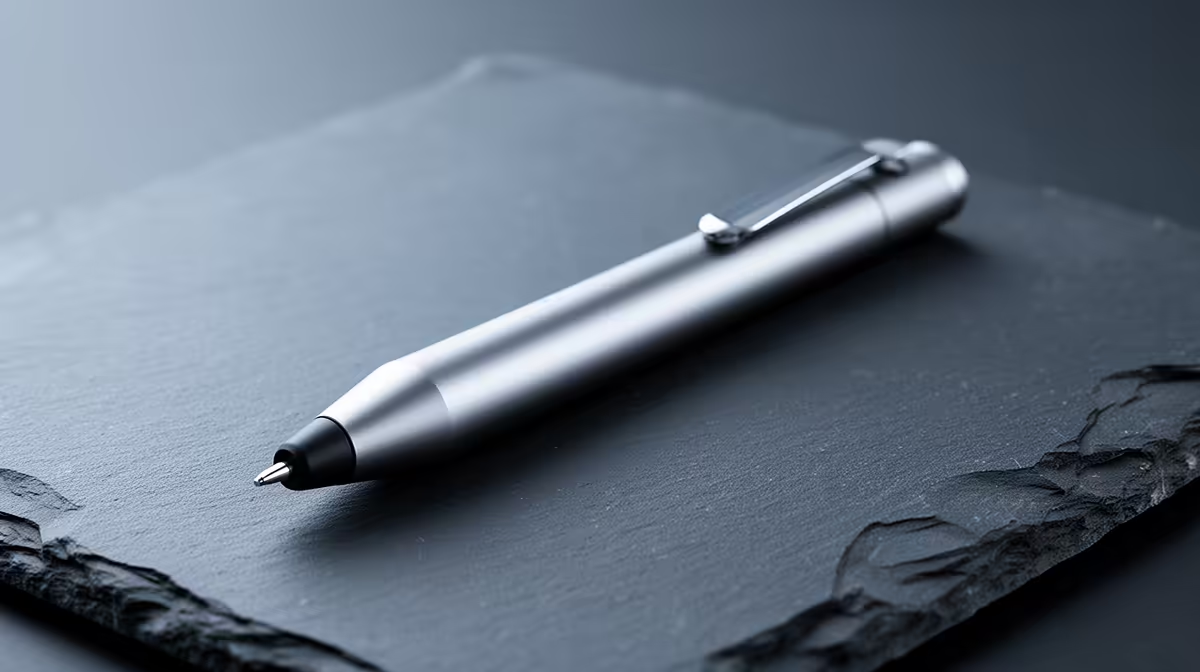
Students who carry their pen in a bag risk tip damage from contact with keys, chargers, and other items. A pen with a hard cap or clip that covers the nib when stored is a worthwhile practical feature. Nib durability matters for heavy daily note-takers: hard POM nibs last twelve to eighteen months; softer paper-feel nibs need replacement every three to six months. For NSFAS-supported students where budget is tight, a hard-nib pen with a lower total cost of ownership makes more sense over a three-year degree than a soft-nib pen requiring frequent replacement packs at R150 to R250 each.
Ask Your University's IT Desk About Compatible Devices ⚡
Many SA universities with digital learning initiatives have a preferred 2-in-1 laptop model that integrates with their LMS and assessment systems. If you are buying a new device for your degree, confirm which pen protocol it uses before purchasing a stylus separately. Some institutions also run discounted device schemes that include compatible pens.
FAQ
Can I use one stylus pen across different devices like my phone, tablet, and laptop?
Active stylus pens are protocol-specific and will only deliver full pressure and tilt functionality on devices that match their protocol. A stylus designed for MPP will not work on an Android tablet that uses USI. If you need cross-device compatibility, check whether your devices share a protocol before purchasing.
Is a stylus more useful than a separate keyboard for student productivity?
They serve different tasks. A stylus excels at annotating, diagramming, and handwritten equations. A keyboard is faster for long-form typed text like essays and reports. The ideal student setup includes both, but if budget forces a choice, a keyboard attachment is usually more broadly useful for academic writing.
How do I store a stylus to prevent it from rolling off desks in lecture theatres?
Look for pens with a flat edge or pocket clip on the barrel. The clip holds the pen to a notebook or bag pocket, and the flat section prevents rolling. A pen loop attached to your laptop sleeve is the most secure solution and costs under R100 at most local stationery and tech retailers.
Choosing a stylus for your studies in South Africa?
Evetech stocks active stylus pens suited to student budgets and compatible with popular 2-in-1 laptops used at SA universities. Browse the range to find the right pen for your device and degree.