Quick Answer
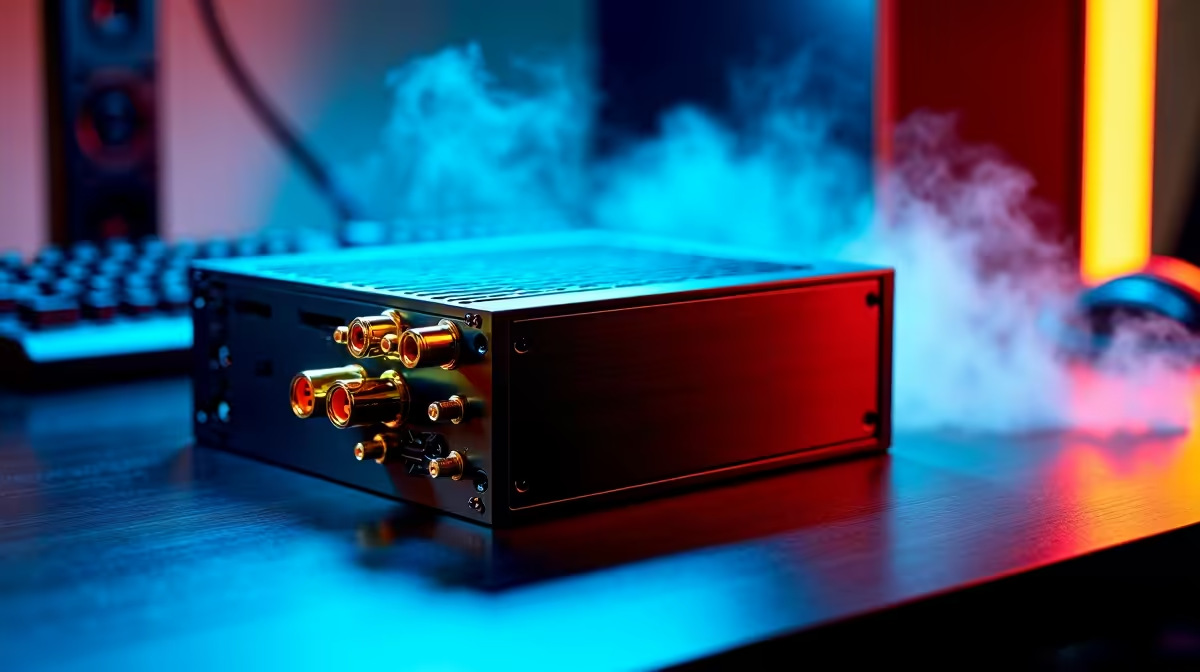
For heavy-duty rendering workstations, prioritise: Platinum or Titanium efficiency for reduced heat on long runs, 1000W to 1200W for sustained GPU-plus-CPU draw, capacitors rated at 105 degrees Celsius minimum, continuous-rated wattage at 40 degrees Celsius ambient, dual EPS CPU connectors if your board uses them, and a 10-year warranty from a brand with local SA support.
Sustained Load vs Peak Load: Why Rendering Is Harder on PSUs 🖥️
Gaming PSUs survive by spending most of their time at idle, with brief bursts at full load. A rendering workstation runs at 70 to 95% PSU load for hours or days continuously. This sustained stress is fundamentally harder on every component: capacitors run hotter for longer and transformer core losses accumulate. A PSU designed around intermittent gaming peaks may deliver reliably over a 20-minute stress test but show voltage creep over a 12-hour overnight render. For rendering workstations, look explicitly for a unit with continuous rated output at 40 degrees Celsius, listed in the full specification sheet rather than the marketing copy.
Wattage and Connector Requirements for GPU Rendering 🔧
For a workstation using a single RTX 5080 at 320W TDP alongside a high-end Ryzen 9 platform at 280W sustained, plus storage, networking, and cooling overhead, total sustained draw reaches 750 to 850W. A 1000W Platinum unit running at 75 to 85% sustained load is the appropriate fit. If the build uses an RTX 5090 at 575W TDP plus a heavy platform, step to 1200W and budget R6,500 to R8,500 in South Africa. Dual EPS CPU connectors are required on AMD TRX50 and Intel Xeon W boards; confirm your PSU includes two 8-pin EPS cables before purchasing.
Reliability Features for 24/7 Operation in SA 🌡️
For a South African rendering studio running overnight jobs, reliability is critical. Look for PSUs with full protection suites including OVP, UVP, OCP, OTP, SCP, and SIP. Semi-fanless operation up to 30 to 40% load is beneficial if the workstation idles between jobs, reducing fan bearing wear in a 24/7 machine. Digital monitoring via USB (available on Corsair HX series and Seasonic Prime units) allows logging PSU rail voltages and temperatures over time, providing early warning of component drift before a failure.
Stress-Test the PSU Before a Long Render ⚡
Before trusting a new PSU for a 48-hour commercial render job, run a combined CPU and GPU stress test for a minimum of four hours and log 12V rail voltage every minute. If the 12V rail drifts more than 0.2V from baseline or if OCP trips at any point, investigate further before committing a critical job.
FAQ
Does a rendering workstation need a UPS in addition to a quality PSU?
Yes, strongly recommended in South Africa. A quality PSU handles internal power regulation but does nothing about mains interruptions. A UPS sized for the workstation's sustained draw (typically 1500VA to 2000VA for a 1000W rendering workstation) provides enough runtime to cleanly save a render checkpoint, preventing hours of lost render time.
Is Titanium efficiency worth the premium for a rendering workstation?
For a workstation running 2000 or more hours annually, yes. At 94% efficiency versus 92% for Platinum, the 2-percentage-point gap on a 900W sustained draw saves roughly 36 kWh per year, or R90 at R2.50 per kWh. The cooler operation and higher-quality components typically justify the cost for professional 24/7 machines.
Can I use a gaming-oriented PSU in a rendering workstation?
A gaming-oriented PSU from a reputable brand will function in a rendering workstation, but confirm the sustained-load temperature rating is 40 degrees Celsius. Workstation-oriented variants from Seasonic Prime, Corsair HX or AX, and be quiet! Dark Power are designed with 24/7 sustained use in mind.
Building a professional rendering workstation in South Africa?
Evetech stocks 1000W and 1200W Platinum and Titanium PSUs suited to sustained workstation loads. Browse the power supply section at Evetech.