Quick Answer
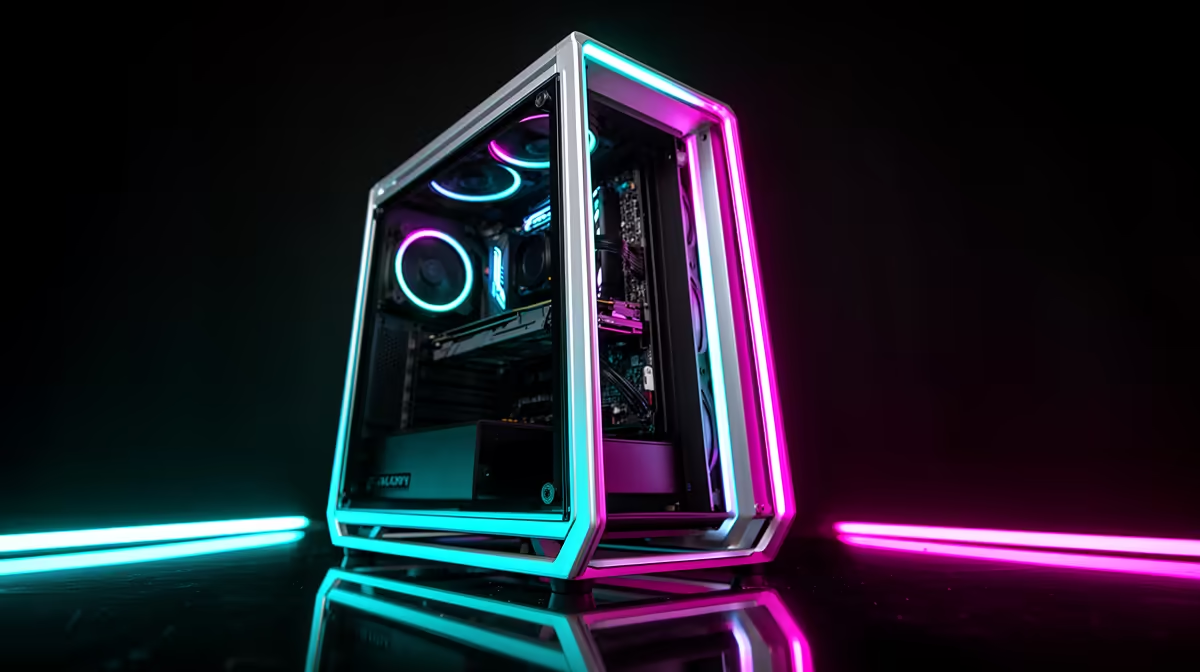
A premium E-ATX gaming case typically represents four to eight percent of a ZAR-denominated PC build budget. On a R40,000 build, that is R1,600 to R3,200; on a R80,000 enthusiast build, it is R3,200 to R6,400. Cases at R5,000 to R8,000 make sense when your components genuinely require E-ATX board support and superior thermal headroom.
Budget Allocation for a ZAR-Based E-ATX Build 💰
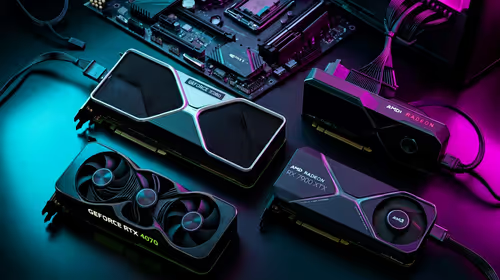
Here is how a R60,000 high-end gaming build typically breaks down when an E-ATX case is included. CPU (Ryzen 9 9950X or Core Ultra 9 285K): R12,000 to R16,000. GPU (RTX 5080 or RTX 5090): R18,000 to R32,000. Motherboard (X870E or Z890 E-ATX): R6,000 to R9,000. RAM 64GB DDR5-6400: R3,500 to R5,000. NVMe SSD 2TB PCIe 5.0: R2,000 to R3,500. AIO cooler 360mm: R2,500 to R4,000. PSU 1000W Gold: R2,500 to R4,000. Case: R4,500 to R7,000. The case is the seventh largest line item but enables the entire build by housing it correctly. Skimping here to add R1,500 to the GPU budget is a false trade-off when the difference between a R3,000 mid-tower and a R6,000 E-ATX full-tower is genuine compatibility and cooling clearance.
When to Spend More vs Spend Less on the Case 🔧
Spend more (R6,000 to R9,000) if your build requires: dual radiator loops (420mm front plus 360mm top), a sliding modular motherboard tray for frequent maintenance, curved or panoramic glass for a desk showcase setup, or a chassis that will outlast three hardware generations. Spend less (R3,500 to R5,000) if your build is primarily functional, sits under a desk, and will not be reconfigured. A R4,000 Fractal Design or Corsair iCUE case is not a budget option; it is a capable, well-engineered chassis at the practical price point for most SA builders.
Resale and Longevity Considerations for SA Buyers 🏆
PC cases have longer useful lifespans than any other component. A premium E-ATX case purchased today should comfortably house components through two or three platform refreshes, from AM5 now to whatever follows in 2028 to 2030. When you amortise the cost across five to eight years of ownership, a R7,000 case works out to R875 to R1,400 per year, making it one of the best value propositions in a build. Cases from established brands also hold reasonable second-hand value on South African classifieds, particularly if the glass panels are undamaged.
Leave Room in Your Budget for Fans ⚡
An E-ATX case with 15 fan slots does not come filled. A quality set of six to eight 140mm PWM fans from brands like Noctua, be quiet!, or Arctic costs R1,200 to R3,000 extra. Include this in your initial budget rather than discovering it after the case arrives.
FAQ
Should the case be the first or last component I buy for an E-ATX build?
Buy the case early once you have confirmed your motherboard's E-ATX dimensions. Many builders wait until last and then discover their chosen case does not support their exact board size. Confirm compatibility before ordering any other components.
Is R4,500 a realistic minimum for a quality E-ATX case in SA?
Yes. Cases below R3,500 that claim E-ATX support often have structural compromises, thin steel, or inadequate cable management space. R4,500 is the practical floor for a case that will serve a serious build.
Can I buy a case on its own and ship it separately from other components?
Yes, cases ship independently. Buying the case first also lets you plan cable routing and fan layout before other components arrive.
Balancing your ZAR build budget?
Evetech stocks E-ATX cases across the R3,500 to R9,000 range, with real stock available for fast delivery or in-store collection.