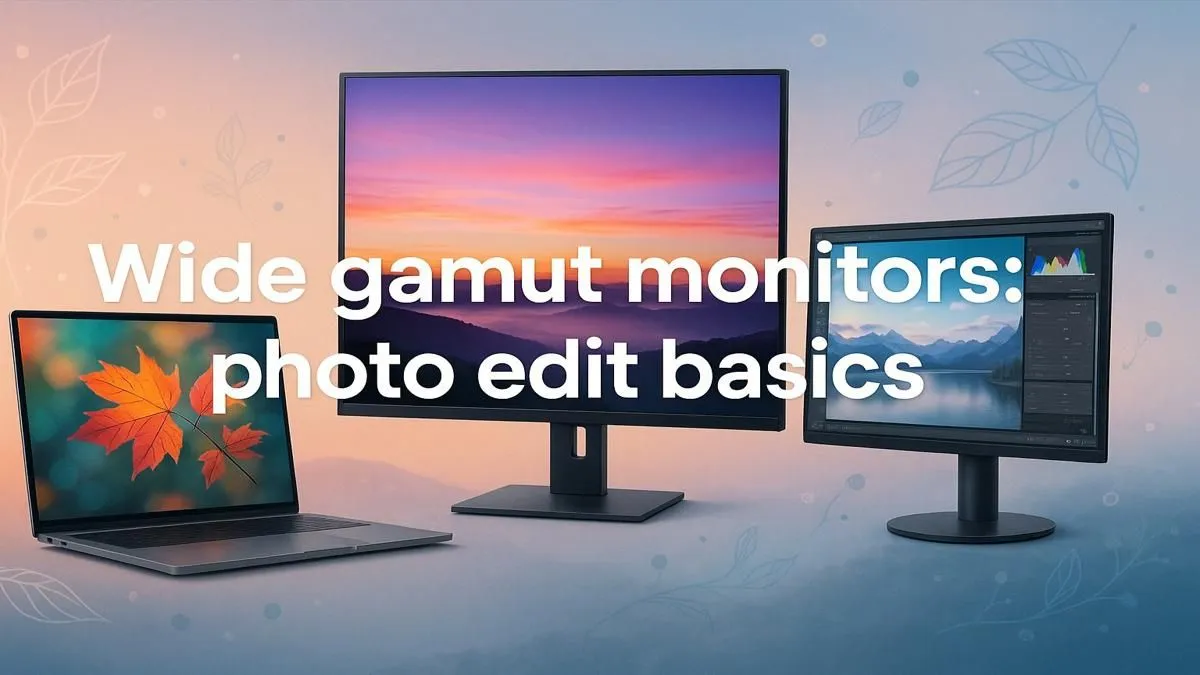
Ever felt that sinking feeling? You nail the perfect shot, the colours look vibrant on your camera's screen, but when you get it onto your PC... it looks flat. Lifeless. Muted. This common frustration for aspiring photographers in South Africa isn't your fault; it's your monitor's. A standard screen can't display all the colours your camera captures. To fix this, you need a wide gamut monitor for photo editing, the true canvas for your digital darkroom.
What Exactly is a 'Wide Gamut' Monitor?
Think of colour on a screen like a box of crayons. Your average monitor has the standard sRGB colour space—it's like a 24-pack of crayons. It has all the basic colours and works fine for browsing the web and office work.
A wide gamut monitor, however, is like the massive 120-crayon artist's set. It covers much larger colour spaces like Adobe RGB or DCI-P3, giving it millions of extra shades of green, cyan, and red that an sRGB screen simply cannot produce. For photographers, this isn't a luxury; it's essential for seeing and editing your work accurately.
Why Your Photos Demand a Wide Gamut Monitor for Editing
Using a standard monitor for editing is like trying to paint a sunset with only primary colours. You'll get close, but you'll miss all the subtle, rich tones that make the image special. A proper monitor for photo editing with a wide colour gamut ensures that what you see is what you get.
- True-to-Life Colour: You can edit with confidence, knowing the deep emerald greens of a forest or the vibrant magenta of a protea are displayed accurately.
- Print-Ready Results: It ensures your printed photos match what you saw on screen, avoiding costly and disappointing reprints.
- Professional Polish: Your work will look consistent and professional across different high-end devices and platforms that support wider colour gamuts.
It’s the bridge between your camera's sensor and your final masterpiece. Ready to see the difference? You can browse Evetech's entire collection of PC monitors to get a feel for the options available.
Check The Specs! 📋
When browsing monitors, look for the colour space coverage percentages. A good monitor for photo editing will proudly advertise specs like "99% Adobe RGB" or "95% DCI-P3". Anything over 90% Adobe RGB is a fantastic starting point for serious photography work. sRGB coverage should ideally be 100% or more.
Key Features in a Photo Editing Monitor
Beyond the gamut, a few other specs are critical for photographers. Getting these right transforms your editing workflow from a chore into a creative joy.
Pixel-Perfect Detail: Resolution Matters
More pixels mean a sharper image, allowing you to see fine details without constantly zooming in and out. For photo editing, a 1440p (QHD) monitor is a great start, but stepping up to a 4K or 5K screen is where the magic really happens. The clarity is astonishing, making tasks like fine-tuning sharpness and spotting imperfections effortless. Explore our range of stunning 4K and 5K monitors to see the detail you've been missing.
Colour & Consistency: Panels and Calibration
For consistent and accurate colour, an IPS (In-Plane Switching) panel is non-negotiable. They offer the best colour reproduction and wide viewing angles, meaning the colours don't shift when you move your head. To maintain that accuracy, professionals use a calibration tool. These hardware devices ensure your monitor's colours stay true over time, and they are just one of many essential monitor accessories that can perfect your setup.
Can You Use a Gaming Monitor for Photo Editing?
This is a common question in Mzansi, where many of us are both gamers and creators. The answer is... it depends. High-end gaming monitors are getting better with colour, but they often prioritise speed (refresh rate and response time) over absolute accuracy.
A dedicated wide gamut monitor for photo editing will almost always have better colour uniformity and coverage. However, if you need a hybrid, look for an IPS gaming monitor with good advertised DCI-P3 or Adobe RGB coverage. You can compare the specs on all our gaming monitors to find a potential all-rounder.
Finding the Right Fit for Your Setup ✨
Your choice also depends on your workspace and workflow. Do you prefer an immersive experience? Many editors find that curved monitors help reduce eye strain during long sessions. Are you a photographer who travels or works on-site? A high-quality portable monitor can be an incredible tool for tethered shooting and editing on the go.
Ultimately, investing in a colour-accurate monitor is one of the best upgrades you can make to your photography toolkit. Keep an eye on the best PC monitor deals to find a screen that respects your budget and your art.
Ready to See Your True Colours?
Stop guessing and start creating with confidence. Choosing the right monitor is the single most important step to achieving professional-looking photos. Explore our huge range of monitors and find the perfect canvas for your vision.