Quick Answer
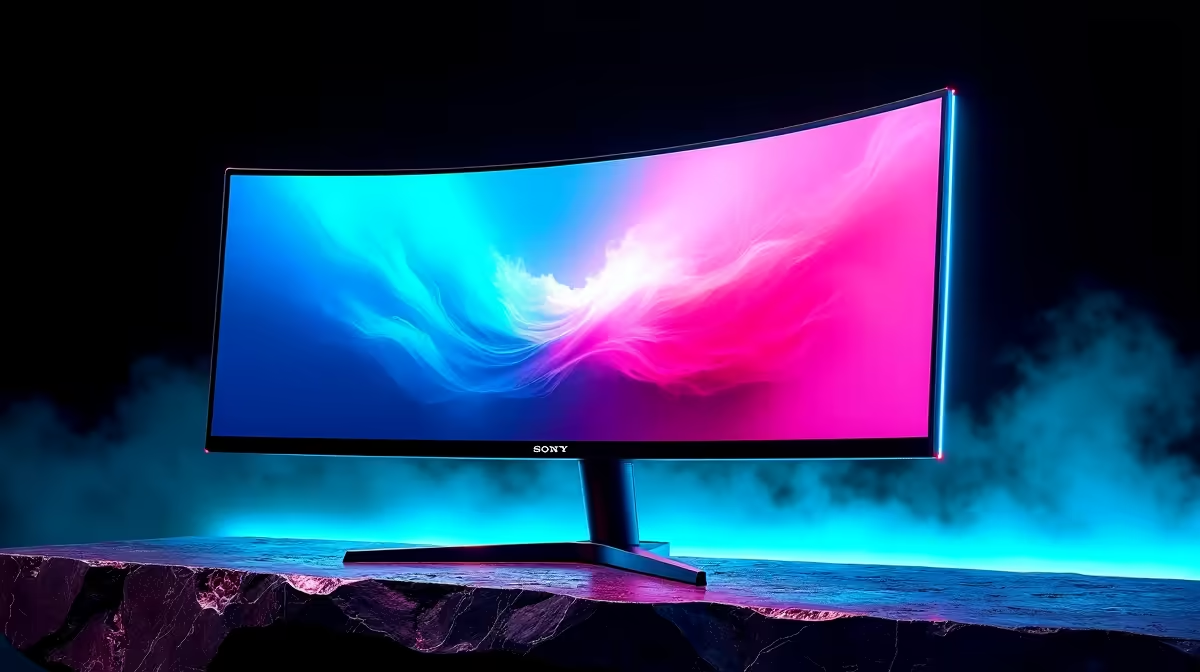
Yes. Modern 49-inch DFHD (3840x1080) ultrawides run at 144Hz and above on current DisplayPort 1.4 and HDMI 2.1 connections. 144Hz at 3840x1080 is well within the bandwidth of both standards. The limiting factor is your GPU's ability to drive 3840x1080 at 144 frames per second in demanding titles, not the monitor's panel capability.
Refresh Rate and Bandwidth at DFHD Resolution 📡
DFHD resolution is 3840x1080, exactly double the horizontal resolution of standard 1080p. At 144Hz, the required display bandwidth is approximately 13.5 Gbps uncompressed, comfortably within DisplayPort 1.4's 32.4 Gbps capacity. HDMI 2.1 handles it without compression too. 165Hz and 240Hz DFHD panels have also shipped from several manufacturers, and these higher refresh rates still fall within DisplayPort 1.4 bandwidth limits. Where you can run into problems is on the GPU side: your graphics card must output 144 frames per second at 3840x1080 to actually use the monitor's 144Hz capability, which is a meaningful rendering demand in GPU-intensive titles.
GPU Requirements for 144fps at 3840x1080 🎮
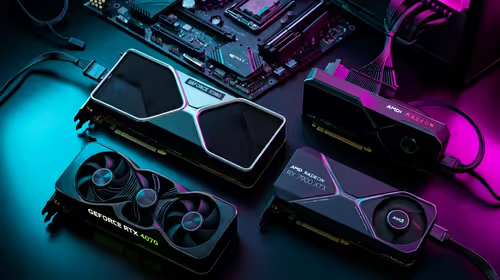
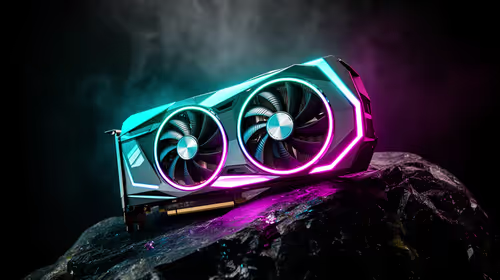
DFHD resolution has roughly 4.1 million pixels compared to 2.1 million at 1080p. That pixel count sits between 1440p (3.7M pixels) and 4K (8.3M pixels) in rendering demand. An RTX 5070 Ti handles 3840x1080 at well above 144fps in most competitive and mid-range graphical titles. Open-world titles at ultra settings are more demanding: the RTX 5070 Ti typically delivers 110 to 160fps in titles like Cyberpunk 2077 at DFHD ultra settings with DLSS 4 frame generation enabled. An RTX 5080 pushes above 140fps more consistently without frame generation. For competitive gaming in lower-fidelity titles at 3840x1080, even a mid-range RTX 5060 Ti sustains 144fps comfortably.
What to Know for the SA Market 🇿🇦
49-inch DFHD monitors are premium peripherals priced from approximately R8,000 to R18,000 in South Africa. At these price points the display represents a significant portion of a full gaming setup budget. Pair a 49-inch 144Hz DFHD display with at least an RTX 5070 Ti to ensure the GPU keeps pace with the refresh rate in most titles without relying exclusively on frame generation. AMD FreeSync Premium Pro and NVIDIA G-Sync Compatible certification on DFHD panels ensures smooth adaptive sync across the full 144Hz range, eliminating visible tearing during scenes where fps drops momentarily below the target.
Use DisplayPort Not HDMI for 144Hz ⚡
Always use the DisplayPort output from your GPU to connect a 49-inch 144Hz DFHD monitor rather than HDMI, unless the monitor specifically lists HDMI 2.1. Many older HDMI 2.0 implementations cap at 120Hz at DFHD resolution or require chroma subsampling that reduces image sharpness. DisplayPort avoids this ambiguity entirely.
FAQ
Can a console connect to a 49-inch DFHD monitor at 144Hz?
Current-generation consoles output via HDMI at up to 4K 120Hz. A 3840x1080 DFHD monitor is not the native resolution target for console output, and consoles cannot display at 3840x1080 natively. The monitor will typically apply scaling, which may not look satisfactory. DFHD ultrawides are primarily a PC gaming peripheral.
Is 3840x1080 sharp enough on a 49-inch screen?
At typical desk distances of 60 to 90cm, 3840x1080 on a 49-inch panel is noticeably less sharp than a 1440p or 4K monitor. Text and fine UI details appear softer. This resolution is optimised for immersive wide field-of-view gaming rather than pixel-dense productivity work.
Does split-screen on a 49-inch DFHD monitor work well as a dual-monitor replacement?
Yes. The 32:9 aspect ratio divides cleanly into two 16:9 1080p virtual screens using Picture-by-Picture mode. Each half delivers a 1920x1080 image, matching a pair of standard 1080p monitors in a single panel with no bezels.
Ready to go ultrawide for your next gaming monitor?
Browse Evetech's 49-inch ultrawide gaming monitor range and find the right DFHD panel for your GPU and setup.