


PCIe 5.0 vs PCIe 4.0 for Video editing in 4k in SA
PCIe 5.0 vs PCIe 4.0 for video editing in 4k is mainly about fit, features, compatibility, cost, and upgrade path, not one automatic winner. SA buyers should match the choice to the setup.
Read moreSSD prices are expected to ease gradually as NAND flash makers expand capacity through 2027 and into 2028, following the same supply pressure that hit RAM.
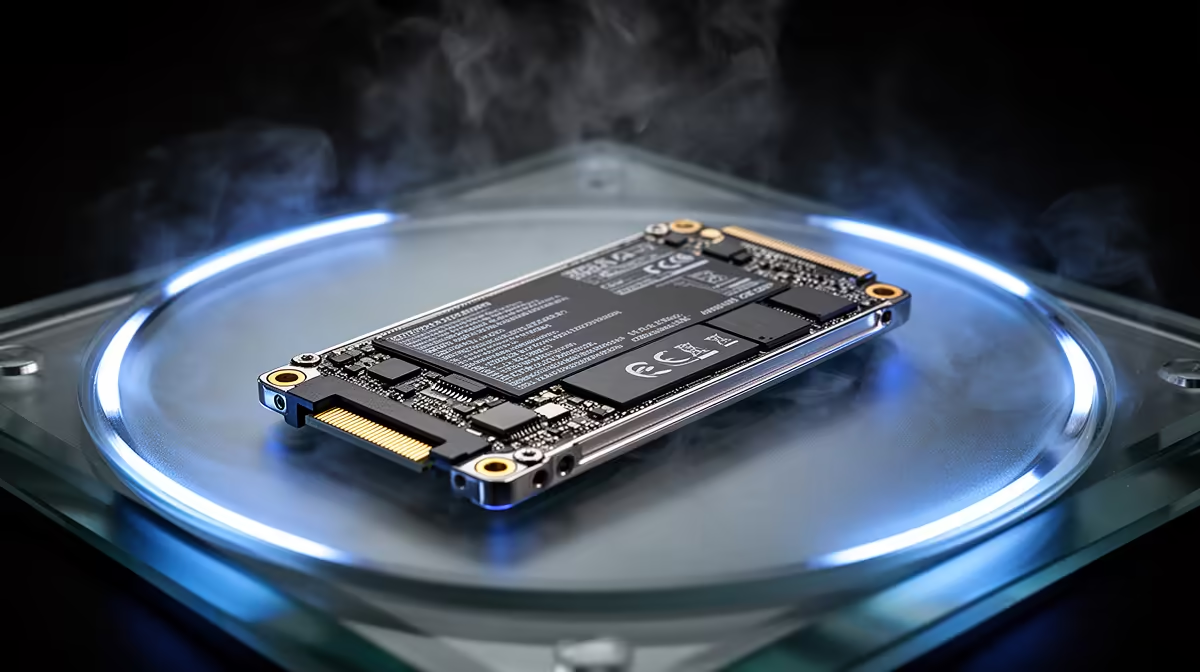
SSD prices can ease only after more NAND supply reaches the products people buy and demand stops absorbing it. Capacity expansion through 2027 and 2028 creates a path towards relief. It does not create a date you can circle for a half-price drive.
Plan for SSD prices to ease in stages through 2027 and into 2028, with no guaranteed size or timing for the drop. Buy now when storage is full, a drive is unhealthy or a new PC needs to be tested. Wait when the upgrade is optional and you can track exact drives against a target price.
NAND flash is the storage medium inside consumer SSDs. Manufacturers can change output, layer designs and product mix, but those decisions pass through controllers, packaging, drive assembly, validation and distribution before a finished model reaches South Africa.
Increasing factory capacity is a long process. Equipment has to be installed, yields improved and products qualified. A 2027 project can influence the market in stages, with fuller effects appearing later.
Demand can consume the new output. Data centres, AI systems, phones and PCs all use flash. A recovery in device sales or a large infrastructure cycle can keep pressure on supply even as production grows.
Compare exact models across the storage drive range and SSDs buyers favour. A small SATA reference for July 2026 is the named Dahua V800 256GB at R1,199. It cannot predict a 1TB Gen4 NVMe price.
SATA, Gen3 NVMe, Gen4 and Gen5 drives do not share one price curve. Controllers, flash grades, cache design and heat management add their own costs. Relief in commodity NAND may reach basic drives before premium models.
Capacity matters too. A 2TB drive may offer better cost per gigabyte in one month, while two discounted 1TB models win in another. Recalculate using comparable performance and warranty.
Old stock can hold an earlier cost. A retailer may have one capacity sourced before a change and another from a new shipment. This can produce strange ratios inside the same product family.
South African currency movement can amplify or weaken global relief. Save current Rand prices rather than applying an international forecast percentage to the local basket.
A drive showing health warnings should be backed up and replaced without waiting for a forecast. Important data deserves a separate backup regardless of drive age. Price movement cannot recover lost files.
A full gaming SSD can justify more capacity when uninstalling and downloading interrupts play. Measure the active library, leave room for updates and decide whether 1TB or 2TB solves the next few years.
New builders need storage to install Windows and test the machine. Buying CPU, GPU and motherboard now while delaying the SSD leaves the system incomplete. Choose a balanced drive and gain the use.
Creation workloads can earn a faster or larger drive through time saved on transfers, caches and source media. Check sustained performance because short benchmark bursts may hide slow behaviour after cache fills.
An optional secondary drive can wait. Save two or three compatible models, their capacities, interfaces and July prices. Set a target cost per gigabyte and a final purchase date.
Check motherboard slots before planning a future NVMe addition. Some slots share bandwidth or support a slower generation. If the last useful M.2 slot is free today, one larger drive may protect it better than a small bargain.
Keep specifications fixed during comparisons. A portable SSD, SATA drive and Gen4 NVMe product serve different roles. A lower future price on a different interface does not prove that the drive you wanted became cheaper.
Promotions can reach the target before the broad market eases. Buy when the exact completed value works. Waiting for the lowest point is impossible because the bottom becomes clear only after prices rise.
Capacity gives the most dependable long-term benefit. A drive large enough for the library remains useful even if a faster interface appears. Peak speed can matter for work, while gaming load differences between good NVMe generations can be small.
Choose a reputable exact model with a clear warranty and suitable endurance. Use a heatsink when the drive and workload require it. Keep firmware and backups current.
When prices fall, older drives do not become slower. A July purchase can remain good value through the work and games it supports before 2028. Calculate that use beside any possible future saving.
A cheaper future SSD may use a different controller or flash design from the model you saved. Check sustained performance, endurance and warranty again. Product families can change internally while the retail name looks familiar.
Portable, SATA and NVMe drives also serve different jobs. A discounted external SSD is useful for moving files, while an internal NVMe model is the cleaner game and boot drive. Keep the interface fixed in the forecast comparison.
When the target arrives, buy enough capacity for a reasonable keep-cycle. Repeating the purchase a year later because the small drive filled can erase the saving you waited to capture.
Check the old drive's health before assigning it a second role. A worn boot SSD should not become the only home for family photos or project archives. Use it for replaceable data and keep important files on a separate backup.
If a future drive is bought for a laptop, measure physical size and heatsink clearance. Desktop cooling advice does not transfer to every notebook slot.
Supply expansion may support gradual easing through 2027 and 2028, but no exact retail date is guaranteed.
No. Interface, capacity, controller, stock age and product tier can create different price paths.
Wait when current storage is comfortable and you have a target. Buy when library management or work needs the space now.
No. Currency, distribution and replacement-stock timing can change the local result.
No. The drive delivers months of use, and a suitable model remains useful after market prices change.
Track exact SSD models and capacities, then buy when storage need and current cost beat the uncertainty of the 2027 to 2028 outlook.
Supply expansion may support gradual easing through 2027 and 2028, but no exact retail date is guaranteed.
No. Interface, capacity, controller, stock age and product tier can create different price paths.
Wait when current storage is comfortable and you have a target. Buy when library management or work needs the space now.
No. Currency, distribution and replacement-stock timing can change the local result.
No. The drive delivers months of use, and a suitable model remains useful after market prices change.
PCIe 5.0 vs PCIe 4.0 for video editing in 4k is mainly about fit, features, compatibility, cost, and upgrade path, not one automatic winner. SA buyers should match the choice to the setup.
Read more
Wi-Fi 7 vs Wi-Fi 6e for competitive esports comes down to router support, latency goals, device compatibility, and coverage. SA buyers should match the choice to the real network setup.
Read more
ATX 3.1 vs ATX 3.0 for mMO and live-service games buyers - what changes is mostly about compatibility, budget, upgrade path, and setup fit. SA buyers should check device support and real needs before expecting a clear win from either option.
Read more
LGA 1851 vs LGA 1700 can affect Twitch and YouTube streaming when gaming and encoding share CPU resources. For SA creators, the real-world difference depends on encoder choice, memory support, motherboard cost, thermals, and upgrade plans.
Read more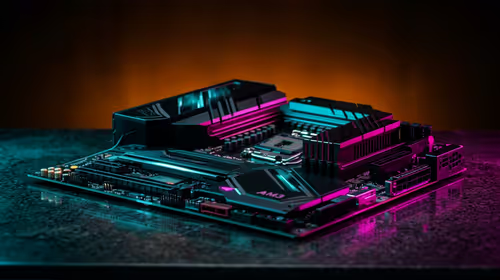
X870E vs X670E for aaa single-player gaming is mainly about fit, features, compatibility, cost, and upgrade path, not one automatic winner. SA buyers should match the choice to the setup.
Read more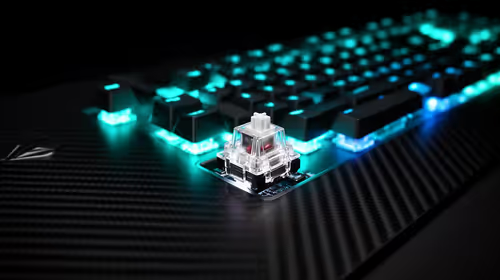
Hall Effect switches vs Mechanical switches for mMO and live-service games is mostly about compatibility, budget, upgrade path, and setup fit. SA buyers should check device support and real needs before expecting a clear win from either option.
Read more
A fake 113GB GTA VI ISO reportedly used empty padding around a small malware payload. SA gamers should delete unofficial builds, keep Windows security active and wait for official channels.

Wi-Fi 6E vs Wi-Fi 6 matters for 4K video editing when files move across a network. The real-world difference between Wi-Fi 6E and Wi-Fi 6 for video editing in 4K depends on NAS access, cloud uploads, router range, and SA creator workflows.

The difference between PCIe 5.0 and PCIe 4.0 for SA gamers is mostly bandwidth headroom. Compare GPU slot needs, NVMe speed, motherboard support, and upgrade timing before paying extra for a newer platform.

Gaming PC stuck pixel checks in South Africa should confirm the monitor fault first. Use colour tests, screenshot comparison, cable swaps, display menu checks, and clear photos before deciding on support.

Shokz OpenFit Air 2 earbuds weigh 7.2g each and use a redesigned dual-driver open-ear layout. SA buyers should choose them for comfort and awareness, not maximum isolation.

AMD's current driver now lists a Radeon RX 9050 4GB, while product coverage details a narrowed memory system. SA buyers should weigh the low VRAM ceiling against current local Radeon options.

Samsung Display has demonstrated a 16-inch 2.5K OLED laptop panel running at 300Hz. SA buyers should wait for a named notebook, full panel specifications and a local price before planning an upgrade.

Microsoft says some Windows 11 game crashes after recent updates are linked to RGB-related drivers. Affected SA gamers should confirm the update and driver before using the published registry workaround.

Minisforum's M2 Pro pairs Core Ultra X7, Arc B390 graphics and 32GB onboard memory in 1.8 litres. SA buyers should weigh its fixed memory and $1,439 launch offer against local mini PCs.

Smart monitors can add apps and convenience, but they also add privacy settings and unwanted-software risk. SA buyers should audit the operating system before paying for extras.

Lenovo says Legion Go failures linked to BIOS N3CN42WW are not user error. Affected SA owners should stop retrying the update, preserve proof and open a support case.
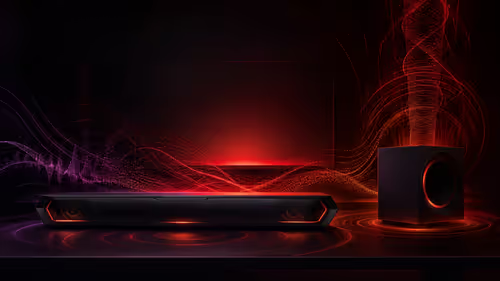
The ROG Gjallar gaming soundbar is now listed in the US at $599.99. SA buyers should compare its 2.1.2 audio, wireless bass and built-in chat controls with simpler local options.