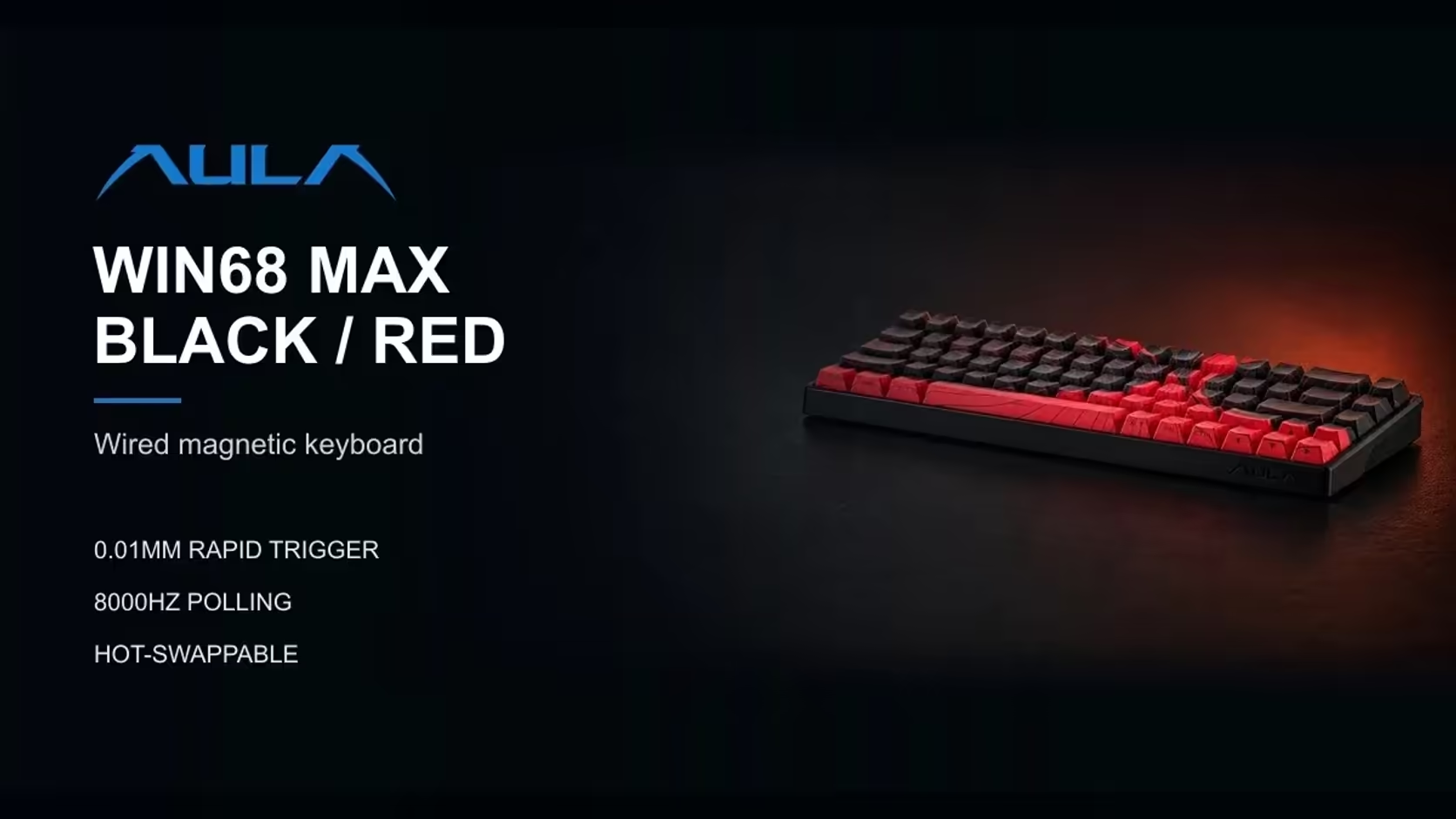
Two of AULA's wired magnetic keyboards chase the same player: someone who wants every input to land exactly when intended. The WIN68 MAX does it in a small plastic 65% shell with a long list of key modes. The AG75 does it in a heavy CNC-machined aluminium body with an even finer Rapid Trigger rating. Choosing between the WIN68 MAX or AG75 comes down to size, weight, build and how far you want to take tuning.
Quick Answer
Pick the AULA WIN68 MAX if you want a compact 65% board with 68 keys, Wing Chun switches and 0.01mm Rapid Trigger precision. Pick the AULA AG75 if you want a 75% layout with 81 keys in a full CNC aluminium case, a carbon fibre plate and Rapid Trigger rated at 0.001mm. Both are wired, both poll at 8000Hz and both carry SOCD and DKS. Evetech sells the WIN68 MAX for R699, while the AG75 runs from R2,399 to R2,799 depending on edition and colour.
📐 Size and key count: 68 against 81
The most visible difference is the layout. The WIN68 MAX is a 65% board. It keeps letters, the number row and arrow keys, while F1 to F12 live behind Fn. The AG75 is a 75% board with 81 keys, which brings a dedicated function row back while staying far narrower than a full-size keyboard.
AULA quotes the AG75 at 319.8 x 143.8 x 42.1mm. It does not publish measurements for the WIN68 MAX, so a millimetre comparison is not possible, but a 65% layout is by definition the smaller footprint because it leaves out that top row.
Who benefits from which:
- Low-sensitivity shooter players who need maximum mouse room lean towards the MAX.
- Anyone who uses F-keys for work shortcuts, game menus or quick saves will appreciate the AG75's extra row.
- If your desk is shallow as well as narrow, the missing function row on the MAX saves depth too.
🏗️ Plastic compact against machined aluminium
Here the two boards feel like different classes of product.
The AG75 build
AULA describes a full CNC-machined aluminium case, sandblasted at 220 grit and anodised. Under the keys sits a carbon fibre plate over six dampening layers, including a Poron switch pad, PE foam, PET and PO base foam. A switchable spring shock-absorbing structure sits in the base, so you can change how the board feels under heavy typing. The case opens without tools through a ball-catch quick-release design. The finished board weighs about 1532g without the cable.
That weight matters on the desk. A board of roughly one and a half kilograms stays planted during frantic movement, with little chance of creeping across the mat.
The WIN68 MAX build
AULA's page for the MAX focuses on switches and modes rather than the shell. It lists hot-swappable keycaps and magnetic switches, per-key south-facing RGB and a WIN68 ribbon on the side, but it does not describe the case material, plate or foam, and it does not give a weight or explain how to open the case. If build detail is your deciding factor, the AG75 is the one with the documented specification.
⚡ Rapid Trigger, switches and modes
Both boards use Hall Effect magnetic switches, so actuation can be tuned and Rapid Trigger can reset a key the instant you start lifting.
Switches
The WIN68 MAX runs Wing Chun switches: 36gf to register, 49gf at the bottom and 3.4mm of travel, with actuation adjustable from 0.1mm to 3.4mm. The AG75 splits by edition. The Pro, in Shadow Grey or Armor Silver, uses LEOBOG Frostcore switches. The Ultra, in Battle Shine Orange, uses LEOBOG Eight Treasures switches and ships with PBT dye-sub and transparent keycaps. AULA does not publish force figures for the LEOBOG switches on these pages.
Precision
The rated Rapid Trigger precision is 0.01mm for the MAX against 0.001mm for the AG75, and each lets you strip the dead zone out entirely. Is the tenfold figure a real edge? For most players, the honest answer is that 0.01mm is already far finer than a finger can control deliberately. The finer rating matters more as a sign of how precisely the AG75's sensing and processing are engineered than as something you will feel on every press.
Key modes
The mode lists overlap heavily. Beyond Rapid Trigger, the MAX brings Rapid Switch, Toggle, Mod-Tap, DKS and SOCD. The AG75 matches every one of those and adds Multi-Point Trigger and END, plus macros. Both are set in AULA's browser-based tools: the web driver on the MAX and the web HUB on the AG75.
Polling and scanning
Both poll at 8000Hz over a USB-C cable. The MAX adds seven selectable polling levels and quotes a scan rate of 4kHz across the full board, up to 32kHz on one key. The AG75 quotes a 256kHz full-key scan rate and a triple-MCU design that AULA says cuts processing delay.
💡 Lighting, tinkering and ownership
Lighting differs in approach. The MAX lights each key from below, with south-facing LEDs covering some 16.8 million shades. The AG75 uses what AULA calls twin-star lighting, with both north and south-facing RGB and 170 LEDs in total, ten of them under the space bar.
For tinkerers, the AG75 is the easier board to open thanks to its tool-free quick-release case. Both are hot-swappable for magnetic switches, so browsing the keyboard switches range is relevant either way. Stay with magnetic switches in both, since the sockets sense a magnet rather than a metal contact.
Ownership is level. The WIN68 MAX and all three AG75 editions come with a 2 Years Local Warranty through Evetech. Pricing for each is shown on its product page at Evetech, and the full line-up sits in the gaming keyboards category.
A simple way to decide: if you value a small footprint and plan to use Mod-Tap to stretch a compact layout, the MAX makes sense. If you want a function row, a heavy desk-planted chassis and a case built to be opened and modified, the AG75 is the better match.
Frequently Asked Questions
Do both boards resolve opposite key presses?
Yes. SOCD is listed for both the WIN68 MAX and the AG75, along with DKS, Mod-Tap and Toggle.
How many more keys does the AG75 have?
Thirteen. The AG75 has 81 keys in a 75% layout, while the MAX has 68 in a 65% layout without a dedicated function row.
Which one stays put better during play?
The AG75. At about 1532g in a solid aluminium case, it is far less likely to shift than a lighter compact board.
Will I feel 0.001mm against 0.01mm?
Unlikely in normal play. Both are finer than a finger controls on purpose; the AG75 figure reflects its engineering more than a felt difference.
Which case is simpler to open?
The AG75, which uses a tool-free ball-catch quick release. AULA does not describe opening the MAX's case.
What are the AG75's dimensions?
AULA lists it at 319.8 x 143.8 x 42.1mm, with a weight of roughly 1532g excluding the cable.
Deciding between compact and aluminium?
See both AULA boards alongside other magnetic keyboards in Evetech's gaming keyboard range and match the build to your desk and your game.