Quick Answer
Before ordering any Xigmatek PSU, confirm three numbers: total connector count your build needs, the 80 PLUS rating you are paying for, and physical depth in mm against your case spec. A 650W unit covers most single-GPU SA builds; jump to 750W only if a 200W-plus graphics card is on the cards.
What to check before the order goes in
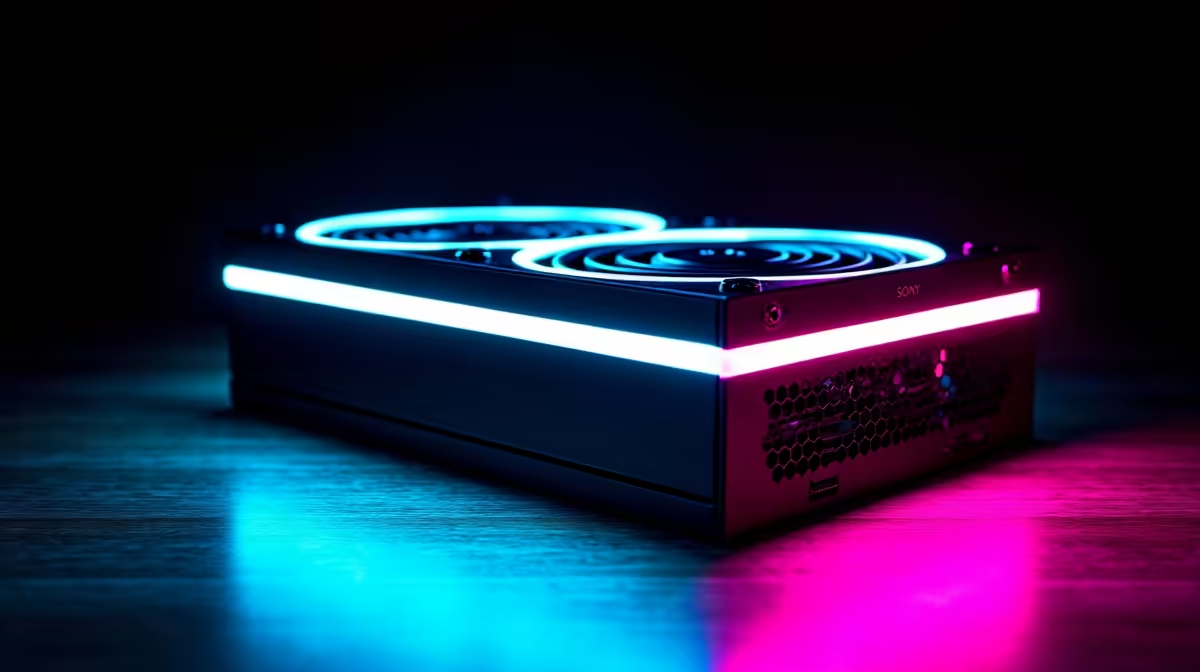
Match the PSU form factor to your chassis first. Most Xigmatek units ship as standard ATX, but compact and mini-ITX cases need SFX or a depth under 140mm to clear the front fans. Count your connectors next: one 24-pin, the right number of 8-pin EPS for the CPU, and enough PCIe 6+2 leads for your card. A modern GPU often wants two PCIe cables, so a unit with a single split lead will leave you short.
Wattage headroom without overspending
Add your CPU and GPU rated draw, then add roughly 150W for drives, fans and overhead. For a Ryzen 5 plus mid-range GPU that lands near 450W of real load, so a quality 650W Xigmatek gives clean headroom and quiet fan behaviour. Paying for 850W on that build wastes money you could put toward storage.
FAQ
Does a Xigmatek PSU work with an AMD and Intel board the same way?
Yes. The 24-pin and EPS connectors are standard across both platforms, so connector compatibility is identical. Only the count of EPS plugs your motherboard wants differs, so check whether your board has one or two 8-pin CPU sockets.
How do I know if my case fits the unit?
Compare the PSU depth in mm to your case manufacturer's listed maximum. Standard ATX cases usually take up to 160mm; small cases may cap at 140mm or require an SFX bracket.
Is modular worth paying extra for here?
For tidy cable runs and better airflow, semi-modular is the sweet spot under R2,000. Fully modular helps most in glass-panel builds where every unused cable shows.
Pro Tip
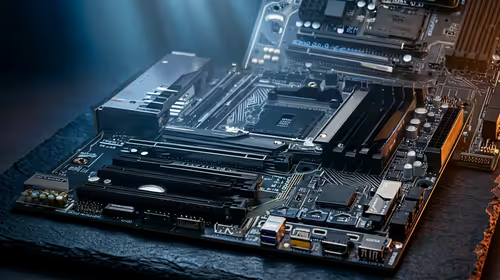
Photograph your motherboard's CPU power sockets and your GPU's power inputs before you buy. Matching those exact connector counts to the PSU spec sheet prevents the most common return.