Quick Answer
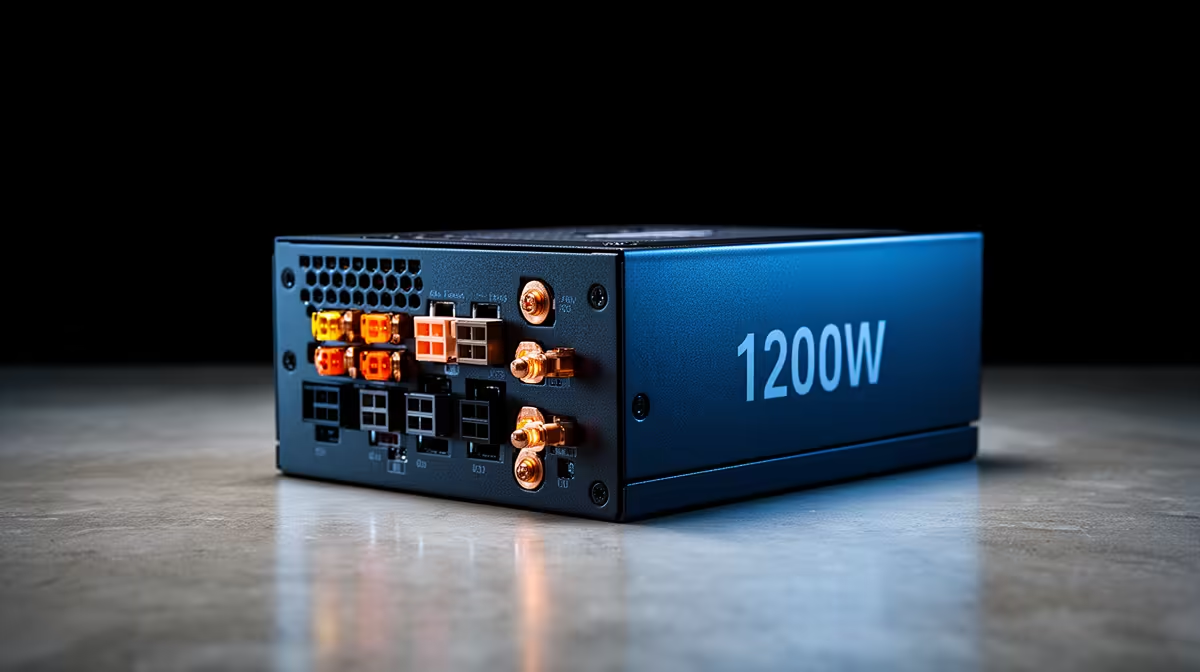
A premium 1200W PSU (R4,500 to R5,500) makes sense for a creator workstation when you are running an RTX 5090 or dual-GPU compute setup alongside a high-TDP CPU like the Ryzen 9 9950X or Core Ultra 9 285K, where combined sustained loads exceed 750W. For builds centred on a single RTX 5080 and a mid-range CPU, a quality 1000W Platinum unit at R3,200 to R4,200 is the more economical choice.
Defining a Creator Workstation Power Profile 🖥️
Video editors, 3D artists, and AI practitioners use hardware differently from gamers. A gaming session runs the GPU at high but variable loads with frequent dips to near-idle. A Blender render or DaVinci Resolve export saturates the GPU at 90 to 100 percent of its TDP for minutes or hours at a stretch. The RTX 5090 at 575W sustained, combined with a Ryzen 9 9950X at 170W all-core and NVMe drives at 10W each, can push a workstation above 800W under peak render load. A 1000W PSU handles that at 80 percent capacity, which is within spec, but a 1200W unit drops that to 67 percent, the cooler-running efficiency sweet spot for most 80 Plus Platinum designs.
Breaking Down the R4,500 to R5,500 Premium 💰
At this price tier in South Africa, a 1200W Platinum PSU typically includes full modularity, a native 12V-2x6 cable, a ten-year warranty, 105-degree-rated Japanese capacitors, and zero-RPM mode below 20 to 30 percent load. The ten-year warranty is particularly valuable for a workstation that runs extended hours: it covers the device for nearly the entire useful lifespan of a high-end GPU. Compared to a budget 1200W Bronze unit at R2,200 to R2,800, the premium tier unit runs 8 to 10 percent cooler and typically includes better overvoltage and short-circuit protection circuits that matter in a machine running R50,000 to R80,000 worth of components.
When to Stick With a 1000W Unit Instead 🔧
If your workstation uses a single RTX 5080 (360W) with a Ryzen 7 9700X (65W), total sustained workstation load sits around 550 to 600W. A 1000W Platinum unit handles that at 55 to 60 percent capacity, well inside the efficiency sweet spot. Spending an extra R1,000 to R1,500 for 1200W buys you headroom you will never use in practice. The exception is if you plan to add a capture card, multiple NVMe drives in a RAID array, or anticipate a GPU upgrade to RTX 5090 tier within the PSU's warranty period.
Calculate Before You Buy: Workstation Load vs PSU Capacity ⚡
Add GPU TDP plus CPU TDP plus 50W for drives and peripherals to get your peak wattage, then aim for a PSU rated at 1.35 times that figure. For an RTX 5090 and Ryzen 9 9950X workstation, that formula outputs around 1,020W, confirming 1200W as the right tier rather than overkill.
FAQ
Is an 80 Plus Titanium PSU worth the premium for a creator workstation in SA?
For a workstation running 10 or more hours per day, the two to three percent efficiency improvement over Platinum can save R150 to R300 annually in electricity. Over a ten-year PSU lifespan, Titanium certification eventually pays back its R800 to R1,500 premium, but the break-even point is only reached with heavy daily use.
Do 1200W PSUs run louder than 1000W units?
Not inherently. Premium 1200W units with zero-RPM mode are silent below 30 to 40 percent load. At 800W draw, both a well-built 1000W and a well-built 1200W unit will spin fans at moderate RPM. The 1200W unit often runs quieter at that load because it is at 67 percent capacity versus the 1000W unit at 80 percent.
Can a 1200W PSU power a dual-GPU workstation in South Africa?
Depends on the GPU combination. Two RTX 5080 cards at 360W each plus a high-TDP CPU can approach 900W to 950W under peak load. A 1200W Platinum unit handles that comfortably. Dual RTX 5090 setups would require a 1600W unit or dual PSU configuration, which is niche territory outside mainstream creator builds.
Building a creator workstation that runs all day?
Evetech stocks premium 1000W and 1200W Platinum PSUs backed by local warranty, sized for South Africa's most demanding creative builds.