A 3000W workstation power supply is not a bigger version of a normal gaming PSU. It is specialist infrastructure for unusually dense systems with several power-hungry accelerators. New 3000W and 3200W designs show where AI and rendering workstations are heading, but the wall circuit and build plan matter before the headline wattage.
Quick Answer
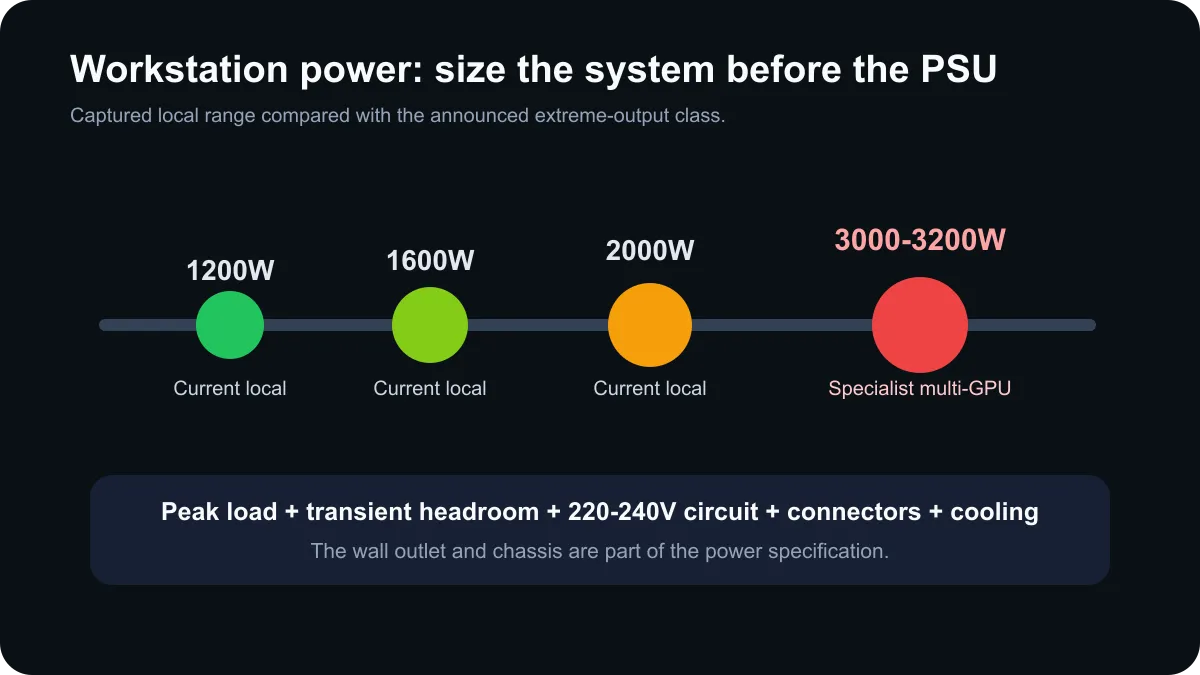
The new extreme-wattage class includes 3000W and 3200W models with four native 12V-2x6 graphics connectors. These units target multi-GPU compute rather than ordinary gaming PCs, and their high-voltage input requirements must be checked before installation. A captured South African catalogue read found live 1200W to 2000W options from R4,599 to R13,199. Most buyers should calculate measured peak load and sensible headroom before moving beyond that range.
⚡ Why four GPU connectors change the build
Four native 12V-2x6 cables allow a power supply to feed several current high-power graphics cards without building an untidy chain of adapters. That matters in AI, simulation, 3D rendering and other workloads where more than one accelerator may run at sustained load. It does not mean every system should install four cards. Motherboard lanes, chassis spacing, cooling and software support often become the real limits first.
A workstation power budget must include the processors, memory, drives, fans, pumps and USB devices as well as graphics cards. Short transient spikes also need headroom. Add the component limits, compare them with measured reviews for similar hardware, and leave a margin that does not force the PSU to live at its ceiling.
The current power supplies above 700W show how broad the normal market already is. A single-GPU system can often be served well below 3000W, with less cost, easier installation and a wider choice of cases.
🔌 The wall socket is part of the specification
Extreme-output models do not necessarily deliver their full rating from every outlet. The announced designs specify high-voltage input ranges, and a comparable 3000W workstation unit is designed around 220V to 240V operation. South Africa's nominal supply may appear suitable, but the actual circuit, breaker, outlet, plug and cable still need professional confirmation.
Do not use travel adapters, improvised extensions or a shared office strip to solve this. A qualified electrician should confirm continuous current, breaker protection, earthing and whether other equipment shares the circuit. The workstation can draw less than its maximum most of the time, but the installation must tolerate the designed worst case.
Efficiency also matters. An 80 Plus rating describes conversion efficiency at defined loads, not total electricity use. The computer still draws what the workload requires, plus conversion losses. A larger unit does not force a PC to consume 3000W, but extreme oversizing can be expensive and may place ordinary workloads outside the most efficient operating range.
🇿🇦 Compare against current local options
The captured live list included a 2000W unit at R4,599, 1300W at R6,999, several 1200W choices from R8,199 to R8,599, and a 1600W premium model at R13,199. All were marked in stock when queried. Those prices show why capacity alone is a poor value measure. Efficiency, electrical protections, connector layout, acoustic performance and warranty can move the price in either direction.
Browse current Corsair power supplies and Cooler Master power supplies to compare realistic local alternatives. Check the physical PSU length, cable bend clearance and case intake before ordering. Four thick GPU cables need routing space and should not be sharply bent at the connector.
For a professional build, write down the intended cards, their sustained and transient power, CPU limit, remaining system load and planned growth. Then have the workstation integrator and electrician approve the full design. A 3000W rating is useful only when the computer, room cooling and electrical supply are engineered as one system.
Frequently Asked Questions
Who needs a 3000W workstation power supply?
It targets unusually dense systems with several high-power accelerators. A normal single-GPU gaming PC rarely needs this class.
Can a 3000W PSU run from a normal wall socket?
The announced units require high-voltage input ranges. A qualified electrician should confirm the circuit, outlet and plug before installation.
Why are there four 12V-2x6 connectors?
They support several modern high-power graphics cards with native cables rather than a chain of adapter connections.
Does a larger PSU always use more electricity?
No. Components draw what the workload demands, though conversion efficiency and oversizing still affect cost and practicality.
What did high-wattage local units cost?
The captured live range ran from R4,599 for 2000W to R13,199 for a premium 1600W model, with several 1200W and 1300W choices between them.
What should be checked before buying?
Confirm peak load, transient headroom, voltage, circuit capacity, connectors, dimensions, airflow, warranty and local support.
Size the whole workstation before choosing the PSU. Compare current high-wattage options, document every component load, and have the electrical circuit checked before installing extreme multi-GPU hardware.