Quick Answer
Joburg needs stricter cooling because highveld heat, altitude, and dust leave less thermal margin than many coastal rooms. In buyer terms, spend on a mesh front, a clean fan path, and a cooler matched to the CPU before paying extra for lighting. Joburg rooms can sit around 28-32 C in summer, and highveld dust can add 3-6 C when filters are ignored, so the practical win is lower noise and steadier boost clocks, not a prettier screenshot.
What the SA room does to cooling
A gaming PC does not cool itself against a lab temperature; it cools against the room it sits in. Joburg and Cape Town can give builders hot afternoons, dusty floors, and desks pushed close to walls, which all reduce the air a case can actually move. A front panel with real intake area and washable filters is more useful than a sealed glass face with extra LEDs.
Use the build target as the check. A Ryzen 7 7800X3D or Core i7 with an RTX 4070 Super, RTX 4080 Super, or bigger GPU can dump enough heat to make weak airflow obvious. If the machine drops clocks, the result can be sudden fan noise, temperature spikes, and a Ryzen 7 or Core i7 gaming build should keep sustained CPU loads below the high-80s C and avoid noisy 100% fan curves.
Parts that deserve the budget
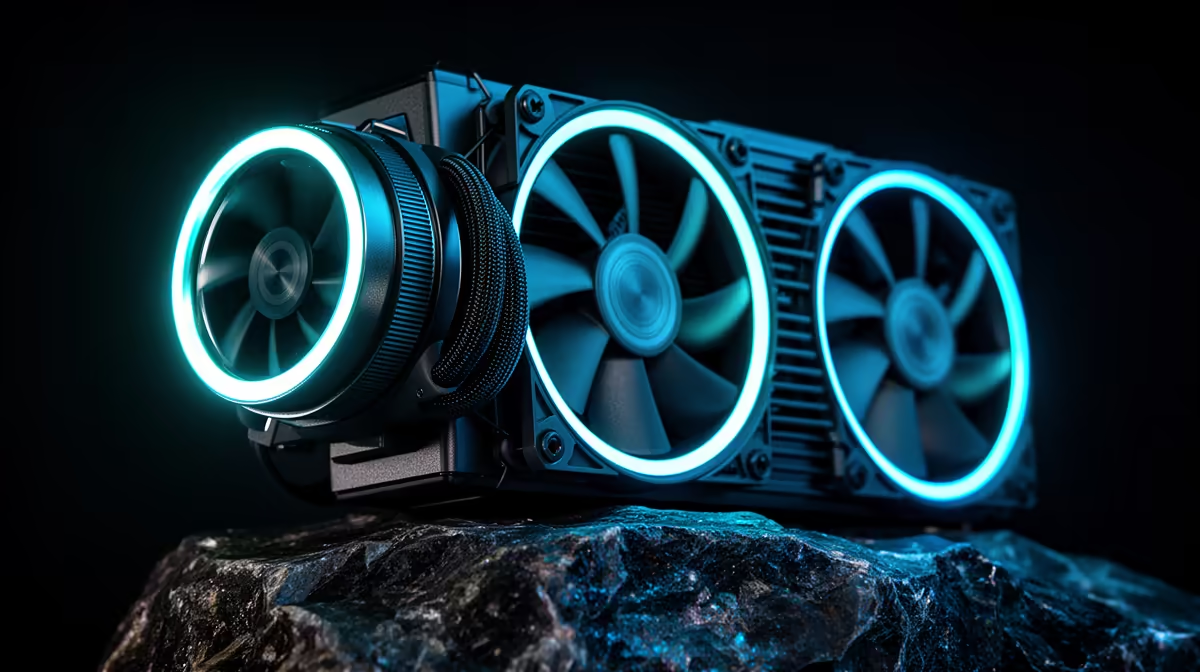
Start with known airflow cases such as DeepCool AK400, Cooler Master Hyper 212, DeepCool AK620, and 240 mm AIO coolers. For many SA buyers, the sensible range is R500-R1,400 for air coolers and R1,500-R3,500 for 240 mm liquid coolers; spending above that should buy better build quality, clearance, filters, or quieter fans, not only more LEDs. Check GPU length, CPU cooler height, and whether the case ships with at least two front intakes.
For Joburg-style cooling, pair the case with a practical tower cooler or 240 mm AIO before chasing cosmetic upgrades. For coastal or humid rooms, dust access and corrosion-aware cable management matter because cleaning is part of keeping temperatures stable.
When RGB still makes sense
RGB is fine when the cooling basics are already covered. It becomes a poor priority when it replaces airflow, forces a closed front panel, or leaves the GPU recycling warm air. A neat ARGB case with mesh and fan control can be a good choice; a sealed case with bright lighting is the risky one.
FAQ
Should SA gamers choose airflow or RGB first?
Choose airflow first if the PC has a mid-range or high-end GPU. RGB can be added later, but poor intake can raise temperatures by 5-10 C and make a quiet build run loud.
Is a cheaper mesh case enough for a gaming PC?
Yes, if it has a clear front intake, dust filters, and enough clearance for the GPU and cooler. Many R900-R3,000 cases are sensible if the fan layout is not blocked.
How many fans should a South African gaming case have?
Three to four case fans is the clean target: two front intakes, one rear exhaust, and optionally one top exhaust. More fans help less than correct direction and open intake.
Check the airflow path
Before choosing the case, confirm front intake area, GPU clearance, CPU cooler height, and filter access. If those four checks pass, lighting can be a style choice instead of a performance risk.