


Gigabyte FO32U24G OLED: The SA Buyer Check
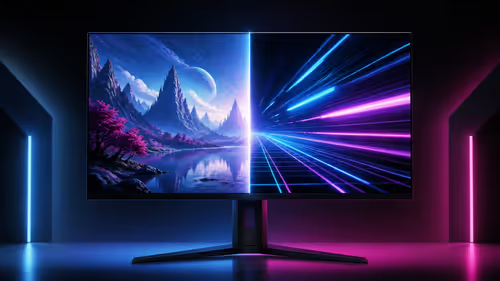
Gigabyte's FO32U24G pairs 4K 240Hz and FHD 480Hz modes on a 32-inch Tandem WOLED panel. SA buyers should compare the two use cases and wait for confirmed local pricing.
Read moreAULA's F87S combines 8kHz wired and 2.4GHz polling with hot-swap switches and tri-mode connectivity. SA buyers should wait for a confirmed local listing before judging its value.
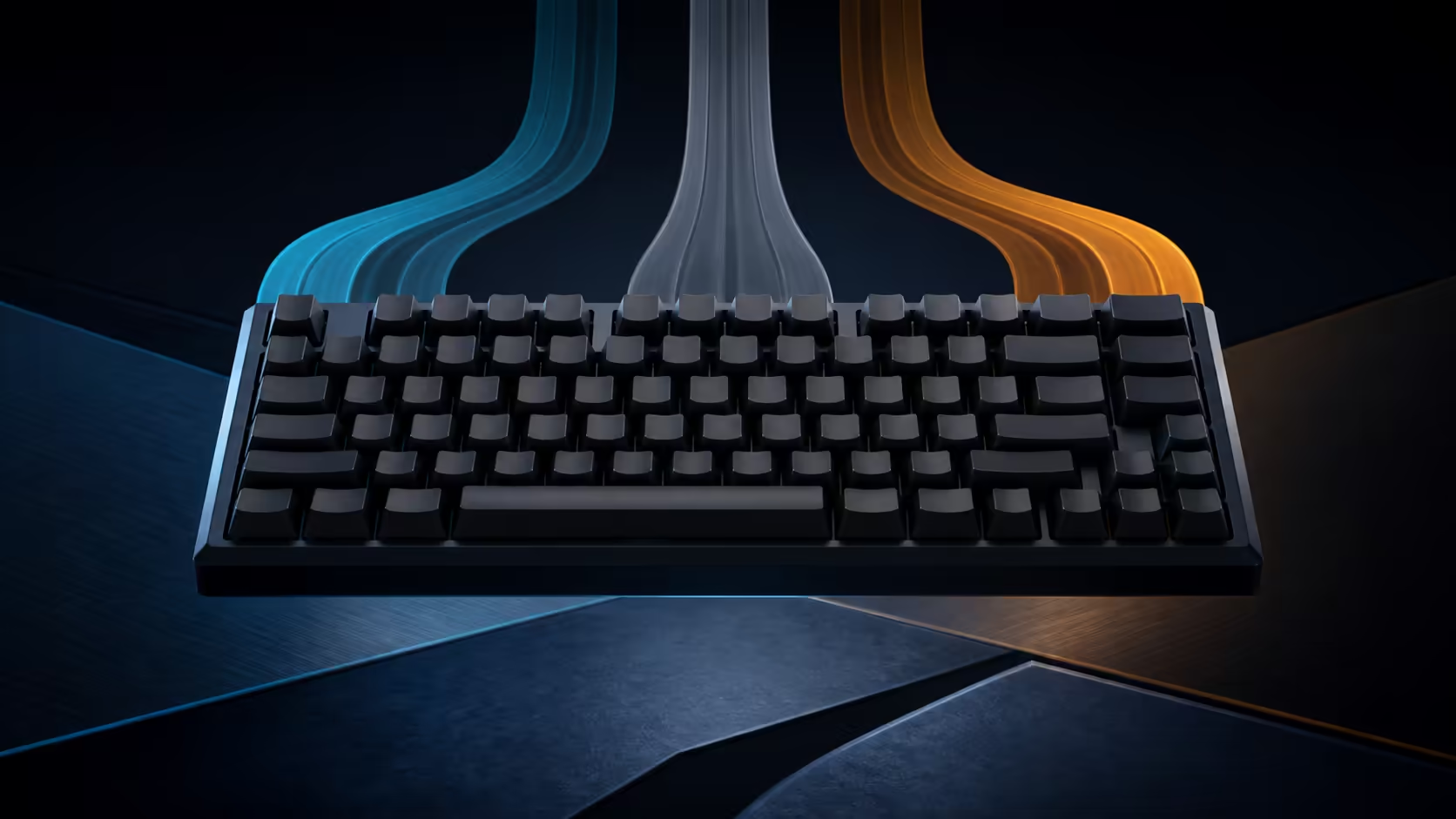
AULA's F87S combines three connection modes with a compact tenkeyless layout, hot-swap switch sockets and unusually high polling claims. That sounds like a long feature list for an announced $89.90 keyboard, but South African buyers still need a local price, warranty path and real stock before calling it a bargain. The useful question is whether its layout and connection choices solve a desk problem.
The F87S is a tri-mode TKL mechanical keyboard with 8,000Hz polling in wired and 2.4GHz modes, Bluetooth support and a 10,000mAh total battery. No matching AULA model appeared in the exact Evetech catalogue snapshot on 22 August. The wider keyboard sample started at R129, so the launch price cannot be converted into a fair local comparison until landed stock appears.
A tenkeyless board removes the number pad while keeping the function row, arrows and navigation cluster. That gives a mouse more lateral space without forcing a user into the tighter layers of a 60% board. It is a practical fit for a player using low mouse sensitivity, a smaller desk or a laptop stand beside the keyboard.
The compromise is equally clear. Anyone who enters long strings of numbers, works heavily in spreadsheets or relies on dedicated macro keys may miss the removed pad. The gaming keyboard range includes full-size, compact and TKL alternatives, so layout should be the first filter. A claimed 8kHz rate cannot restore keys that the daily workload needs.
The F87S uses a gasket-mounted structure and five damping layers. Those details aim to soften the typing feel and manage case sound, but switch choice, keycaps and desk surface still change the result. A buyer who cares about sound should treat a recorded sample as guidance, not a promise for every switch variant.
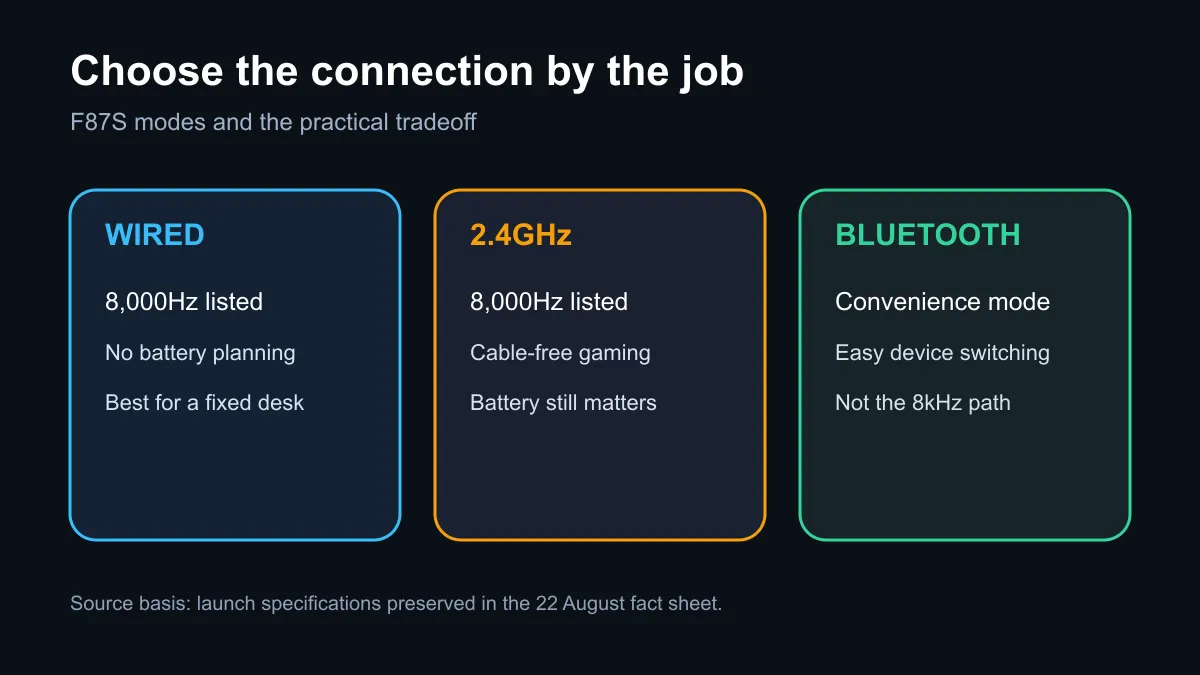
Wired operation avoids battery management and is the safest route for the advertised 8,000Hz polling. The 2.4GHz link offers a cleaner desk while retaining the same headline polling rate. Bluetooth is the flexible option for tablets, work laptops and quick device switching, but it is not presented as the high-performance gaming path.
That makes the mode decision straightforward. Use wired for a fixed competitive setup, 2.4GHz when cable freedom matters, and Bluetooth for convenience across slower-paced tasks. The large battery is useful only if the board's lighting and connection habits still deliver sensible time between charges. A 10,000mAh capacity describes stored energy, not a guaranteed number of days.
At 8,000Hz, a device can report input far more frequently than a standard 1,000Hz peripheral. The possible benefit is lower input-sampling delay, but the visible difference depends on the whole path: the game engine, CPU load, frame rate, display refresh rate and the player's consistency. A high number on the box does not guarantee a measurable improvement in every title.
Higher polling can also add processing overhead or expose compatibility quirks. Start at a stable rate, verify that games behave correctly, and raise it only when the rest of the system can use the extra reports. The best keyboard upgrade is still reliable switches, a suitable layout and predictable key response.
Hot-swap support can extend the board's useful life because compatible switches can be replaced without soldering. Buyers should still confirm the socket type and supported switch format before ordering replacements. Current keyboard specials are a useful reminder to compare the complete board, not assume hot-swap support makes every switch compatible.
The exact local read found no AULA match among the sampled in-stock keyboard rows. It did show a broad market beginning at R129 for a basic wired keyboard and R299 for wireless keyboard-and-mouse combinations. Those are not direct mechanical gaming alternatives. They simply show why a converted dollar price would create a false comparison.
The final decision needs the rand price, included switch, local warranty, keycap layout and delivery date. Compare it with current keyboard best sellers once stock appears. Buy now if an available board already provides the layout, connection and switch feel required. Wait for the F87S if tri-mode TKL use and hot-swap flexibility are both priorities and the existing keyboard still works.
No. It uses a tenkeyless layout that keeps arrows and navigation keys but removes the dedicated number pad.
Yes. Those are the three listed modes, although the 8,000Hz claim applies to wired and 2.4GHz operation.
No. The benefit depends on frame rate, display refresh, game support and CPU overhead. A stable lower rate can be the better setting.
No confirmed local price or matching Evetech listing was available in the 22 August snapshot.
Building a cleaner gaming desk? Choose the layout and connection first, then compare polling features and the confirmed local warranty.
It is a tenkeyless mechanical keyboard with wired, 2.4GHz and Bluetooth modes plus hot-swap switch sockets.
Yes. The launch lists 8,000Hz polling for both wired and 2.4GHz operation.
AULA lists 10,000mAh total capacity, described as two 5,000mAh cells.
No confirmed Evetech listing appeared in the exact 22 August catalogue snapshot.
The launch listed $89.90, which is not a confirmed South African retail price.
It suits buyers wanting a compact TKL layout, wireless flexibility and hot-swap switches in one board.
Gigabyte's FO32U24G pairs 4K 240Hz and FHD 480Hz modes on a 32-inch Tandem WOLED panel. SA buyers should compare the two use cases and wait for confirmed local pricing.
Read more
A South African price check found one 16GB DDR4 kit up 229% as memory and SSD costs lifted a midrange desktop basket. Buyers should compare complete upgrade paths, not one part.
Read more
Windows 11 update KB5121003 is linked to crashes in several multiplayer games on versions 24H2 and 25H2. Check the build, report the fault and avoid risky file or update changes unless the problem is confirmed on your PC.

Sennheiser's Momentum True Wireless 5 adds user-replaceable batteries, 12-hour playback and a $299.95 launch price. There is no confirmed South African date, so compare longevity with live earbuds from R199 to R2,999.

AVerMedia's GC531 and GC535 are professional HDMI capture devices for continuous streaming, with RGB24 capture up to 2K30 and 4K30. South African creators should compare them with live 4K capture cards from R2,099.

From 1 October 2026, WhatsApp Business Platform service replies in South Africa are expected to cost about $0.0076, or 12 cents, per delivered message.

CISA has added Windows IKE flaw CVE-2026-33824 to its actively exploited list. Supported Windows systems need the April 2026 security update or tightly limited IKE exposure.
Windows 11 update KB5121003 is linked to crashes in several multiplayer games on versions 24H2 and 25H2. Check the build, report the fault and avoid risky file or update changes unless the problem is confirmed on your PC.

Comsol's standalone 5G network covers about one million Gauteng homes and starts commercial ISP service in September. Early packages range from R275 to R875 a month, but coverage and fair-use rules still decide the real value.
Sennheiser's Momentum True Wireless 5 adds user-replaceable batteries, 12-hour playback and a $299.95 launch price. There is no confirmed South African date, so compare longevity with live earbuds from R199 to R2,999.
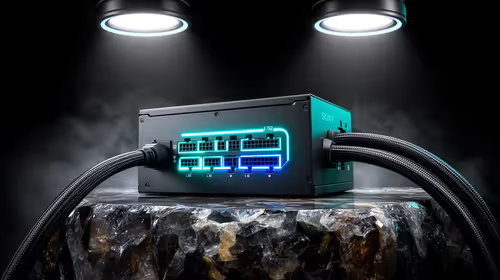
A 650W PSU is a risky ceiling for an RTX 5090 system if you want comfortable safety headroom. SA builders should check total platform draw, PSU age, cable support, case airflow, and upgrade plans before relying on it.
80+ Gold and 80+ Platinum affect 4K video editing through power efficiency and heat. The real-world difference is lower wasted energy, steadier PSU thermals, and quieter long renders for SA creator workstations with hungry CPUs and GPUs.
How to fix low FPS Windows 11 Ryzen 7 9800X3D starts with BIOS, chipset, thermals, and graphics settings. Use this SA checklist to confirm the build is boosting correctly before blaming the CPU, GPU, RAM, or display.
AM5 vs AM4 for Strategy and Sim Games comes down to CPU path, motherboard features, memory support, I/O needs, and upgrade timing. SA buyers should match the choice to their setup instead of assuming one option always wins.