



DDR4 Prices Jump 229% in SA: What Buyers Should Do
A South African price check found one 16GB DDR4 kit up 229% as memory and SSD costs lifted a midrange desktop basket. Buyers should compare complete upgrade paths, not one part.
Read moreGigabyte's FO32U24G pairs 4K 240Hz and FHD 480Hz modes on a 32-inch Tandem WOLED panel. SA buyers should compare the two use cases and wait for confirmed local pricing.
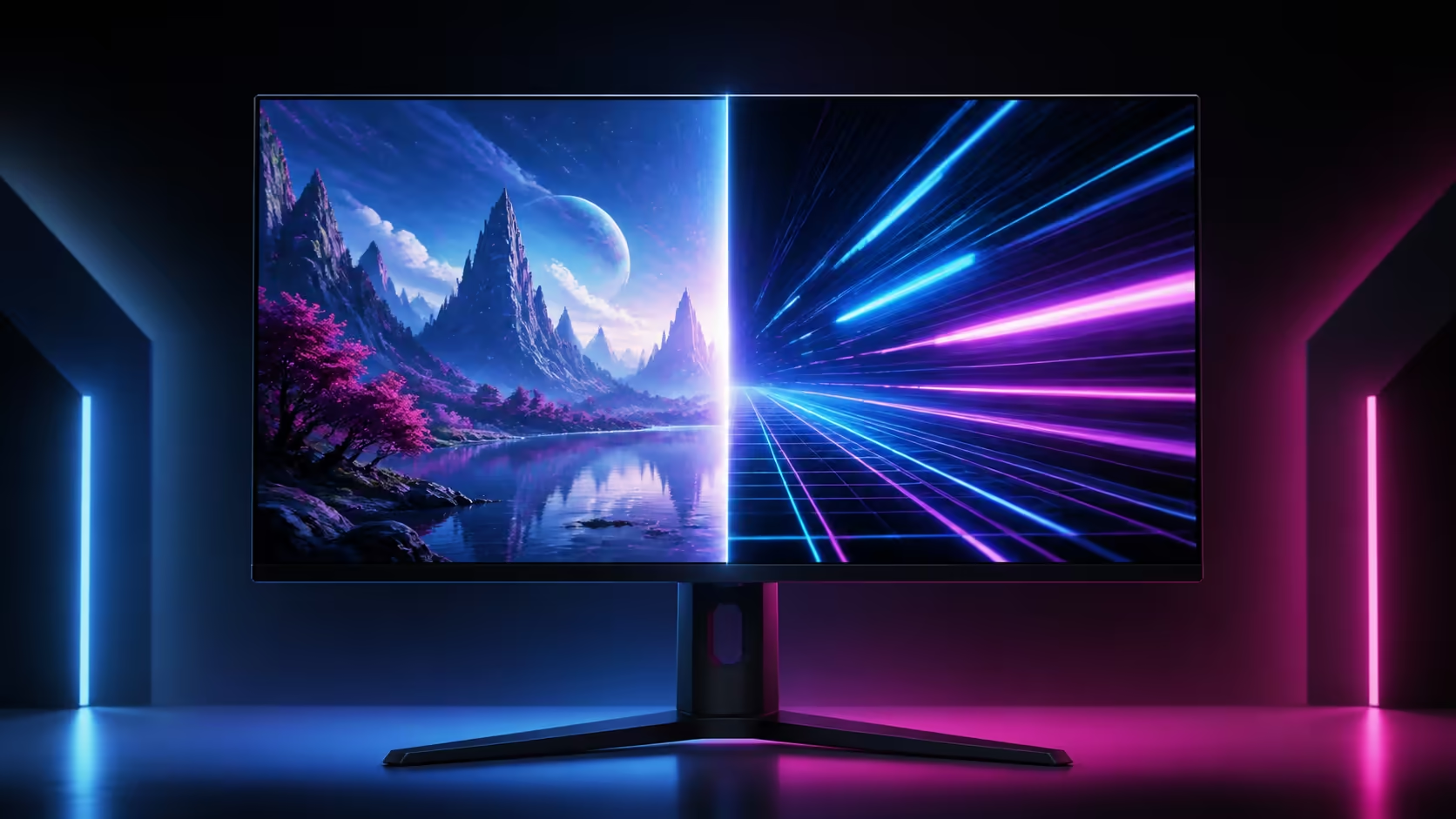
Gigabyte's AORUS ELITE FO32U24G is designed around a choice that normally requires two monitors. It can run at 4K and 240Hz for image detail, or switch to Full HD and 480Hz for competitive speed. The headline is attractive, but the right South African buying decision depends on the games, graphics hardware and local price rather than the largest refresh-rate number.
The FO32U24G is a 32-inch-class Tandem WOLED monitor with a glossy surface and dual 4K 240Hz or FHD 480Hz modes. No matching Gigabyte OLED appeared in the exact local sample. Current in-stock OLED monitors in that read ranged from R9,999 to R19,999, so buyers should wait for the local FO32U24G price before judging its value.
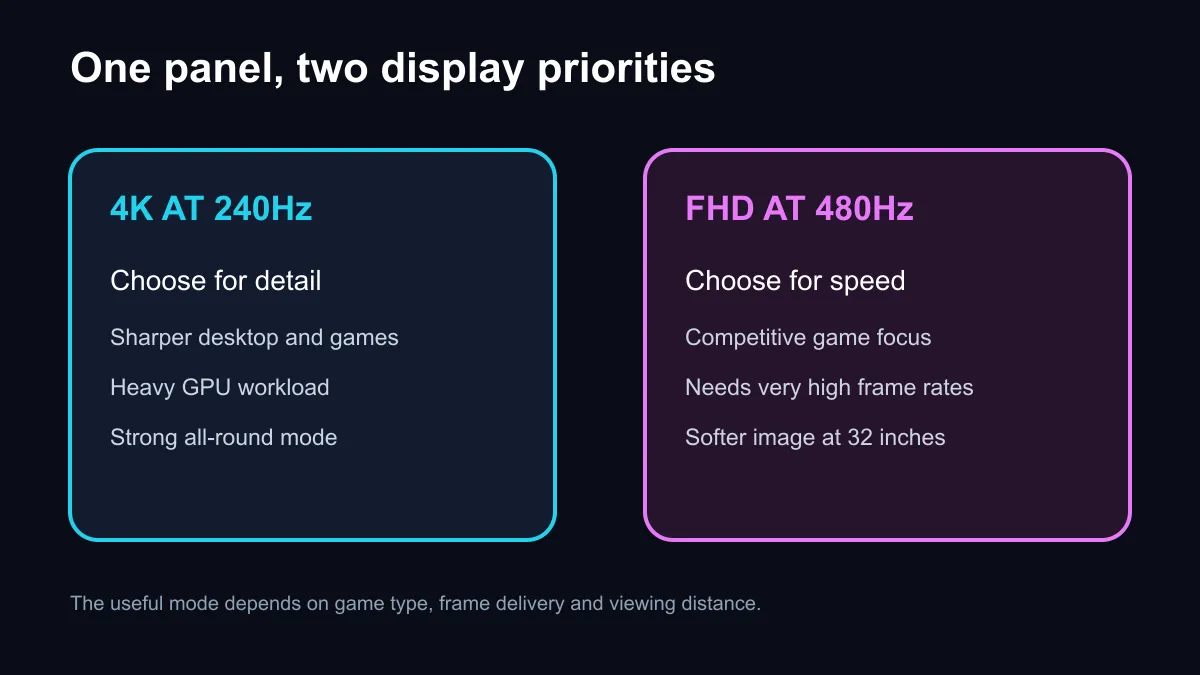
4K at 240Hz targets detailed single-player games, high-resolution desktop work and sharp media. It asks a great deal from the graphics card, especially when a game uses demanding ray tracing or lacks effective upscaling. The 240Hz ceiling still gives substantial headroom when lighter titles run faster.
Full HD at 480Hz makes a different trade. It reduces pixel count to chase much higher frame rates for esports play. The mode only adds value when the PC can sustain hundreds of frames per second and the user prefers response over image density. At 32 inches, Full HD will look visibly softer than 4K at normal desk distance.
That is why dual mode should be treated as two tools, not one universal best setting. A buyer can use 4K for most games and switch to 480Hz only for titles that can exploit it. The gaming monitor range shows how refresh, resolution and size must be considered together.
The preview identifies a Tandem WOLED panel and a RealBlack Glossy surface. A tandem structure is intended to improve output and efficiency, while the glossy treatment can preserve perceived clarity and contrast in a controlled room. It can also reflect windows and direct lights more clearly than a heavily matte screen.
Room setup therefore matters. A dark gaming space can show OLED black levels at their best. A bright office with a window behind the user may make reflections the dominant issue. Before buying, map the monitor position, light sources and viewing distance. Panel technology cannot compensate for a poor physical setup.
OLED care also remains part of ownership. Static desktop elements, long sessions and brightness habits affect risk over time. The monitor includes care features, but buyers should still use sensible screen-off settings and allow maintenance cycles to complete. Warranty wording for panel retention matters as much as the launch specification.
A 4K 240Hz screen does not require every game to run at 240 frames per second, but it rewards a strong GPU and a balanced processor. Competitive 480Hz play places even more emphasis on consistent frame delivery and CPU performance. Average frame rate alone is not enough; uneven frame times can make a high-refresh display feel less fluid than expected.
Connection support also needs confirmation on the final regional model. Buyers should match the graphics card output, cable standard and desired mode instead of assuming every port can carry every combination. Console owners should check the supported console resolution and refresh separately because 480Hz PC operation does not imply the same console mode.
The exact Evetech sample included a 27-inch QHD 240Hz WOLED model at R9,999, a 27-inch 480Hz OLED at R17,999 and a 26.5-inch 4K 240Hz OLED at R19,999. These are useful reference points, not forecasts for the new Gigabyte display. Browse current OLED monitor options to decide which feature already carries the biggest premium.
Current coverage points to a fourth-quarter 2026 window, but Gigabyte has not confirmed a South African date or rand price. That leaves the most important value question open. A premium dual-mode monitor must justify itself against cheaper 4K OLEDs, faster lower-resolution OLEDs and the possibility of keeping an existing secondary display.
Wait if the present screen still works and dual mode is the main attraction. Buy an available model now if a failing monitor is stopping work or play and the current monitor best sellers already meet the required resolution and refresh. The FO32U24G becomes compelling only when both modes will be used and the local warranty supports long-term OLED ownership.
Yes. Its primary mode is 4K at up to 240Hz, with a separate Full HD mode reaching 480Hz.
No. The PC must produce very high frame rates, and many demanding games will not reach that level.
It can show strong clarity, but direct light and windows may produce obvious reflections. Room control matters.
No rand price has been confirmed. The captured local OLED sample ranged from R9,999 to R19,999.
Choosing an OLED gaming monitor? Match resolution and refresh to the games your PC can actually drive, then compare the local warranty.
It is a 32-inch-class dual-mode gaming monitor using a Tandem WOLED panel with a glossy surface.
The preview lists 4K at 240Hz and Full HD at 480Hz through a dual-mode control.
Current coverage points to the fourth quarter of 2026, but regional timing can differ.
No. Gigabyte has not confirmed a rand price or local availability date.
Yes. The captured Evetech OLED sample ranged from R9,999 to R19,999 on 22 August 2026.
It best suits a buyer who wants sharp 4K games and can also drive very high frame rates in competitive titles.
A South African price check found one 16GB DDR4 kit up 229% as memory and SSD costs lifted a midrange desktop basket. Buyers should compare complete upgrade paths, not one part.
Read more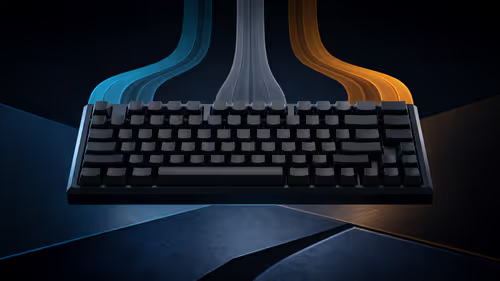
AULA's F87S combines 8kHz wired and 2.4GHz polling with hot-swap switches and tri-mode connectivity. SA buyers should wait for a confirmed local listing before judging its value.
Read more
Windows 11 update KB5121003 is linked to crashes in several multiplayer games on versions 24H2 and 25H2. Check the build, report the fault and avoid risky file or update changes unless the problem is confirmed on your PC.

Sennheiser's Momentum True Wireless 5 adds user-replaceable batteries, 12-hour playback and a $299.95 launch price. There is no confirmed South African date, so compare longevity with live earbuds from R199 to R2,999.

AVerMedia's GC531 and GC535 are professional HDMI capture devices for continuous streaming, with RGB24 capture up to 2K30 and 4K30. South African creators should compare them with live 4K capture cards from R2,099.

From 1 October 2026, WhatsApp Business Platform service replies in South Africa are expected to cost about $0.0076, or 12 cents, per delivered message.

CISA has added Windows IKE flaw CVE-2026-33824 to its actively exploited list. Supported Windows systems need the April 2026 security update or tightly limited IKE exposure.
Windows 11 update KB5121003 is linked to crashes in several multiplayer games on versions 24H2 and 25H2. Check the build, report the fault and avoid risky file or update changes unless the problem is confirmed on your PC.

Comsol's standalone 5G network covers about one million Gauteng homes and starts commercial ISP service in September. Early packages range from R275 to R875 a month, but coverage and fair-use rules still decide the real value.
Sennheiser's Momentum True Wireless 5 adds user-replaceable batteries, 12-hour playback and a $299.95 launch price. There is no confirmed South African date, so compare longevity with live earbuds from R199 to R2,999.
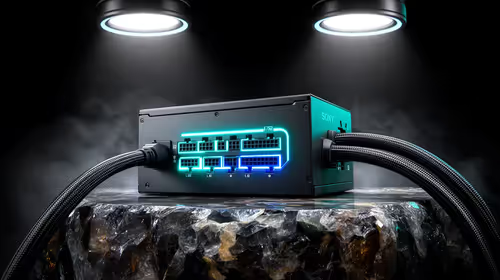
A 650W PSU is a risky ceiling for an RTX 5090 system if you want comfortable safety headroom. SA builders should check total platform draw, PSU age, cable support, case airflow, and upgrade plans before relying on it.
80+ Gold and 80+ Platinum affect 4K video editing through power efficiency and heat. The real-world difference is lower wasted energy, steadier PSU thermals, and quieter long renders for SA creator workstations with hungry CPUs and GPUs.
How to fix low FPS Windows 11 Ryzen 7 9800X3D starts with BIOS, chipset, thermals, and graphics settings. Use this SA checklist to confirm the build is boosting correctly before blaming the CPU, GPU, RAM, or display.
AM5 vs AM4 for Strategy and Sim Games comes down to CPU path, motherboard features, memory support, I/O needs, and upgrade timing. SA buyers should match the choice to their setup instead of assuming one option always wins.