The Control Resonant final PC requirements answer a question the earlier preliminary table could not: what hardware is attached to raster, ray-traced and path-traced targets. The top profile is severe, but it is not the game's minimum. A sensible build starts by choosing the presentation you want, then matching the system to that target.
Quick Answer
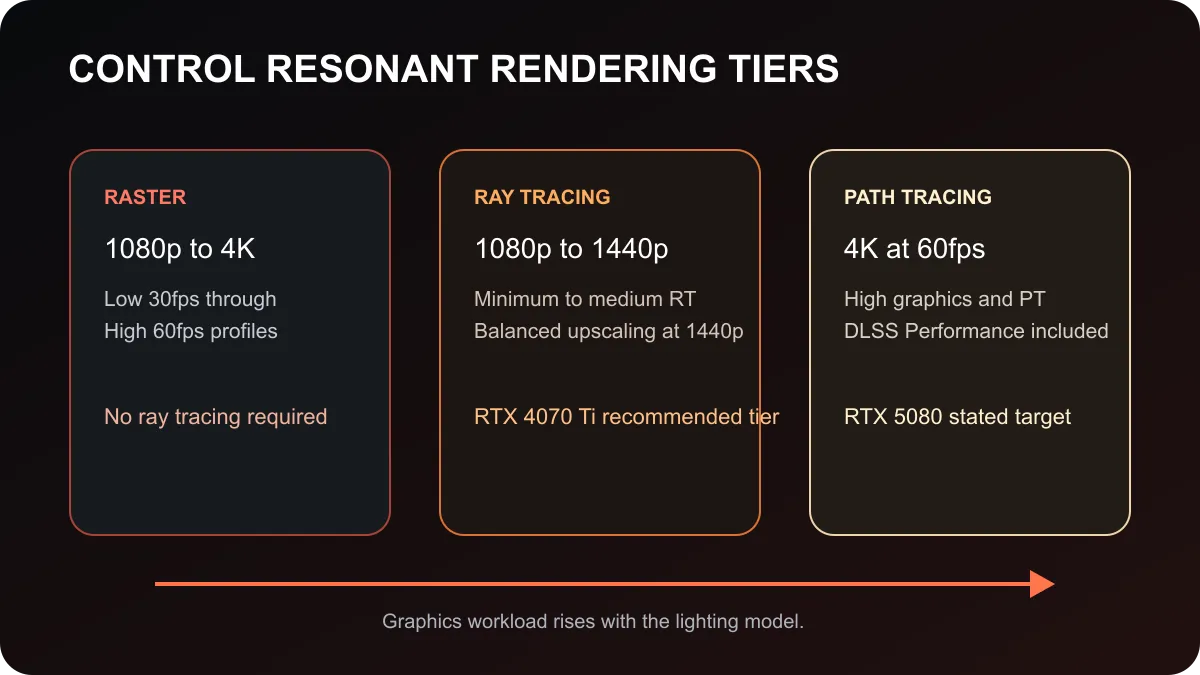
The final table starts with 1080p at 30fps on low settings using FSR Quality, and scales through 1440p 60fps raster play, 4K 60fps raster play, medium ray tracing and high path tracing. The top stated target uses an RTX 5080 for 4K 60fps with high graphics, high path tracing and DLSS Performance. It also lists a Core i7-10700 or Ryzen 7 3700X and 16GB of system memory. The captured Evetech catalogue showed active in-stock RTX 5080 graphics cards from R26,999, but buyers who do not need the top visual preset should not treat that as an entry requirement.
Read the target before the part number
System-requirement tables only make sense when resolution, frame rate, quality setting and upscaling mode stay attached to the hardware. The minimum profile targets 1080p at 30fps on low settings with FSR Quality. That is a basic playability target, not a promise of the visual presentation shown in path-tracing material.
The recommended raster profile targets 1440p at 60fps on medium settings with Balanced upscaling. A higher raster profile targets 4K at 60fps on high settings with Performance upscaling and lists an RTX 3080 or Radeon RX 6800 XT. Those two profiles matter because they show that ray tracing is not compulsory for a complete PC playthrough.
The ray-tracing minimum starts lower than the enthusiast profile, with GPUs including the RTX 2060 Super, Radeon RX 6600 and Intel Arc A580. The recommended medium ray-tracing target at 1440p 60fps moves to RTX 4070 Ti or Radeon 9070. The final path-tracing target reaches RTX 5080 at 4K 60fps with DLSS Performance.
What the RTX 5080 target really means
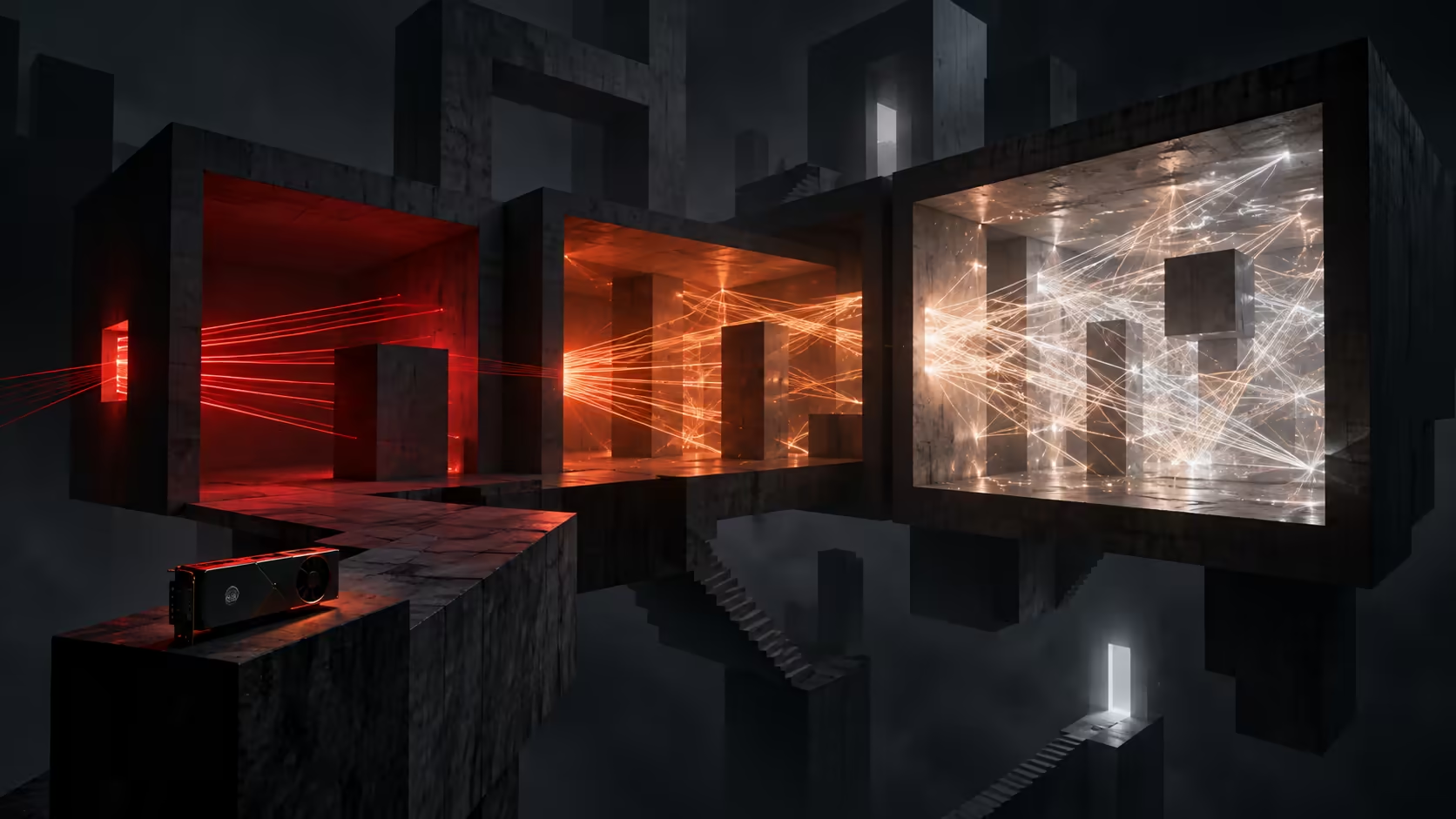
Path tracing calculates a much broader lighting solution than standard raster rendering. It can improve indirect light, reflections and shadow interaction, but it also increases graphics workload sharply. The stated RTX 5080 tier is therefore a showcase profile for high path tracing at 4K, not a claim that every player needs that card.
DLSS Performance is part of the target. That means the game internally renders fewer pixels and reconstructs the final 4K output. Anyone comparing raw graphics-card benchmarks should keep that condition attached to the 60fps claim. A native-resolution result is a different workload.
Processor requirements change less dramatically across the published tiers than graphics requirements. Several higher profiles retain the Core i7-10700 or Ryzen 7 3700X with 16GB of memory. Real frame pacing can still depend on scene complexity, drivers and launch-day patches, so the table is a planning baseline rather than a guaranteed result for every system.
South African upgrade choices
The live catalogue sample returned seven active products containing RTX 5080, including graphics cards from R26,999 and complete gaming PCs from R61,109. The lowest captured card was a Palit RTX 5080 at R26,999, followed by an overclocked Palit listing at R27,999 and an ASUS ProArt model at R34,999. These were current read-only results, not permanent quotes.
Use the RTX 5080 graphics-card page if the top path-tracing target is genuinely the goal. Compare RTX 5080 gaming PCs when replacing the whole platform, or review the GPU best sellers for broader price context.
Upgrade only after measuring your present system
Start by choosing 1080p, 1440p or 4K, then decide whether ray tracing or path tracing is essential. Check the present graphics card against that row. Also record the processor, memory capacity, power supply, case clearance and monitor resolution. A graphics-card replacement that exposes a weak power supply or cramped chassis is not a complete plan.
The game launches on 24 September 2026. Waiting for final driver notes and independent benchmarks can be the most useful option when the present system sits near a published tier. Those tests will show frame-time stability and how much each upscaler changes image quality.
Frequently Asked Questions
Does Control Resonant require an RTX 5080?
No. The RTX 5080 belongs to the high path-tracing 4K 60fps target. Lower raster and ray-tracing profiles list less demanding GPUs.
What does the minimum profile target?
It targets 1080p at 30fps on low settings with FSR Quality.
When will independent benchmarks matter?
They become most useful at launch, when drivers, final code and real scene data can be tested together.
Check the current graphics-card range only after choosing the visual target you want to hold.
Buy for a defined rendering target. Keep resolution, frame rate, quality and upscaling attached to every hardware comparison.