A warning from a major graphics-board group puts fresh pressure on the affordable end of the GPU market. South African buyers should treat it as a planning signal, not proof that every local card will jump in price.
Quick Answer
PC Partner, the company behind Zotac, expects shortages of entry-level graphics cards to become more severe in the second half of 2026. Its annual results had already identified graphics-memory costs as a source of price pressure. That risk makes a complete, ready-to-build shortlist useful, but it does not justify panic. Our 17 August catalogue snapshot found live cards from R4,399, with RTX 5060 rows beginning at R8,499. Compare the exact graphics-card stock against the games and resolution you actually use.
📉 What the shortage warning means
Entry-level boards have less room to absorb higher memory and component costs. If supply tightens, manufacturers can ship fewer low-price models, change the mix or raise board prices. PC Partner's warning is especially relevant because it participates directly in the add-in-board market. A separate year-long PC Gamer tracker also found that its cheapest recorded current-generation US cards all cost more on 14 August 2026 than a year earlier.
Neither source sets a South African retail price. Local distributors may have stock bought at earlier costs, and the rand, promotions and model mix can move independently. A warning about the second half of the year therefore describes risk, not a calendar for automatic price rises.
🎮 Build a local performance ladder
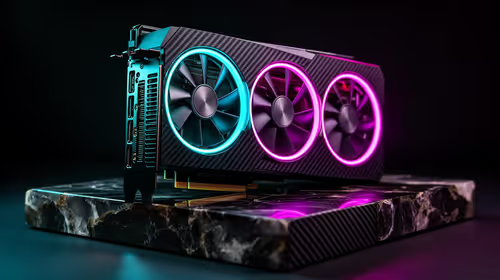
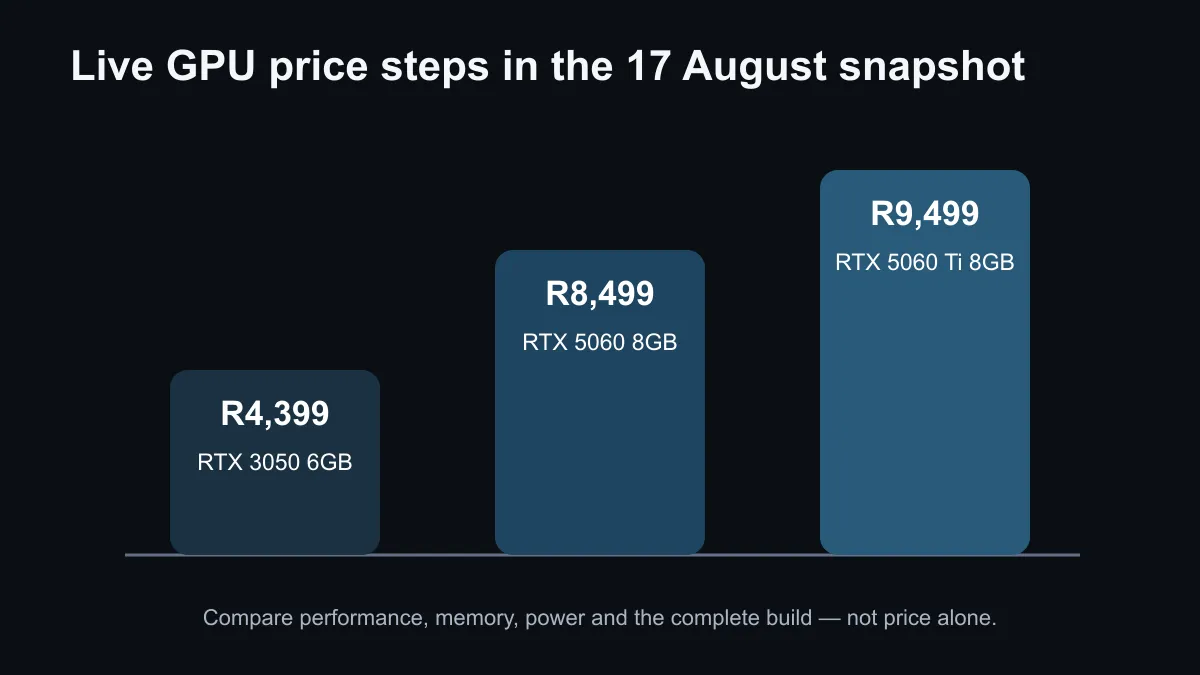
The timestamped Evetech sample gives three useful steps. A Palit GeForce RTX 3050 6GB was R4,399 and an MSI RTX 3050 6GB was R4,999. The first RTX 5060 listing was a Palit 8GB model at R8,499, with several other RTX 5060 cards between R8,699 and R9,199. RTX 5060 Ti 8GB rows started at R9,499, while a 16GB Palit RTX 5060 Ti appeared at R12,999.
These prices do not make the cards interchangeable. A low-cost RTX 3050 can suit lighter 1080p play, but a buyer targeting newer games, higher settings or longer ownership should compare measured performance and memory limits. The Nvidia graphics-card section is a starting point; the target frame rate and monitor resolution decide whether the cheaper tier is enough.
🧾 Avoid buying one part in isolation
A graphics card only becomes useful inside a compatible system. Confirm power-supply wattage and connectors, case length and thickness, motherboard slot clearance and processor balance. Check the display outputs against the monitor. If the rest of the build is months away, an early GPU purchase can consume warranty time while the card sits untested.
Write two thresholds before shopping: the minimum performance tier and the maximum full-build budget. Then compare two or three exact models at that tier. The GPU best-seller page can help identify popular current options, but popularity does not replace the power, size and performance checks.
Buy now when the complete system is ready, the card meets the target and the price is acceptable today. Wait when the build is undefined, the current PC still handles the workload or buying the GPU would force cuts to power, storage or the monitor. A supply warning should shorten an already sensible decision, not create a purchase that has no finished system behind it.
Also keep the local snapshot in perspective. The R4,399 entry point is a real captured price, not a promise that the same stock will remain. The correct habit is to compare the same models over time rather than treating a changing cheapest row as a market index.
Frequently Asked Questions
Are all entry GPUs about to disappear?
No. The warning points to tighter supply risk, not a confirmed end date for every model.
Does a US price tracker predict South African prices?
No. It adds global context, while local pricing still depends on currency, distributors, stock timing and competition.
Is 6GB of graphics memory enough?
It can suit lighter 1080p workloads, but newer games and higher settings may need more. Check game-specific tests before buying.
Should I choose the cheapest RTX 5060?
Compare cooler design, dimensions, warranty, noise and stock as well as the GPU name.
Ready to lock the graphics budget? Choose the performance tier first, confirm the complete build, then compare live cards inside that fixed ceiling.