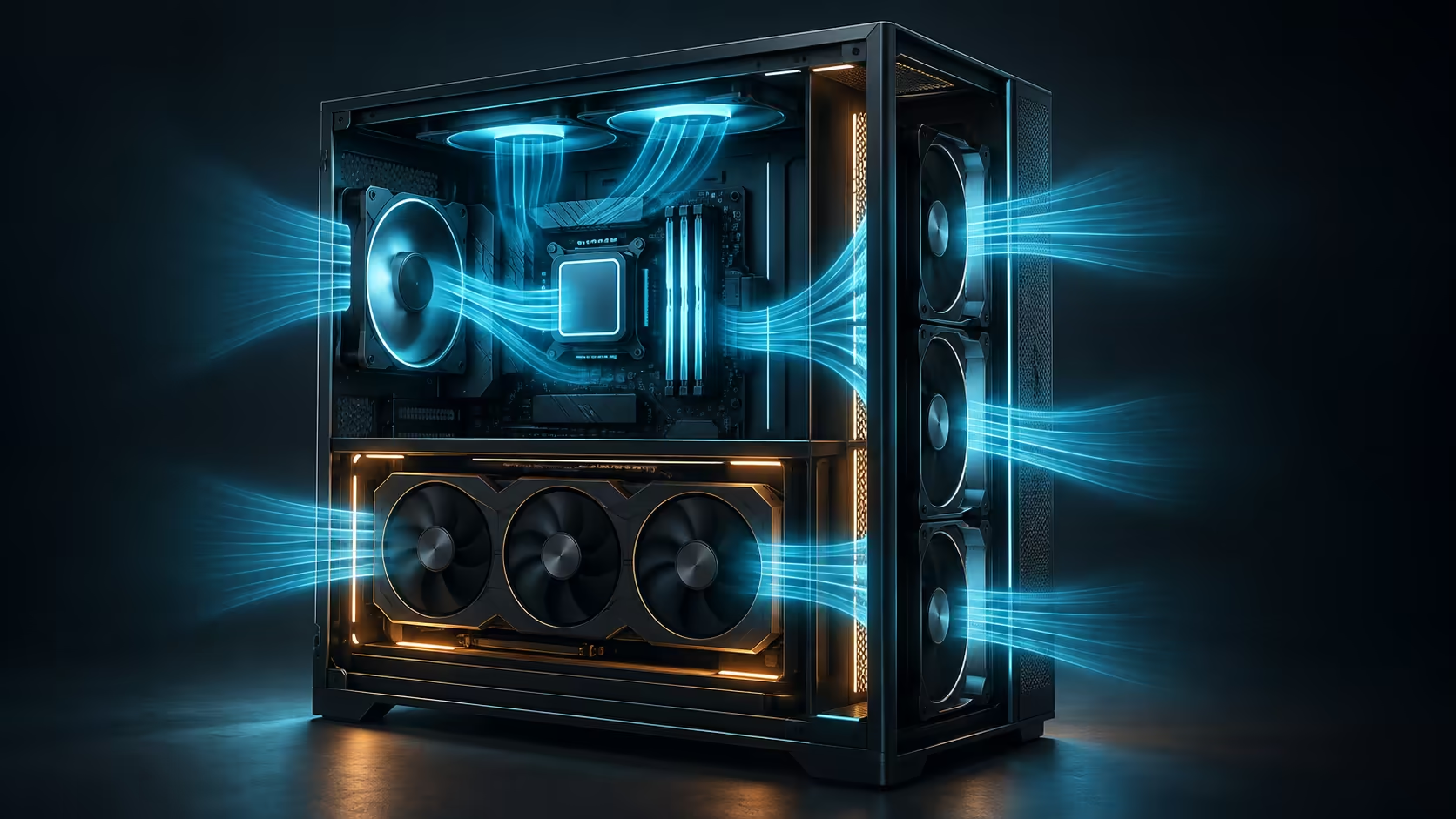
The Phanteks EX5 case is built around a simple idea: the hottest parts of a modern PC do not have to share one large chamber. Its divided layout gives the graphics card, motherboard area and cooling hardware more deliberate paths for fresh air. That makes the launch interesting, but the unusual structure also makes physical fit more important than the render.
Quick Answer
Phanteks announced three EX5 versions for September 2026. The standard EX5 is a 449 x 234 x 474 mm ATX mid-tower with support for graphics cards up to 358 mm long and a 360 mm side radiator. The EX5 Plus and EX5 Max add an integrated 360 mm liquid cooler, while the Max also adds a 6-inch display. No confirmed South African price or retail date appeared in the captured material. For local buyers, the correct decision is to measure every large component and compare the full cooling cost with current cases, which started at R699 in the captured Evetech category sample.
How the divided airflow layout works
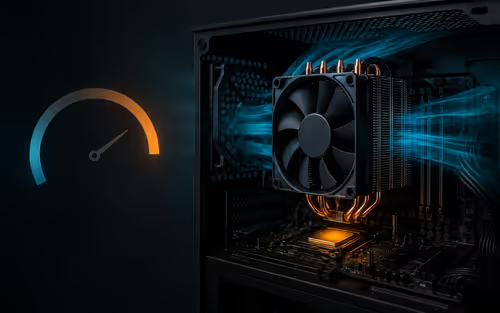
A conventional case often draws air through one front panel and sends it across nearly every component. The EX5 instead gives major heat sources their own zones. The graphics card sits in a front compartment, while a rear motherboard fan directs air towards the processor socket, voltage-regulation area, memory and M.2 storage. Heat from the graphics card is less likely to pass directly across those parts before leaving the case.
This does not guarantee better temperatures in every build. The result still depends on the graphics-card cooler, radiator direction, room temperature and fan curves. What the structure does offer is a clearer route for air and fewer reasons to fill every available position with extra fans. That can reduce cost and noise when the supplied layout performs as intended.
The standard model includes a rear 120 mm motherboard fan and leaves the liquid cooler to the builder. The Plus and Max integrate a 360 mm cooler with concealed tubing. Those versions may suit a clean showcase build, but they also tie more of the cooling system to the case package.
Clearance matters more than the outside dimensions
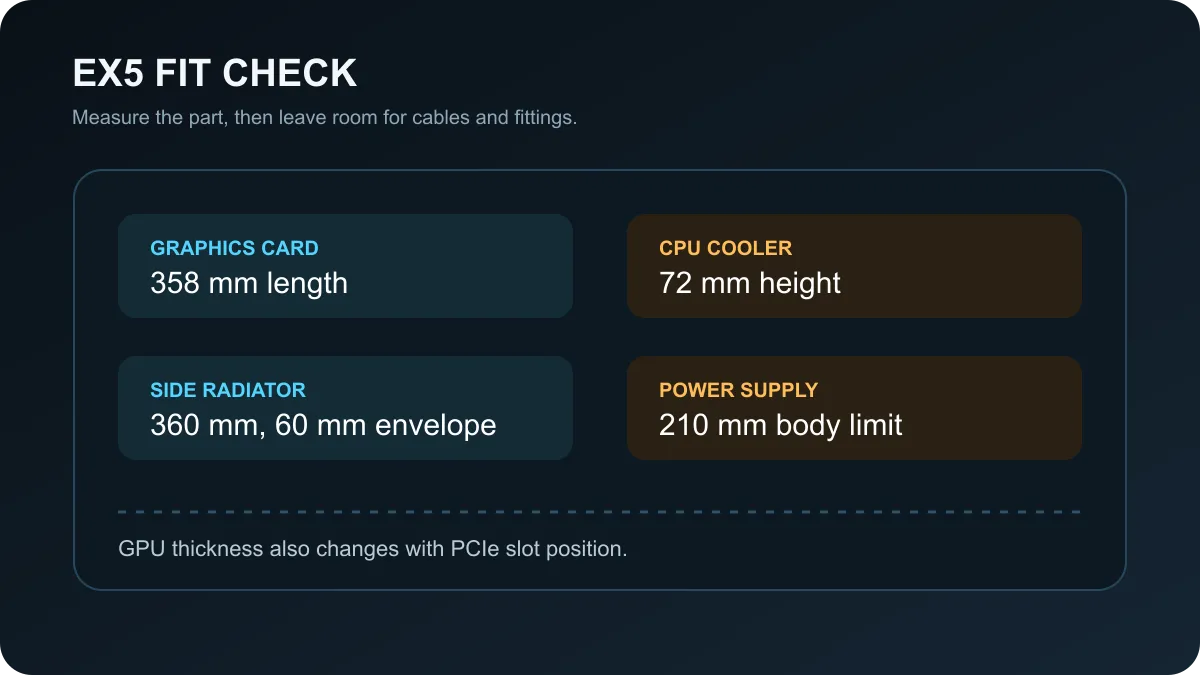
The official specification lists 358 mm of graphics-card length and up to 175 mm of width. Thickness changes with the PCIe slot position: a card can have more room when mounted in the first slot than when its connector starts lower down. That detail is essential for large modern coolers. Do not rely on the advertised slot count alone.
The standard EX5 lists a 72 mm processor-cooler height, which strongly favours liquid cooling or a low-profile air cooler. The side radiator area supports a 360 mm unit within a stated 413 x 134 x 60 mm envelope. The power-supply limit is 210 mm. Storage is modest, with positions for one 3.5-inch drive and one 2.5-inch drive. Builders carrying several older drives should plan that constraint before moving parts.
Use the diagram as a pre-purchase check: record the exact length, width and thickness of the graphics card, the height of the processor cooler, the radiator plus fan thickness, and the power-supply body and cable bend. Leave working room for connectors rather than treating the last millimetre as usable space.
South African price and availability context
Phanteks gave the standard EX5 a foreign launch price from $109.99, but that figure is not a local quote. Freight, distribution, tax, support and the chosen version can materially change a South African shelf price. No EX5 listing appeared in the captured Evetech mid-tower sample, so the article does not convert the US amount into rand.
The live sample did show active in-stock mid-tower cases from R699, including models with tempered glass and supplied fans. Start with the mid-tower case category, compare the current case specials, and review the case best sellers. Check the live listing again at purchase time because price and stock can move after this snapshot.
Who should wait for the EX5?
Wait if the divided GPU chamber is the feature you specifically want and your present case is working well. Independent thermal and acoustic testing should show whether the design can meet its cooling claim with fewer fans. It will also reveal how easy the front graphics compartment is to build in and how much clearance remains around power cables.
Buy a current case if a failed fan, damaged panel or cramped build needs an immediate replacement. A familiar mesh-front chassis with clear clearances can be a safer choice than waiting for an unconfirmed local arrival. The best case is the one that fits the parts, delivers controlled airflow and can be supported locally.
Frequently Asked Questions
What is the Phanteks EX5 case?
It is an ATX mid-tower that separates major components into dedicated airflow zones instead of using one open internal chamber.
Does every EX5 include a 360 mm cooler?
No. The standard EX5 accepts a side 360 mm radiator but leaves the cooling choice to the builder. The Plus and Max include the integrated unit.
Is a South African price confirmed?
No local price or retail date was present in the captured sources. Treat foreign prices only as launch context.
Measure first, then compare the current PC-case range by fit, supplied cooling and support.
Build around measured clearances, not a product render. Record every major component dimension before deciding whether the EX5 layout is worth waiting for.