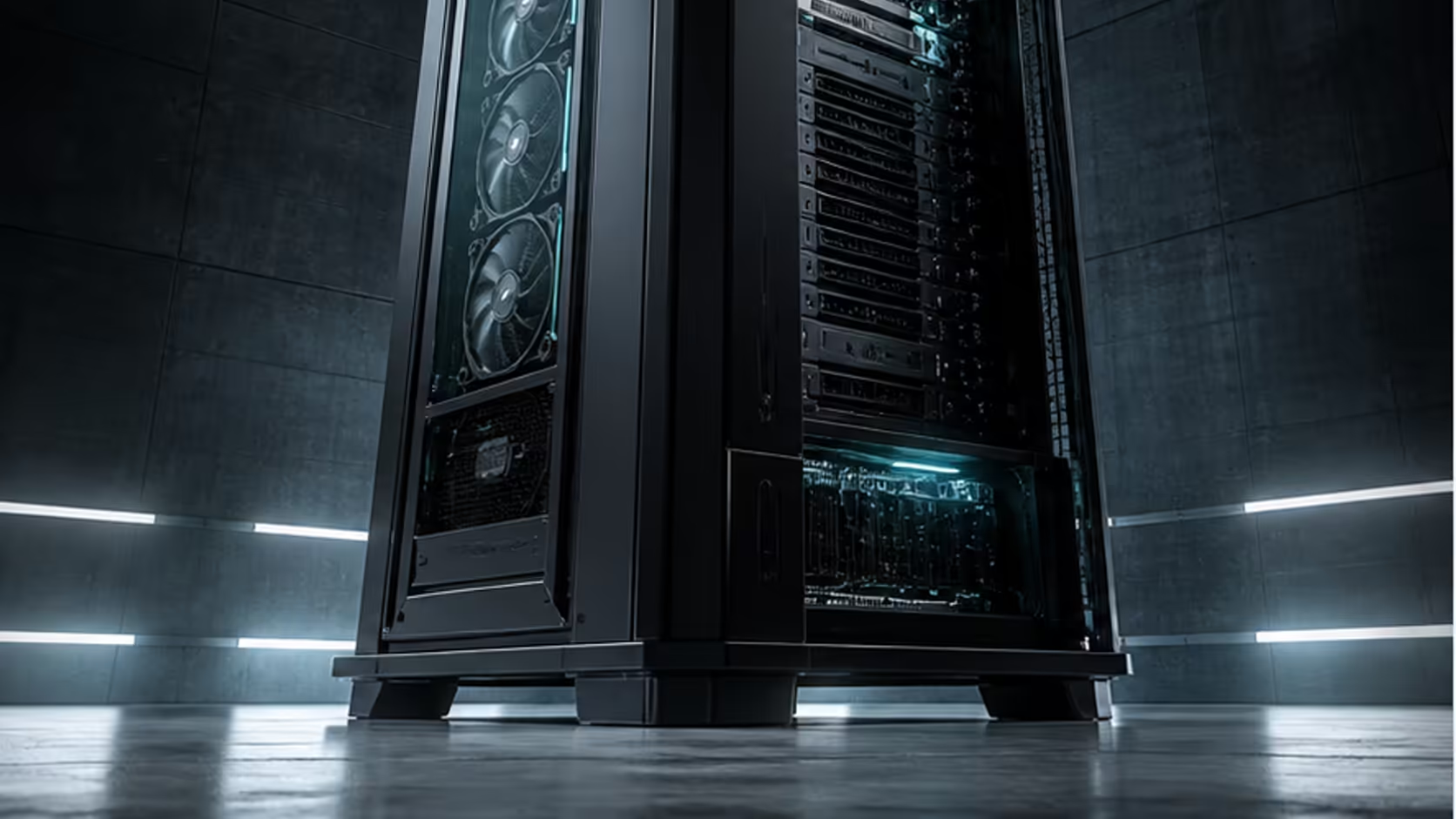
SilverStone's ALTA T2 is not a normal gaming case enlarged for effect. The 99-litre super tower is built around workstation-scale boards, extensive expansion and ambitious cooling, so the first buying question is whether a build truly needs its volume.
Quick Answer
The ALTA T2 supports board formats from Mini-ITX through E-ATX, XL-ATX, SSI-CEB and SSI-EEB, with 11 expansion slots and dual power-supply capability. A 12 August catalogue read found large in-stock E-ATX and full-tower cases from R3,399 to R10,999, but no exact ALTA T2 listing. Use the current computer case range as the local value baseline.
📐 Ninety-nine litres changes the room plan
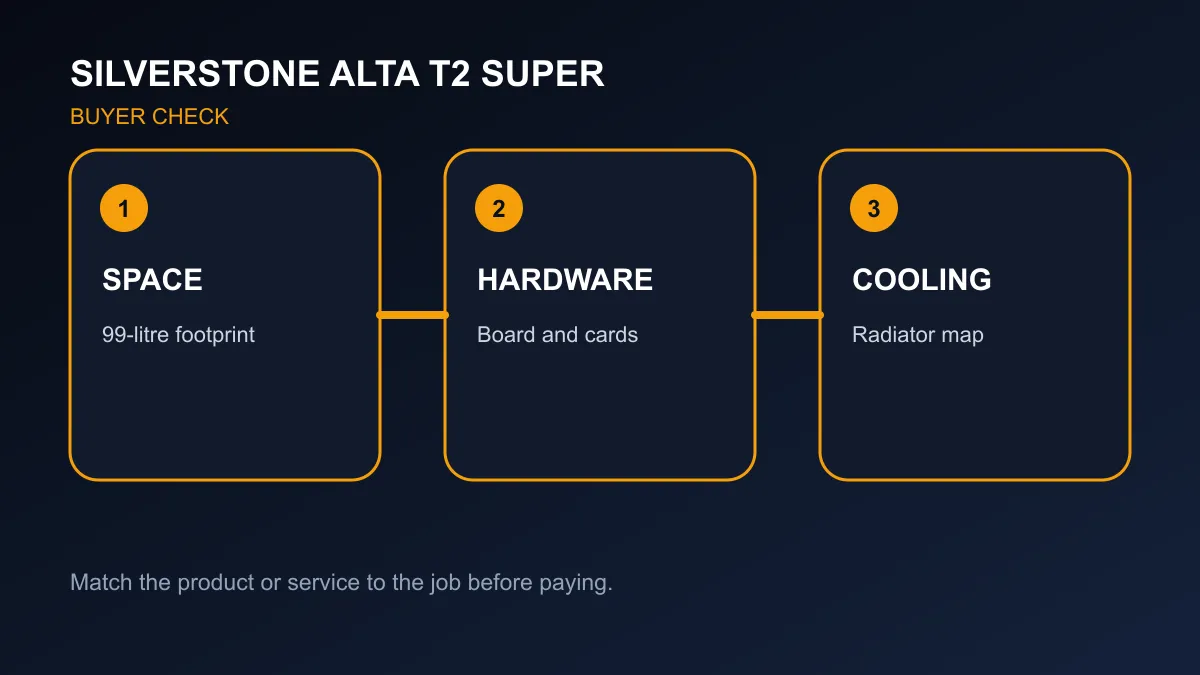
A case of this scale needs more than a free patch of desk. Builders should allow clearance for panels, cables, filters and airflow, then consider whether a loaded system can be moved safely. A heavy graphics card, several drives, large radiators and two power supplies can turn the finished machine into a semi-permanent workstation.
The broad motherboard list matters to professionals using SSI-EEB or SSI-CEB boards with more sockets, memory channels or expansion lanes. For an ordinary ATX gaming build, much of the internal room may remain unused. Empty volume is not harmful by itself, but it adds cost, footprint and longer cable routes without improving frame rates.
🧩 Expansion is the real reason to go large
Eleven expansion slots create room for multi-card compute, capture, networking or storage configurations that smaller cases cannot accommodate comfortably. Dual power-supply capability can support specialised builds, although it also raises planning requirements around power delivery, cable routing and electrical load.
Cooling support is similarly broad, with room for multiple large radiator positions. Builders still need to map radiator thickness, fan depth, reservoir placement and tubing before ordering parts. A compatibility headline cannot prove that every component combination fits at the same time.
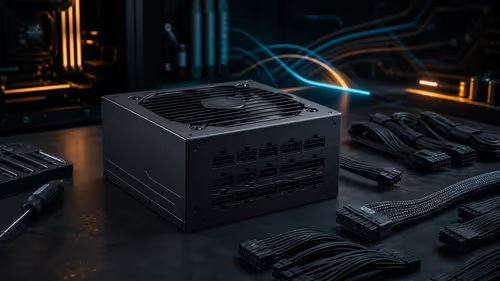
Cable planning becomes harder as the enclosure grows. Power leads must reach distant sockets without crossing fans, and data cables need routes that still allow panels to close. Extra-long extensions can introduce clutter, so draw the component layout and power path before committing to a dual-supply design. A single correctly sized power supply may remain simpler for many builds.
Airflow should follow a coherent direction instead of filling every mount. Large radiators, drive cages and expansion cards can divide the internal space into separate pressure zones. Decide where cool air enters, where heated air leaves and which filters need regular access. More fan positions only help when their flow supports the installed hardware.
Noise and servicing deserve equal attention. A tower with many fans may remain quiet at low speed, while clogged filters or aggressive curves can change that result. Plan how the front, roof and lower filters will be removed after the system is under a desk. Easy maintenance protects cooling performance over the useful life of an expensive workstation.
💵 Local cases show the premium range
The live read returned 12 large E-ATX, full-tower or related high-capacity rows. Examples included Cooler Master MasterFrame designs around R3,399 to R3,499, an ASUS ProArt PA602 at R5,199 and the Cooler Master Cosmos Alpha Gold at R10,999. These prices show how wide the upper case market already is.
Compare case best sellers for mainstream reference points and browse Cooler Master cases for current large-format alternatives. The useful comparison includes required board format, graphics card length, drive count, cooling layout and included fans, not litres alone.
Frequently Asked Questions
How large is the ALTA T2?
The launch describes a 99-litre super-tower chassis.
Which workstation boards are supported?
SilverStone lists SSI-EEB and SSI-CEB alongside consumer motherboard formats.
Is local availability confirmed?
No exact ALTA T2 row appeared in the timestamped Evetech catalogue read.
Planning a workstation-scale build? Measure the space, map every expansion card and radiator, then compare complete local case value.