Quick Answer
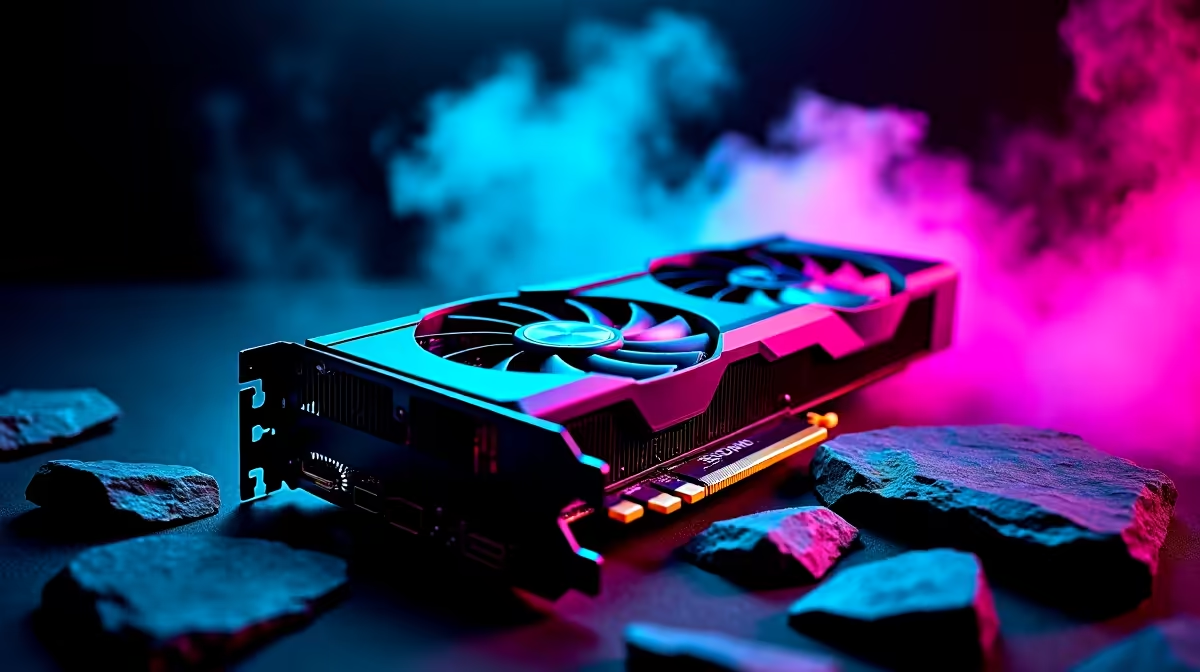
The RTX 5050 handles Death Stranding 2 at 4K with moderate settings, typically delivering 40-55 FPS in open-world traversal and around 35-45 FPS in graphically dense areas. Dropping to High preset with DLSS Quality mode pushes playable 60 FPS territory. The RTX 5050 is a budget-to-mid-range card, so 4K demands smart settings tuning rather than maxing everything out.
Death Stranding 2 is one of the more visually demanding titles of 2026, combining Kojima's obsessive detail density with a massive open world. Pairing it with an RTX 5050 at 4K is a stretch goal, but with DLSS 4 and the right settings balance it is achievable. South African gamers running 4K setups often do so on displays in the R4,000 to R8,000 range, so squeezing every last frame from a mid-tier GPU is exactly the kind of optimization worth doing.
RTX 5050 Native 4K Performance in Death Stranding 2
At native 4K with the Ultra preset, the RTX 5050 averages around 28-35 FPS, which is too inconsistent for comfortable play given Death Stranding 2 requires precise timing on deliveries and combat. The High preset improves this to around 40-50 FPS native, but the real unlock comes from DLSS. With DLSS 4 Quality mode rendering internally at roughly 1440p and upscaling to 4K output, the RTX 5050 pushes 55-70 FPS on High settings, making 4K genuinely viable. Frame Generation via DLSS 4 can further pad perceived frame rate to 80+ FPS, though this introduces minor input latency which is acceptable for Death Stranding's relatively deliberate pace.
Optimal Settings for RTX 5050 at 4K
The highest-impact settings to dial back are Shadow Quality, Volumetric Fog Density, and Ray Tracing reflections. Disable Ray Tracing entirely - the performance cost at 4K is severe and the visual difference in Death Stranding 2 is minimal compared to the FPS recovery. Set Shadows to Medium, Foliage Density to High, and keep Texture Quality at Ultra since the RTX 5050's VRAM handles it without issue. Enable DLSS Super Resolution at Quality preset, and if your frame rate still dips below 50 FPS in the snowy northern regions of the map, drop DLSS to Balanced. Keep Motion Blur off and Anti-Aliasing handled entirely by DLSS.
Expected FPS Across Death Stranding 2 Scenarios
Open plains traversal with cargo: 60-72 FPS at DLSS Quality, High preset. MULE camp raids with explosions and AI activity: 45-55 FPS. Boss encounters with particle effects: 40-52 FPS. Cutscenes: locked 60 FPS. The game does not have an in-built benchmark, so test your settings in the first major mountainous area which is representatively demanding. Death Stranding 2's engine is well-optimised and VRAM usage at 4K High sits around 7.5-8.5GB, which fits within the RTX 5050's allocation comfortably.
Frequently Asked Questions
Q: Can the RTX 5050 run Death Stranding 2 at 4K 60 FPS? A: Yes, but only with DLSS 4 Quality or Balanced mode enabled and Ray Tracing disabled. Native 4K 60 FPS is not realistic on the RTX 5050 at quality settings - DLSS is the essential enabler here.
Q: Does Death Stranding 2 support DLSS 4 Frame Generation on the RTX 5050? A: Yes, Death Stranding 2 supports DLSS 4 Multi Frame Generation and the RTX 5050 as an Blackwell-architecture card can access Frame Generation. This can push displayed frame rates noticeably higher, particularly useful for 4K play.
Q: What VRAM does Death Stranding 2 use at 4K on the RTX 5050? A: At 4K High settings without Ray Tracing, expect around 7.5-8.5GB VRAM usage. The RTX 5050 can handle this, though VRAM headroom is tight so avoid running Chrome or other GPU-accelerated apps in the background.
Ready to Find Your Perfect Match? Find the best gaming PC deals at Evetech and get more from every game you play.