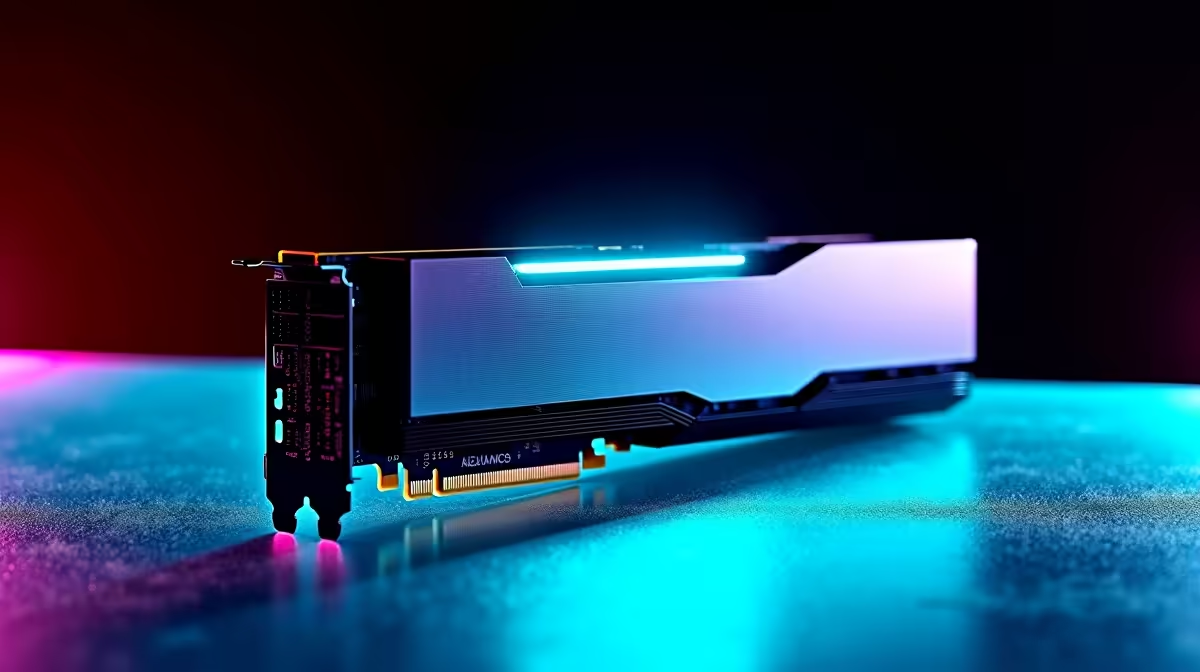
The AMD Radeon RX 7600 launched as a budget-to-midrange GPU, but 2026's driver updates and software stack have brought a new dimension to the card: AI-accelerated features via AMD's RDNA 3 AI accelerators. For SA gamers looking to extract maximum value from a mid-tier graphics card, understanding what the RX 7600's AI capabilities actually deliver - versus marketing claims - is worth exploring.
Quick Answer
The RX 7600 includes dedicated AI accelerators on its RDNA 3 architecture that power AMD FSR 3 (including frame generation), Radeon Super Resolution, and AI-enhanced noise suppression in AMD Noise Suppression. In real-world 2026 benchmarks, FSR 3 frame generation delivers 60–80% framerate uplift at 1080p, making the card punch above its weight for its SA price bracket.
🤖 RX 7600 AI Architecture: What's Actually There?
RDNA 3 introduced dedicated AI accelerators alongside traditional compute units - a first for AMD's mainstream GPU lineup. The RX 7600 carries 32 compute units each with AI acceleration support, amounting to roughly 98 TOPS (tera-operations per second) of AI throughput. This is significantly below NVIDIA's RTX 4060 (which uses dedicated Tensor cores), but AMD's approach integrates AI processing more directly into the shader pipeline, making it efficient for graphics-specific AI tasks like upscaling and frame generation.
The key AI-powered features available on the RX 7600 in 2026 are: FSR 3 with Fluid Motion Frames (FMF), Radeon Super Resolution (RSR), AMD Noise Suppression for streaming, and enhanced denoising in AMD's Radeon ProRender. The card does not support AI-accelerated ray tracing denoising at the same fidelity as NVIDIA's DLSS 3.5 Ray Reconstruction, which remains a meaningful gap for path-traced titles.
📊 Benchmark Results: FSR 3 and Frame Generation in Practice
In 2026 testing at 1080p Ultra settings, the RX 7600 without upscaling averages around 68fps in Cyberpunk 2077 with Ray Tracing off. Enabling FSR 3 Quality mode pushes this to approximately 94fps. Activating Fluid Motion Frames (frame generation) on top lifts output to around 155fps - a 2.28x multiplier over native rendering.
The catch: frame generation adds latency. Anti-Lag+ helps mitigate this on the RX 7600, bringing perceived input lag back to near-native levels in most titles. Competitive games where sub-5ms latency is critical are still better served with frame generation off at a higher native framerate.
At 1440p, native performance drops to around 44fps in demanding titles, making FSR 3 Performance mode more appropriate. Output still reaches 100fps+ with frame generation enabled, which is respectable for a mid-tier GPU at the RX 7600's price point in SA.
🎙️ Real-World AI Features: Noise Suppression and Beyond
AMD Noise Suppression (available via Radeon Software) uses the RX 7600's AI accelerators to clean up microphone audio in real time - useful for SA streamers who stream from noisy home environments. In practice, it performs comparably to NVIDIA RTX Voice for most use cases, though NVIDIA's implementation remains slightly more refined at aggressive noise reduction levels.
The broader AI software ecosystem for RDNA 3 continues to expand through AMD's ROCm platform, but for gaming-focused SA users, FSR 3 and Noise Suppression are the features that directly improve the day-to-day experience. Professional AI workloads (Stable Diffusion, LLM inference) run faster on NVIDIA Tensor cores at this price tier.
❓ FAQ
Q: Does the RX 7600 support FSR 4? A: FSR 4 (AMD's machine-learning based upscaler) requires RDNA 4 architecture (RX 9000 series). The RX 7600 (RDNA 3) supports FSR 3, which uses spatial and temporal algorithms rather than neural network inference.
Q: Is the RX 7600 good for AI image generation in 2026? A: It can run Stable Diffusion via DirectML, but performance is slower than NVIDIA RTX cards of similar price due to CUDA's ecosystem advantage. For gaming with AI features, it's excellent value; for dedicated AI workloads, NVIDIA is the better choice.
Q: How does the RX 7600 compare to the RTX 4060 on AI features? A: The RTX 4060 has an edge in AI throughput (dedicated Tensor cores, DLSS 3.5) and ray tracing performance, but the RX 7600 is typically priced lower in SA and FSR 3 has become widely adopted - the real-world gap is smaller than spec sheets suggest.
Evetech stocks All Graphics Cards and Graphics Card Deals — browse current SA pricing and availability online.
Ready to Find Your Perfect Match? See Evetech's current GPU and gaming PC deals - find your best value build for 2026.