Quick Answer
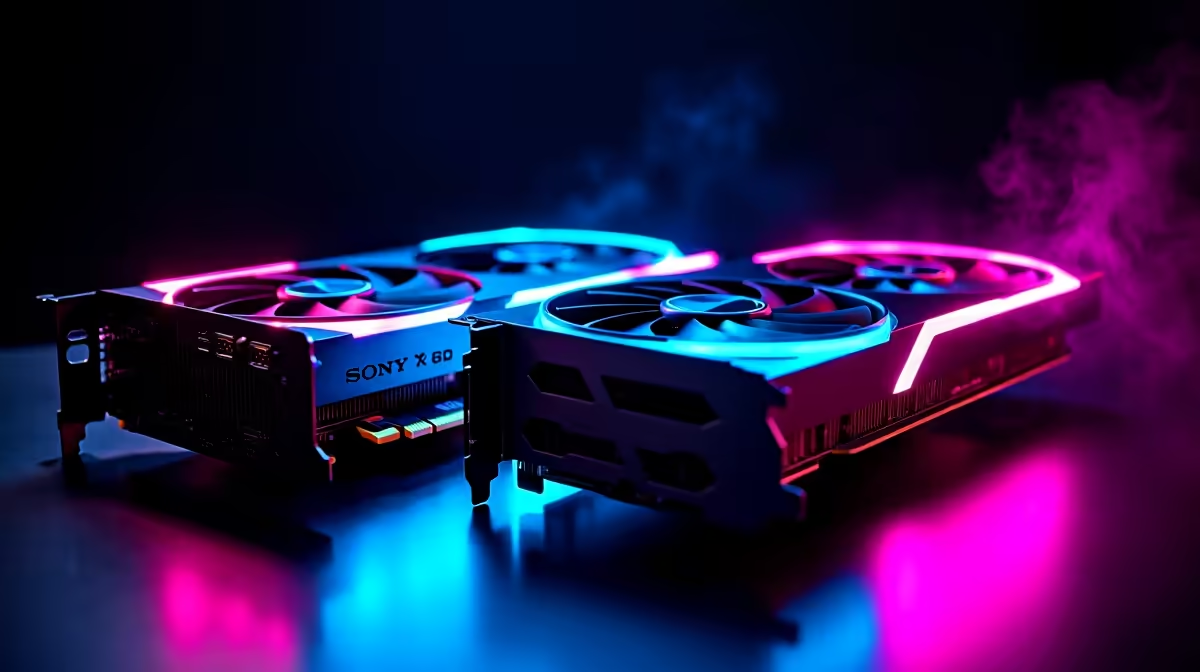
The RX 9070 XT offers superior rasterization performance per rand compared to the older RX 7900 XT in the 2026 South African market, particularly at 1440p. The RX 7900 XT remains competitive at 4K in bandwidth-heavy workloads but commands a higher price point for its older architecture.
Choosing between AMD''s newer RDNA 4 mid-to-high-end card and the previous generation flagship is a genuine dilemma for South African gamers in 2026. The RX 9070 XT launched on the more accessible end of the premium segment while the RX 7900 XT has aged into its current market position after two years of availability. This comparison breaks down performance, value, and platform fit across the scenarios that matter most to local gamers.
Architecture and Specification Differences
The RX 9070 XT is built on RDNA 4, AMD''s fourth-generation ray-tracing and AI-accelerated architecture. It introduces significantly improved ray-tracing hardware compared to RDNA 3, cutting the historical gap with NVIDIA''s RTX lineup. The card ships with 16 GB of GDDR6 on a 256-bit bus, which matches the RX 7900 XT''s memory configuration while operating at lower power - the 9070 XT''s TDP sits roughly 30 to 40 W below the 7900 XT. The RX 7900 XT uses RDNA 3 with 20 GB of GDDR6 across a 320-bit bus, giving it a raw memory bandwidth advantage that benefits specific high-resolution workloads.
1440p Gaming Performance
At 1440p Ultra settings, the RX 9070 XT closes the gap on the RX 7900 XT substantially compared to its positioning on paper. RDNA 4''s improvements to the shader engine and cache hierarchy allow the newer card to match or exceed the 7900 XT in the majority of current-gen titles. In DirectX 12 and Vulkan games that leverage mesh shaders and advanced culling, the 9070 XT''s architectural efficiency shows most clearly. Rasterization-heavy esports titles like Valorant and CS2 at high refresh rates show both cards well above 200 fps at 1440p, making them equally suitable for competitive play.
4K Performance and the Memory Bandwidth Advantage
At 4K, the RX 7900 XT''s 320-bit memory bus and 80 MB Infinity Cache give it a bandwidth edge in open-world titles with large texture streaming demands. Games like Cyberpunk 2077 and Alan Wake 2 at 4K Ultra with RT enabled show the 7900 XT maintaining a 5 to 10 percent lead in select scenarios due to this advantage. However, the RX 9070 XT''s FSR 4 implementation - benefiting from RDNA 4''s dedicated AI accelerators - can close that gap when upscaling is enabled, and the image quality at FSR 4 Quality mode is markedly better than FSR 3 on the 7900 XT.
SA Price-to-Performance and Value Assessment
In the South African market in 2026, the RX 9070 XT retails at approximately R12,000 to R14,000 depending on the AIB partner model. The RX 7900 XT, now in its second year on the market, typically sells in the R14,000 to R17,000 range for new stock. This makes the 9070 XT the superior value proposition at 1440p for most gamers, offering comparable or better performance at a lower price with reduced power draw. The 7900 XT makes more sense only if you specifically need its memory bandwidth advantage at 4K in bandwidth-limited titles and cannot reach the RX 9070 XT or higher-tier RDNA 4 cards.
Frequently Asked Questions
Q: Which card is better for ray tracing in 2026? A: The RX 9070 XT is the better choice for ray tracing. RDNA 4 introduced dedicated hardware ray-tracing accelerators that dramatically improve RT performance compared to RDNA 3, making the 9070 XT competitive with mid-to-high-end NVIDIA cards in RT workloads.
Q: Does the RX 9070 XT support FSR 4? A: Yes. FSR 4 is exclusive to RDNA 4 architecture and is fully supported on the RX 9070 XT. It delivers meaningfully better image quality than FSR 3, which is the version available on the RX 7900 XT.
Q: Will the RX 7900 XT''s 20 GB of VRAM matter in future titles? A: Current titles rarely exceed 16 GB of VRAM even at 4K Ultra, but as texture budgets grow, the 7900 XT''s extra 4 GB could extend its useful life. For most gamers buying today, 16 GB on the 9070 XT is sufficient through 2027 and beyond.
Q: What PSU wattage is recommended for each card? A: The RX 9070 XT fits comfortably in a 750 W PSU build. The RX 7900 XT''s higher TDP is better matched with an 850 W unit, especially if paired with a higher-end CPU.
Ready to Find Your Perfect Match? Compare AMD graphics cards and build your ideal SA gaming PC at Evetech.