Quick Answer
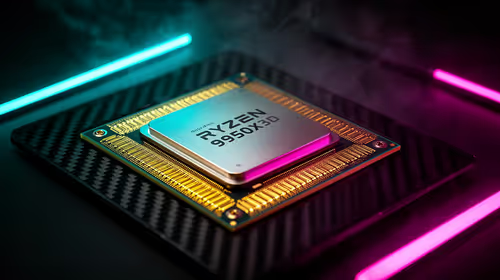
The AMD Ryzen 7 7800X3D and Intel Core i7-14700K are two of the most debated CPUs for gaming and productivity in 2026. The 7800X3D leads in pure gaming frame rates due to its 3D V-Cache technology, while the i7-14700K offers more CPU cores and stronger performance in heavily multi-threaded workloads. Your best choice depends on whether gaming or productivity is your primary use case.
Gaming Benchmarks - Where the 7800X3D Dominates
In head-to-head gaming benchmarks, the Ryzen 7 7800X3D consistently pulls ahead of the i7-14700K. AMD's 3D V-Cache dramatically increases the L3 cache available to the CPU, reducing the latency bottleneck that limits gaming performance. In titles like Call of Duty, Valorant, Counter-Strike 2, and open-world RPGs, the 7800X3D regularly delivers 10 to 20 percent more frames per second at 1080p and 1440p. For SA gamers connecting to local servers on games like Apex Legends or playing with friends on African-hosted titles, that extra headroom translates to noticeably smoother gameplay during peak moments. If gaming is your primary reason for the build, the 7800X3D is difficult to argue against.
Productivity Benchmarks - Where the i7-14700K Fights Back
Switch the workload to productivity tasks and the picture changes. The i7-14700K features 20 cores (8 performance cores and 12 efficiency cores) versus the 7800X3D's 8 cores. In video rendering with DaVinci Resolve or Premiere Pro, 3D modelling in Blender, and compilation tasks, the i7-14700K's extra cores give it a meaningful advantage. Content creators, streamers who also render footage, or professionals doing heavy multitasking will find the i7-14700K's multi-threaded throughput more useful day-to-day. The gap narrows when both CPUs are loaded to their limits, but the Intel chip has genuine headroom the 7800X3D cannot match in thread-heavy scenarios.
Power Consumption and Loadshedding Implications
For South African users on a UPS setup - which is increasingly essential with ongoing loadshedding - power draw matters. The Ryzen 7 7800X3D has a 120W TDP and in practice draws considerably less power under gaming load than the i7-14700K, which can spike above 250W under all-core load. Running a system with an i7-14700K at full productivity load will drain a mid-range UPS battery significantly faster than the 7800X3D. If you are doing late-night renders during stage 4 and relying on battery backup, this is a real operational consideration that SA users face more acutely than most international markets.
Platform Costs and SA Pricing Considerations
Platform choice also affects total build cost in rands. The AM5 platform (for the 7800X3D) uses DDR5 memory, which carries a premium in the SA market, though prices have improved. Intel LGA1700 (for the i7-14700K) supports both DDR4 and DDR5, giving more budget flexibility. However, LGA1700 is a dead-end socket with Intel moving on, while AM5 should support next-generation AMD CPUs, offering longer upgrade longevity - a meaningful factor when components are more expensive in rands than equivalent USD pricing would suggest. Stretching a platform investment further matters in the South African context.
Frequently Asked Questions
Which CPU is better for gaming in 2026, the 7800X3D or i7-14700K? The Ryzen 7 7800X3D is the better gaming CPU in 2026. Its 3D V-Cache technology gives it a consistent 10 to 20 percent frame rate lead in most titles at 1080p and 1440p. For dedicated gaming builds, it is the recommended choice.
Is the i7-14700K better for streaming and content creation? Yes. The i7-14700K's 20-core design gives it superior multi-threaded performance for video rendering, 3D work, and running a game alongside a recording or streaming application simultaneously.
Does the 7800X3D run cooler than the i7-14700K? Generally, yes. The 7800X3D has a lower TDP and draws less power under gaming load. This translates to lower thermal output and better compatibility with standard air cooling, and is an advantage for South African users running off UPS power during loadshedding.
Which platform offers better upgrade longevity in SA? AMD AM5 is the better long-term investment. AMD has confirmed AM5 support through future CPU generations, meaning your motherboard can be reused when upgrading. Intel LGA1700 is reaching end-of-life, limiting future upgrade options.
Ready to Find Your Perfect Match? Shop gaming PC deals at Evetech