Quick Answer
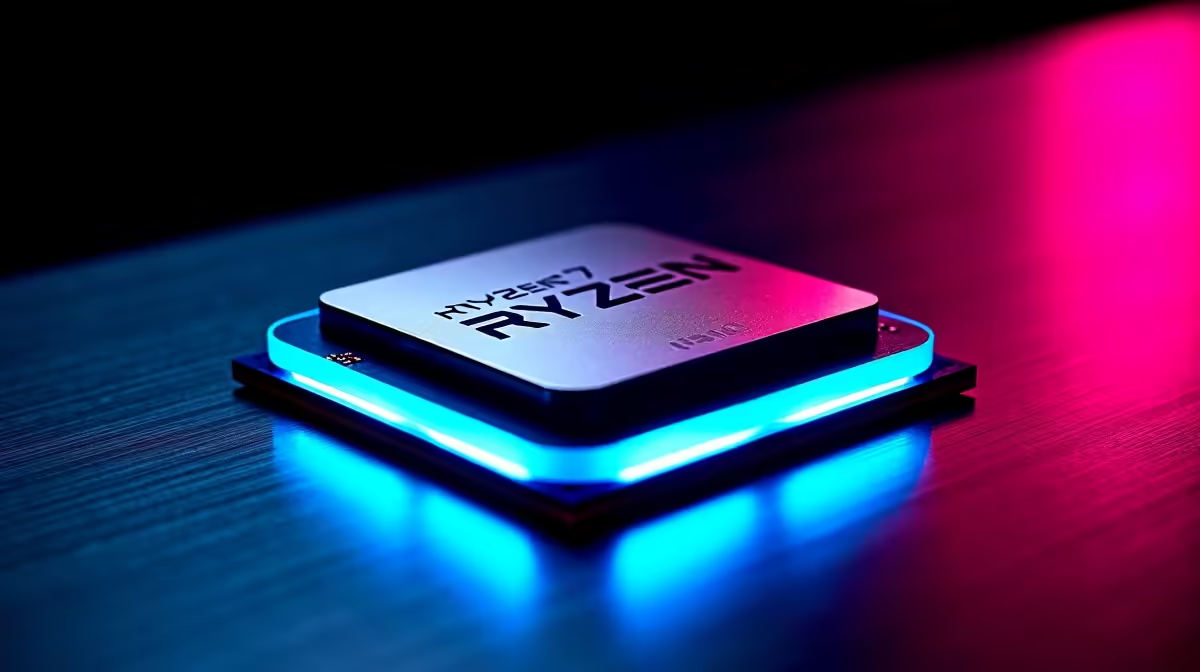
The Ryzen 7 9800X3D delivers outstanding Apex Legends performance thanks to its 3D V-Cache technology, which dramatically reduces CPU bottlenecking in fast-paced battle royale scenarios. Paired with a capable GPU, most players can expect consistently high frame rates well above the 144 Hz threshold on modern high-refresh monitors.
Apex Legends is a frame-rate-sensitive title where the gap between 60 FPS and 144 FPS is the difference between winning and losing a close-range fight. The Ryzen 7 9800X3D has become one of the most talked-about processors for competitive gaming because its 3D V-Cache architecture directly addresses the cache-hungry workloads that battle royale games generate during hectic team fights.
Why 3D V-Cache Matters for Apex Legends
Apex Legends'' engine generates a high volume of draw calls and physics calculations during squad engagements, particularly when multiple squads converge in hot-drop zones. Traditional processors often see their performance limited not by raw clock speed but by how quickly they can fetch the data they need from slower RAM. The 9800X3D''s stacked cache dramatically reduces the frequency of those slower memory accesses, which translates to more stable frame times - exactly what you need when you are sliding around corners at high speed.
The practical result is that the 9800X3D tends to maintain its frame rate more consistently under load than processors without this cache advantage. Instead of dipping during the worst-case moments, it holds its target frame rate more reliably.
Settings and Configuration for Maximum FPS
To get the most out of the 9800X3D in Apex Legends, run the game in full-screen exclusive mode rather than borderless windowed - this gives the GPU and CPU the most direct control over frame pacing. Within the graphics settings, texture streaming budget should match your GPU''s VRAM capacity, and ambient occlusion can be reduced or disabled with minimal visual impact and a measurable performance gain.
Enabling AMD''s EXPO memory profile in BIOS ensures your RAM runs at its rated speed. Running DDR5 at its base JEDEC speed when the processor supports faster profiles leaves performance on the table for no reason.
Pairing the 9800X3D with the Right GPU
The 9800X3D removes the CPU from being the bottleneck, which means your GPU choice becomes the primary frame-rate driver. For 1080p competitive play at very high frame rates, a mid-to-high-tier discrete GPU is the right companion. At 1440p, a higher-tier card keeps frame rates competitive. The key principle is that this processor is capable enough that you should not pair it with a GPU that limits your monitor''s potential - let the CPU''s strengths be realised by a graphics card that can match its throughput.
Frequently Asked Questions
Q: Does the Ryzen 7 9800X3D support DDR4 or DDR5? A: The 9800X3D is an AM5 platform processor and requires DDR5 memory. DDR4 is not compatible with AM5 motherboards.
Q: What motherboard socket does the Ryzen 7 9800X3D use? A: It uses AMD''s AM5 socket, which is compatible with X670, B650, and X870 series motherboards.
Q: Is the 9800X3D worth the premium over non-X3D Ryzen chips for Apex Legends specifically? A: For a competitive Apex Legends setup where maximising frame rate and minimising frame-time variance is the goal, the 3D V-Cache advantage is genuinely meaningful. The gap is most noticeable at 1080p where the GPU is less of a constraint.
Ready to Find Your Perfect Match? Find your next gaming PC build at Evetech - home of AMD Ryzen-powered rigs for SA gamers.