Picture this: you've just dropped some serious ZAR on a shiny new graphics card, ready to crank Apex Legends or Helldivers 2 to max settings. But... the performance is choppy. Your frame rate stutters and dips, especially in chaotic fights. What gives? Chances are, you're facing a classic PC performance problem: a CPU bottleneck. It’s when your processor can't keep up with your powerful GPU, holding your entire system back.
Understanding the Dreaded CPU Bottleneck
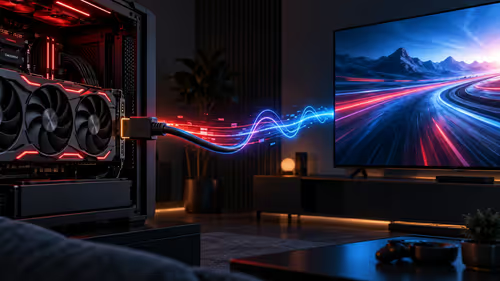
So, what is a CPU bottleneck, exactly? Think of your PC as a production line. Your CPU (Central Processing Unit) is the manager preparing tasks (game frames), and your GPU (Graphics Processing Unit) is the heavy machinery that renders them into the beautiful images you see on screen.
A bottleneck happens when the manager (CPU) can't prepare the tasks fast enough for the machinery (GPU). Your powerful GPU ends up waiting around, doing nothing, which results in lower-than-expected frame rates and frustrating stuttering. This is especially common in games that rely heavily on the processor, like large-scale strategy games or high-refresh-rate competitive shooters where every frame counts. 🚀
How to Spot a CPU Bottleneck in Your Rig
Guessing is not a strategy. You need data to confirm a processor bottleneck. Luckily, it's pretty easy to check. Here’s a simple method using tools already on your Windows PC:
- Fire Up Your Game: Launch the game where you're experiencing performance issues and load into a demanding area.
- Open Task Manager: Press
Ctrl + Shift + Escto open Task Manager. Go to the "Performance" tab. - Analyse the Data: Keep an eye on your CPU and GPU usage percentages. If your CPU usage is consistently high (hovering around 90-100%) while your GPU usage is significantly lower (e.g., 50-70%), you've found your culprit. Your CPU is running flat-out and can't feed your GPU fast enough.
If this test confirms your fears, it might be time to start browsing the wide selection of CPU processors available online to find a better match for your GPU.
Overlooked Performance Boost ⚡
Before you splash out on new hardware, make sure your RAM is running at its advertised speed! Check your motherboard's BIOS UEFI settings for options like XMP (for Intel) or EXPO (for AMD). Enabling the correct profile can give your CPU a surprising performance lift by allowing it to access data from your memory much faster. It's a free performance win!
Fixing a CPU Bottleneck: Your Action Plan
Once you've identified a CPU bottleneck, you have a few options to get things running smoothly again. You can try software tweaks first, but a hardware upgrade is often the only long-term solution. 🔧
Software Tweaks and Settings
Before opening your wallet, try these adjustments inside your game's settings menu:
- Lower CPU-Intensive Settings: Options like "View Distance," "Shadow Quality," "Object Detail," and "Physics Simulations" often hit the CPU hard. Try lowering these first.
- Increase Resolution or Graphical Settings: This sounds counter-intuitive, but hear us out. By increasing the resolution or GPU-heavy settings like "Texture Quality," you force your GPU to work harder. This can help balance the load, leading to a smoother (though potentially lower FPS) experience by making the GPU the limiting factor again.
- Close Background Apps: Make sure unnecessary programs like web browsers, Discord, or streaming software are closed while you game.
The Ultimate Fix: A CPU Upgrade
Sometimes, software tweaks just aren't enough. If you've paired a brand-new, high-end GPU with a processor that's several years old, the performance gap might be too wide to bridge with settings alone. A balanced PC is a happy PC.
Upgrading your CPU is the most effective way to eliminate a severe bottleneck and unlock the full potential of your graphics card. Whether you're looking at the latest AMD CPUs for their multi-core prowess or the raw gaming power of modern Intel CPUs, finding the right processor is key to building a rig that delivers silky-smooth performance for years to come. ✨
Ready to Unleash Your PC's True Power? A CPU bottleneck doesn't have to be the end of your high-FPS dreams. Now that you know how to spot and fix it, the next step is finding the right components for a perfectly balanced rig. Explore our massive range of PC components and build the ultimate gaming machine today.