Quick Answer
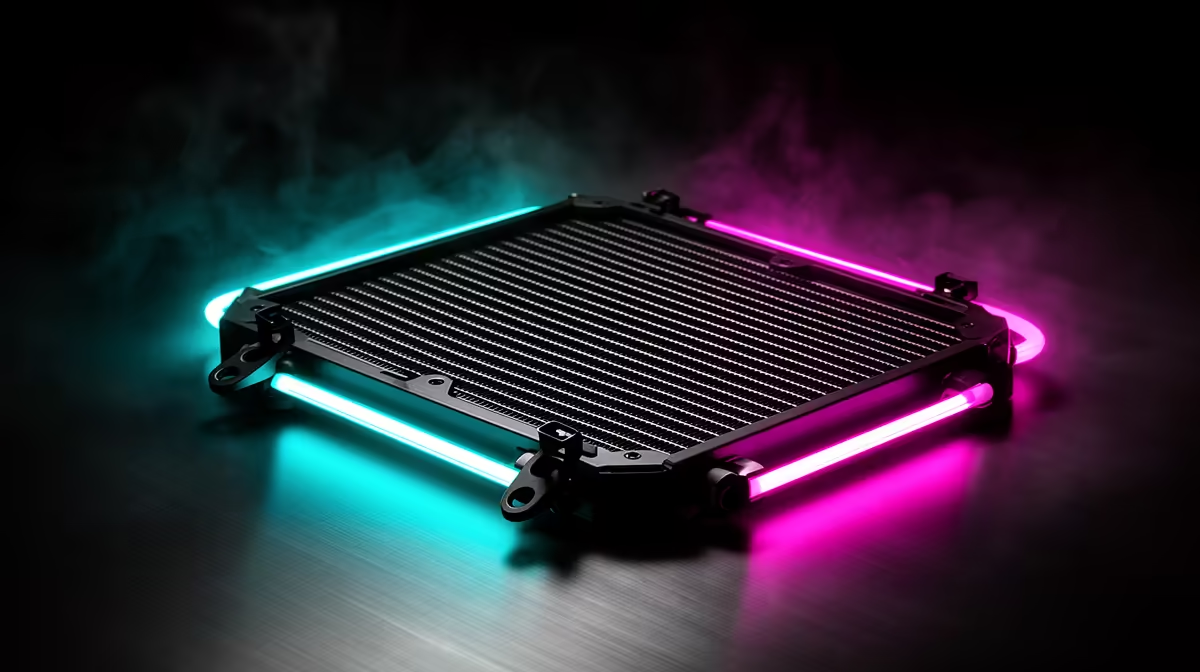
A small PC case that supports a 360 mm radiator will fit a 120 mm x 3 fan array in either the front intake or top exhaust position, and the total internal space required is roughly 394 mm of unobstructed width or length depending on orientation. Not all small cases can fit 360 mm, so always confirm whether the support is front-only, top-only, or both before choosing a cooler.
Why a 360mm Radiator Matters in a Small Case 💧
A 360 mm AIO cooler provides roughly 40 percent more surface area than a 240 mm unit, translating to a Ryzen 9 9950X running at 82 degrees Celsius versus 91 degrees Celsius under sustained Cinebench all-core load at the same 280 W TDP. For content creators in South Africa rendering video or running Blender on a compact workstation, that thermal margin prevents thermal throttling during long render sessions. Cases that list 360 mm front radiator support typically also allow the front fans to pull in fresh, ambient air rather than recirculating pre-heated air off the radiator, which is the optimal thermal configuration.
Front vs Top Mounting: Which Matters More? 🔧
Front mounting is generally superior because the radiator draws in cool ambient air and pushes it across the CPU block, GPU, and toward the rear exhaust in a straight-line path. Top mounting works but means the radiator fans are pulling already-warm case air through the rad, raising coolant temperature by three to eight degrees Celsius. In compact cases where the GPU sits close to the front, a front-mounted 360 mm rad does compete with GPU intake, making the case's mesh density critical. Top 360 mm support is less common in small cases because it requires a top panel at least 120 mm wide with a 394 mm run, which conflicts with compact dimensions.
Thickness Compatibility and Fan Speed Considerations ✨
Not all radiators are the same thickness. Standard radiators are 27 mm thick; high-performance options like the EK Nucleus AIO and Corsair iCUE Elite reach 30 mm to 38 mm. Compact cases designed for 360 mm support may only clear a 27 mm radiator when combined with 25 mm fans. Using a 30 mm radiator with 25 mm fans gives a total stack of 55 mm, which may exceed the front panel clearance. Check the case spec for radiator stack clearance (radiator plus fan), not just the radiator length. A 360 mm AIO suited to a compact build costs R2,800 to R5,500 locally at Evetech, with premium options from be quiet! and NZXT sitting at the upper end.
Front Fan Orientation Changes Everything ⚡
When mounting a 360 mm radiator in the front, orient the fans to pull air in from outside the case and push it through the radiator toward the CPU block. Running the fans as exhaust in front pull means they compete with GPU hot air moving toward the rear, increasing GPU temperatures by up to ten degrees Celsius in some compact layouts. Check the arrow markings on the fan frame to confirm airflow direction before tightening screws.
FAQ
Can a small mATX case fit a 360mm radiator and a high-end GPU simultaneously?
Some can, but it requires careful planning. A front 360 mm radiator in an mATX case typically leaves 280 mm to 340 mm of GPU clearance behind it, so confirm that both dimensions are compatible before choosing parts.
Is a 360mm AIO overkill for a Ryzen 7 9700X in a compact build?
It is generous, but not wasteful. A 360 mm AIO will keep a Ryzen 7 9700X at 60 to 68 degrees Celsius under full gaming load versus 70 to 78 degrees Celsius on a 240 mm unit, and the lower fan speeds mean a noticeably quieter build.
What is the cheapest small case in South Africa that supports a 360mm radiator?
Small cases with 360 mm support typically start around R1,200 to R1,500 locally. Below that price point, most compact cases cap at 240 mm. Evetech's case filter allows you to sort by radiator support size to narrow options quickly.
Looking for a compact case that fits a 360mm AIO?
Evetech stocks a curated range of small gaming and creator cases with verified 360mm radiator support, available online with delivery across South Africa.