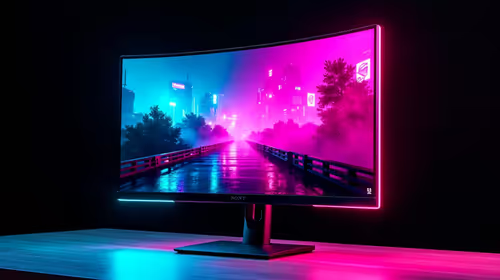
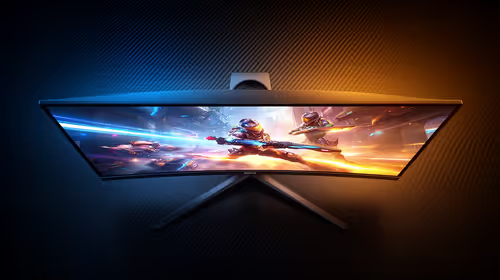
Resolution changes both detail and the size of the usable desktop once scaling is applied. A 3K versus 2K portable monitor comparison therefore needs the same panel size, applications and viewing distance. The 16-inch UPERFECT UColor O2 costs R7,199 and renders 2880x1800.
Quick Answer
The UColor O2's 2880x1800 3K panel provides more pixels and vertical 16:10 workspace than a 2K alternative, benefiting fine creative detail and dense laptop layouts.
Choose 3K when the UColor O2's 2880x1800 grid produces useful detail or workspace at a readable scale. A 2K candidate may suit another user, but its practical result depends on exact resolution, size and scaling. At R7,199, this OLED monitor also offers 120Hz; neither resolution label alone predicts application comfort or laptop performance.
🧭 Calculate workspace after scaling
Open the main application, reference panel and document used together. Adjust operating-system scaling until menus and small text remain comfortable on the 16-inch screen. Note how many panes fit without overlapping.
Repeat on the 2K candidate at its preferred scale. Comparing both at an arbitrary percentage can reward unreadable density rather than useful space.
Browse Evetech portable monitors to build the comparison around actual screen sizes and resolutions.
🧭 Inspect detail with native files
Use a photograph, fine spreadsheet and high-resolution interface. View each at a repeatable zoom and look for text edges, image detail and scaling artefacts. Avoid enlarging one source differently just to make the screens appear equal.
The UColor O2's OLED technology and 10-bit colour answer other display questions. They do not prove that 3K is more colour accurate than 2K.
🧭 Include the host workload
A higher-resolution desktop asks the computer and connection to move more image data. Test the intended application at 2880x1800 and then add 120Hz. Record stability and responsiveness without assuming a universal result from another laptop.
If the USB-C route becomes unreliable, return to a direct cable baseline. Exact host and lead capabilities remain part of the result.
🧭 Decide through repeated windows
Track whether the extra visible panes reduce tab switching or whether larger controls matter more. A portable monitor earns value through the work it keeps visible, not through pixel count that scaling immediately gives back.
Use the Evetech PC-monitor category as a fixed-screen reference when desk space allows a larger format.
Build a density comfort test
Use the chosen scale for an uninterrupted reading or editing session. Record how often the user leans forward, enlarges text or loses the pointer among dense controls. Then increase scaling one step and repeat the same task. The better state balances workspace with comfort instead of maximising visible pixels.
Include a restart and application reopen. A layout that returns differently each time creates hidden setup work that should reduce the 3K score.
Compare exported detail, not just the interface
Open a high-resolution source, inspect it at a fixed zoom and export through the normal application. Compare the result with the known output rather than assuming a sharper screen changes the file itself. Resolution improves what can be viewed; it does not add detail to low-resolution material.
This distinction matters when 3K is being purchased for image or video review. The source and application must preserve the information the panel is capable of showing.
Check the workspace after disconnection
Close the application while it sits on the portable screen, unplug the monitor and reopen the file on the laptop. Reconnect and restore the window arrangement. A 3K workspace adds more value when the operating system handles that transition without losing tools or placing dialogue boxes off-screen.
Save the preferred scale and layout with the test notes. Recovery behaviour belongs in the resolution decision because portable monitors move between one-screen and two-screen states repeatedly.
At 16 inches, that resolution supports crisp text, intricate photos and high-resolution media without requiring a fixed desktop screen. The added pixel load also asks more from a gaming source at 120Hz. A 2K monitor may be easier to drive and still look sharp, so the right choice depends on whether visual detail, workspace density or frame-rate headroom carries the greater practical value.
Frequently Asked Questions
Is 3K always sharper than 2K?
It contains more pixels at a comparable size, but viewing distance, scaling and application rendering shape the visible difference.
Does 2880x1800 guarantee more usable space?
No. Scaling may enlarge controls and text. Compare the actual application layout at a readable setting.
Can a laptop run 3K at 120Hz over any USB-C port?
Do not assume that. Test the exact host, port and cable with the required resolution and refresh combination.
Does higher resolution improve colour accuracy?
No. Pixel count, gamut, calibration and colour error are separate properties.
Ready to choose resolution through visible workspace?
Compare Evetech portable and fixed monitors with your applications, scaling and viewing distance held constant.