


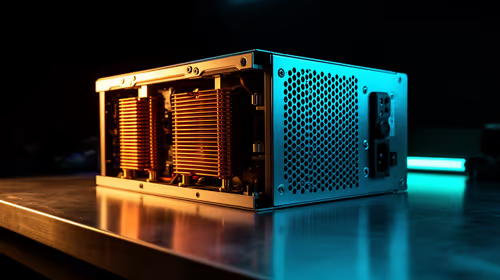
1000W PSU Planning for RTX 5090 Builds in SA
1000W for RTX 5090 needs a full-build check, not a simple yes. Review GPU guidance, CPU draw, transient load, connectors, PSU quality, and upgrade plans before deciding.
Read more8D lumbar support offers adjustment, while fixed lumbar support keeps one shape and position. The R9,599 HBADA E3 Ultra uses 8D adjustable lumbar support within its ergonomic feature set.
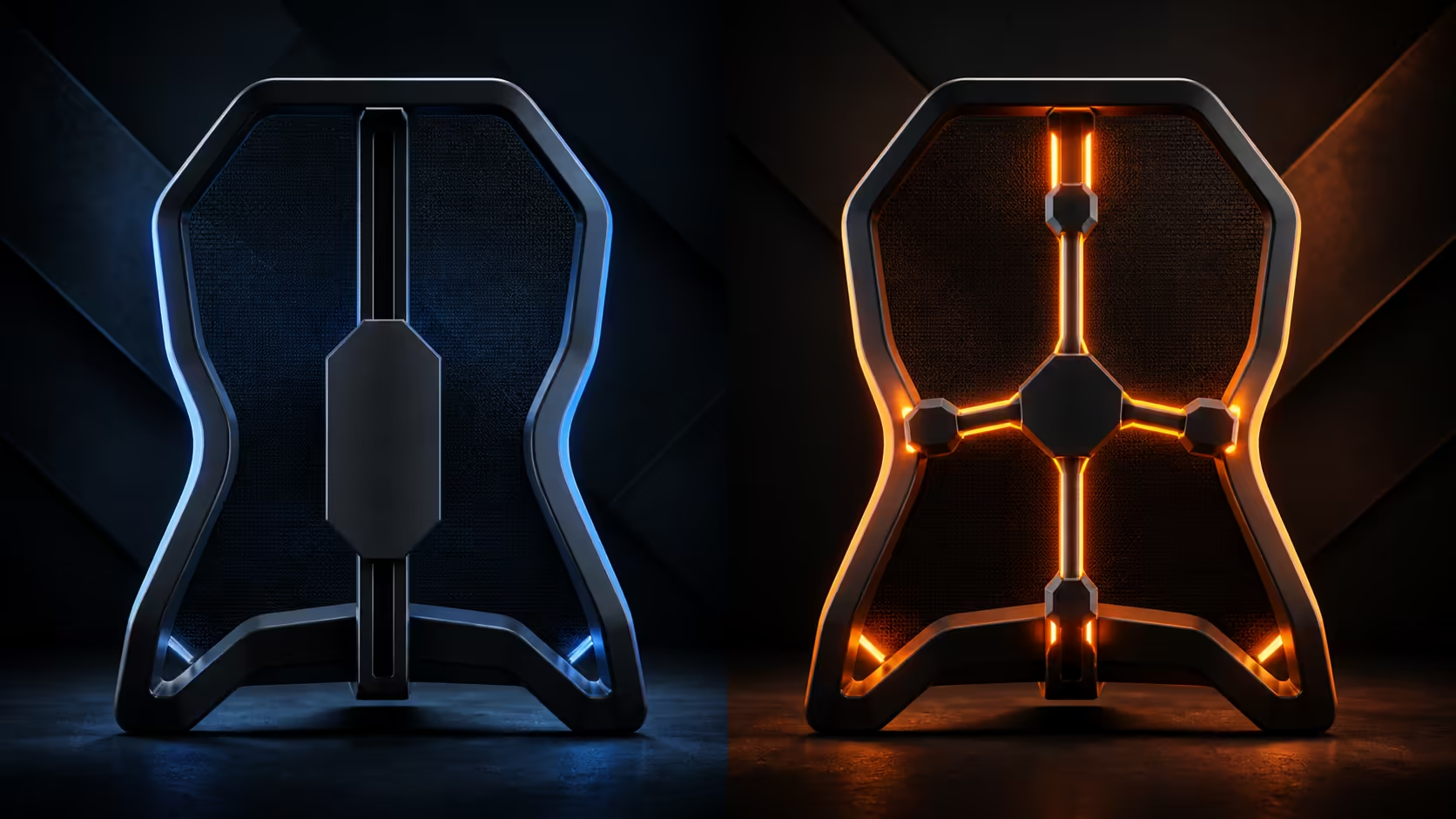
The practical difference in 8D versus fixed lumbar support is whether the user can tune the contact or must accept one built-in position. More adjustment is useful only when it helps a real person find a stable working posture.
The E3 Ultra's adjustable lumbar system adds 40-degree floating wings, one-inch depth change, 1.6-inch height movement and dynamic tilt that fixed support cannot provide.
Fixed lumbar support can suit a user whose body and task align with its preset shape, while adjustable support offers more room to refine the fit. Test both during actual desk work. The HBADA E3 Ultra, priced at R9,599, brings an 8D adjustable lumbar system to this comparison.
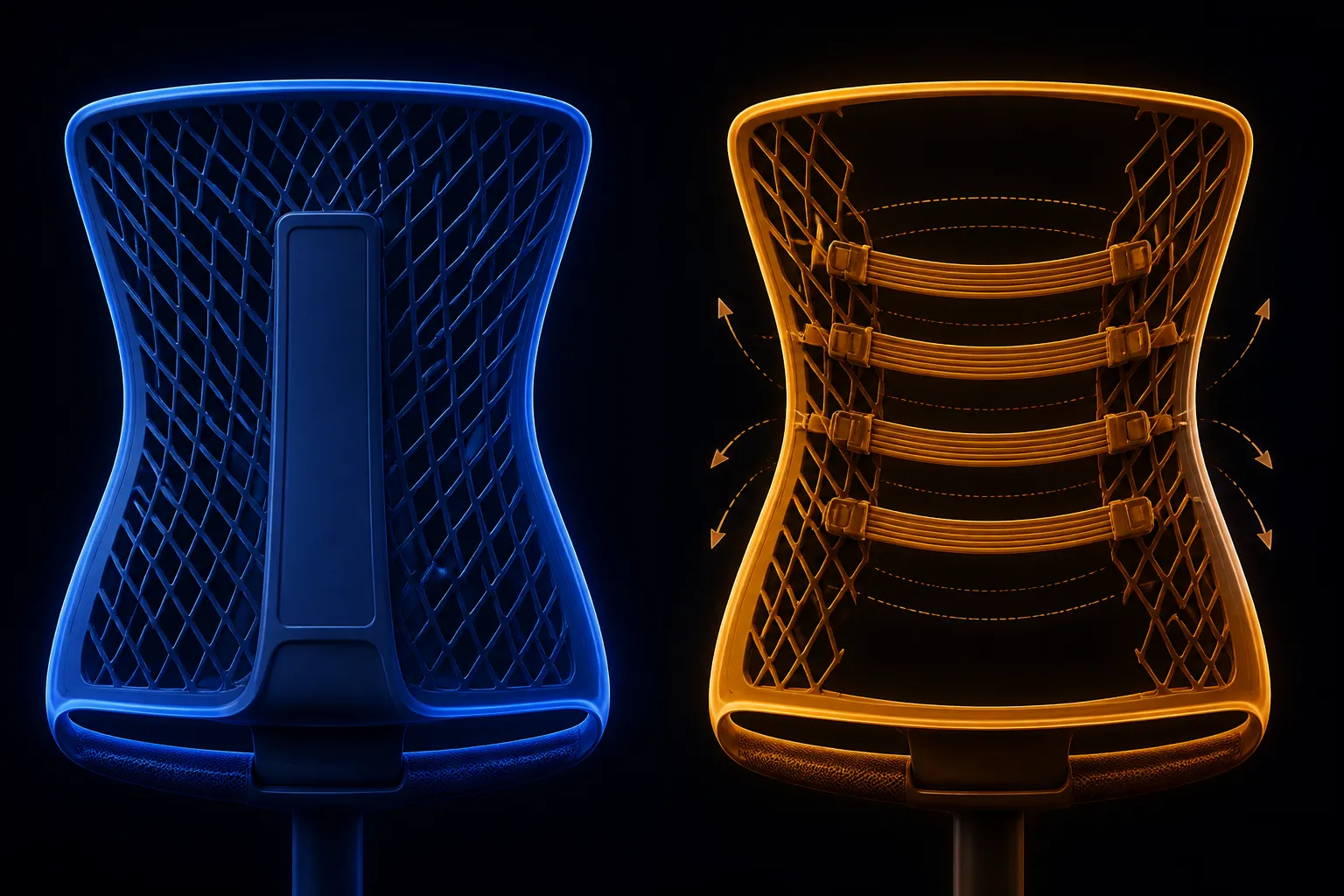
A fixed contour keeps the same relationship to the backrest. It can be simple, consistent and sufficient when its contact lands in the right place. If it misses the user's preferred position, however, the surrounding chair and desk must do more of the adaptation.
Judge it while sitting normally, not by pressing a hand against the shape. The relevant question is whether you can remain supported without sliding, arching or leaning away.
An adjustable design gives the user variables to explore, but a higher-dimensional label does not guarantee a better result. Each movement must reach a sensible position and be understandable enough to repeat.
The E3 Ultra has 8D lumbar adjustment. Compare that capability with alternatives in Evetech's HBADA office seating range, giving credit for control you can actually use rather than for a larger label alone.
Place each chair at the same desk, use the same screen height and perform the same tasks. Observe whether the lower back keeps comfortable contact through typing, reading and reaching. Change only one adjustable setting between trials.
Allow enough time for the first impression to settle. A bold contour may feel supportive immediately yet prove distracting later; a subtler shape may make more sense through an ordinary session.
Lumbar fit does not operate alone. Seat position, backrest angle, arm support and the desk can alter the pelvis and torso. The E3 Ultra also reclines to 140 degrees, so its lumbar feel should be revisited when the backrest angle changes.
Browse Evetech's office chair department with a simple scorecard for contact location, control clarity and repeatability. Neither fixed nor adjustable support promises a medical outcome; the better option is the one that fits the user and task.
Shared use can change the trade-off. Fixed support asks everyone to accept the same contour, whereas adjustment may let each person restore a personal reference. The added control is worthwhile only if transitions are manageable and users do not rely on guesswork each time the chair changes hands.
Price the result rather than the mechanism count. At R9,599, the E3 Ultra needs to meet seat, capacity and desk requirements as well as the lumbar trial. A lower-priced fixed design may still be the rational choice when it fits consistently and removes controls nobody needs.
Include control access in the tie-breaker. An adjustable system that reaches a suitable contact but is difficult for the intended user to operate can offer less daily value than its range suggests.
Fixed support may suit one body without adjustment, but the E3 Ultra can refine contact for task and posture changes. Compare both through the same work session, paying attention to broad contact and unwanted pressure rather than counting directions as automatic comfort.
Fixed support retains one built-in contour, whereas adjustable support lets the user alter aspects of the contact. Usability matters more than the label size.
A person who already fits the preset contour and values simplicity may need no extra control. That decision should follow a realistic desk trial.
Its lower-back system is adjustable and carries an 8D designation. Detailed control operation should be learned from the chair before changes are made.
No. Extra range helps only when it reaches the user's preferred contact and remains easy to understand, set and restore.
Keep the desk, task and sitting time consistent. Compare where support lands, whether posture remains natural and how easily a useful position is maintained.
Neither type can guarantee treatment or prevention. Ongoing pain or neurological symptoms require appropriate professional care rather than a chair-category decision.
Ready to compare lumbar designs through the same work routine? Explore Evetech's chair categories with a repeatable test for contact, control and fit instead of choosing by adjustment count alone.
Fixed support retains one built-in contour, whereas adjustable support lets the user alter aspects of the contact. Usability matters more than the label size.
A person who already fits the preset contour and values simplicity may need no extra control. That decision should follow a realistic desk trial.
Its lower-back system is adjustable and carries an 8D designation. Detailed control operation should be learned from the chair before changes are made.
No. Extra range helps only when it reaches the user's preferred contact and remains easy to understand, set and restore.
Keep the desk, task and sitting time consistent. Compare where support lands, whether posture remains natural and how easily a useful position is maintained.
Neither type can guarantee treatment or prevention. Ongoing pain or neurological symptoms require appropriate professional care rather than a chair-category decision.
1000W for RTX 5090 needs a full-build check, not a simple yes. Review GPU guidance, CPU draw, transient load, connectors, PSU quality, and upgrade plans before deciding.
Read more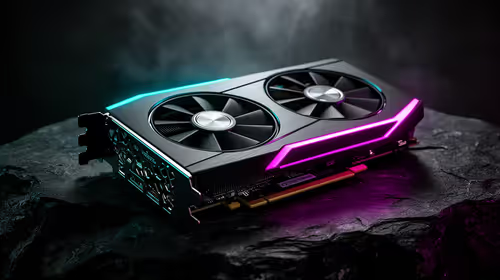
RTX 5080 Super with a 750W PSU is more comfortable than lower wattage if the unit is quality. SA builders should still confirm GPU guidance, CPU draw, connector type, airflow, and upgrade room.
Read more
How to fix FPS drops after a RX 9070 XT starts with driver cleanup, chipset updates, thermals, and power checks. For SA gaming PCs, confirm PCIe seating, monitor refresh, frame caps, and per-game graphics settings before replacing parts.
Read more
How to fix low FPS Windows 11 Wi-Fi 7 issues starts by checking whether the problem is frame rate or network lag. Test ping, drivers, power settings, Ethernet, and game FPS before adjusting visuals.
Read more
AM5 is smart for SA builders because it supports newer Ryzen CPUs, DDR5 memory, and a longer upgrade path. Compare board cost, cooling, gaming needs, and local part availability before choosing your next PC platform.
Read more
AM5 gives Randburg gaming builders a longer upgrade path. For SA buyers, DDR5 support, newer board features, and future CPU options can justify the platform. Weigh board cost, cooler support, BIOS maturity, and upgrade timing before choosing.
Read more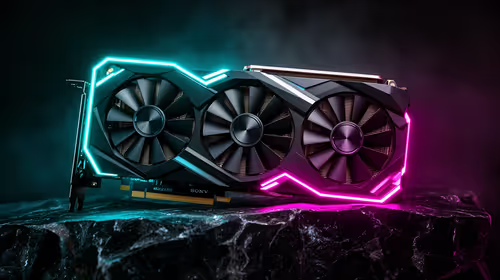
RTX 5090 on a 550W PSU leaves almost no practical room for OC plans. Treat the setup as constrained, with CPU draw, power spikes, cable quality, thermals, and stability checks more important than chasing extra clocks.

FPS drops on a Ryzen 9 9950X3D build often have a fixable cause. Check settings, drivers, thermals, background tasks, network conditions, and bottlenecks before assuming a part must be replaced.

The difference between PCIe 5.0 and PCIe 4.0 for SA gamers is mostly bandwidth headroom. Compare GPU slot needs, NVMe speed, motherboard support, and upgrade timing before paying extra for a newer platform.

Gaming PC stuck pixel checks in South Africa should confirm the monitor fault first. Use colour tests, screenshot comparison, cable swaps, display menu checks, and clear photos before deciding on support.

AMD's current driver now lists a Radeon RX 9050 4GB, while product coverage details a narrowed memory system. SA buyers should weigh the low VRAM ceiling against current local Radeon options.

Samsung Display has demonstrated a 16-inch 2.5K OLED laptop panel running at 300Hz. SA buyers should wait for a named notebook, full panel specifications and a local price before planning an upgrade.

Microsoft says some Windows 11 game crashes after recent updates are linked to RGB-related drivers. Affected SA gamers should confirm the update and driver before using the published registry workaround.
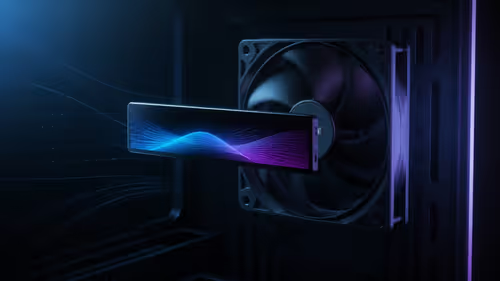
Thermalright's Fan Frame Vision-1 adds a 640x172 status screen to a standard 120mm fan. SA builders should check clearance, USB routing and local support before treating it as an easy upgrade.
1000W for RTX 5090 needs a full-build check, not a simple yes. Review GPU guidance, CPU draw, transient load, connectors, PSU quality, and upgrade plans before deciding.

Wi-Fi 6E vs Wi-Fi 6 matters for 4K video editing when files move across a network. The real-world difference between Wi-Fi 6E and Wi-Fi 6 for video editing in 4K depends on NAS access, cloud uploads, router range, and SA creator workflows.
RTX 5080 Super with a 750W PSU is more comfortable than lower wattage if the unit is quality. SA builders should still confirm GPU guidance, CPU draw, connector type, airflow, and upgrade room.
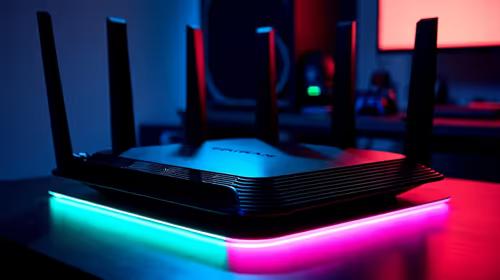
Wi-Fi 6E vs Wi-Fi 6 for Video Editing in 4K comes down to router support, latency, client devices, band support, and home network layout. SA buyers should match the choice to their setup instead of assuming one option always wins.