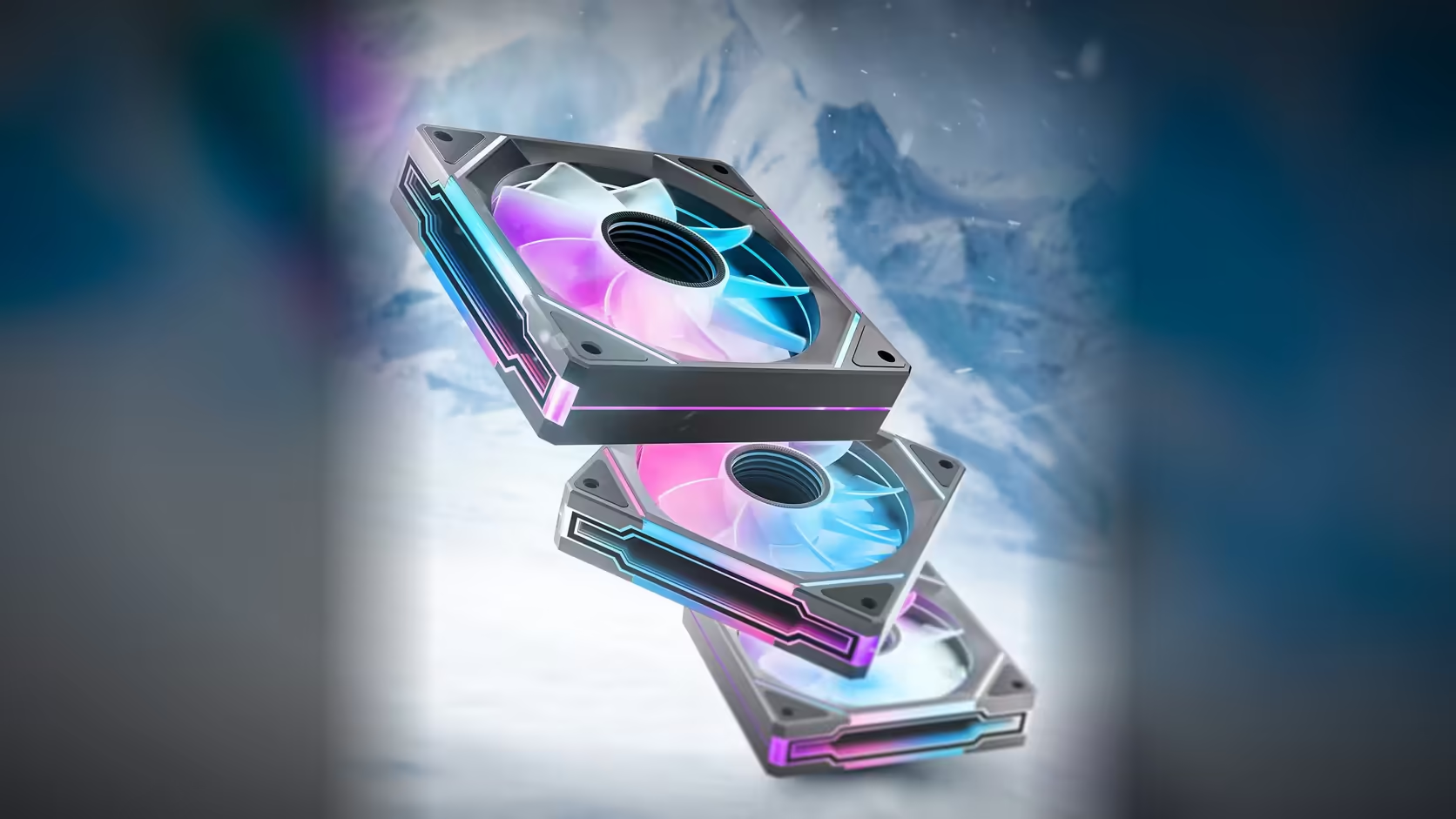
Two cables leave every Amici 5GT fan, and they behave in completely different ways once more than one fan enters the picture. Understanding that split before mounting anything saves a repeat trip through the cable routing.
Quick Answer
Each AsiaHorse Amici 5GT carries its own 4-pin PWM cable for speed control, and that cable does not chain to neighbouring fans. The 5V 3-pin ARGB lead is different: it is built to link across three to four fans, letting one lighting connection cover a small row while each fan still needs its own path to a fan header.
Two systems, two behaviours
It is easy to assume that if the lighting chains, the speed control does too. On the Amici 5GT it does not. The ARGB lead is designed to pass a signal from one fan to the next, so three or four fans can share a single connection back to an addressable header. The PWM lead carries no such design; it runs from each fan straight to a header or a splitter, independently of what any other fan in the row is doing.
What that means for header planning
A row of three fans linked for lighting still needs up to three separate PWM connections, or fewer with a splitter, because the header count for speed is not reduced by chaining the lights. Planning a build around "the lighting only needs one connection" without separately counting the PWM side will leave a build short of headers it did not know it needed.
Why the split exists
Lighting passes a signal along a chain in a way that a fan header's speed and monitoring signal generally does not, at least not on this product. Each fan's PWM connection also lets a board report and control that specific fan's speed, which is harder to do transparently across a chained connection the way lighting data can be. The trade is more individual cables in exchange for fans that remain independent units rather than a fixed, joined assembly.
Practical routing for a small row
For three linked fans, expect one ARGB cable running from fan to fan and then to the board's addressable header, plus three separate PWM cables converging on however many fan headers or splitters the build has available. That is the shape of the cabling regardless of whether the three fans came from a three-pack or were bought as three separate singles, since the cables themselves do not know how they were purchased.
Frequently Asked Questions
Which cable actually links between fans?
The 5V 3-pin ARGB lead, described as linkable across three to four fans in a single chain.
Does the PWM cable ever chain between fans?
No. Every fan keeps its own 4-pin PWM cable, so speed connections are always one cable per fan rather than a shared run.
How many headers does a three-fan row need in total?
One addressable header for the lighting chain, plus up to three fan headers for speed, or fewer if a splitter combines some of them.
Does a splitter change how speed is reported?
Boards typically report a single reading from a splitter, so an individual fan slowing or stopping within that group may not show clearly in monitoring software.
Is this split unique to a three-pack, or does it apply to singles too?
It applies regardless of how the fans were purchased. Cabling behaviour is a property of the fan, not of whether it came from a pack or a single order.
Where can I see current Amici 5GT listings and cabling accessories?
Evetech lists the range under case fans, and splitters or extension leads fall under case accessories.
Does the lighting chain limit ever extend past four fans?
The product description specifies three to four fans for the ARGB chain, so a larger build needs a second addressable header and a second chain rather than one longer run.
Mapping out the cabling for your next fan row?
Check Evetech's case fans and case accessories ranges before you start routing.