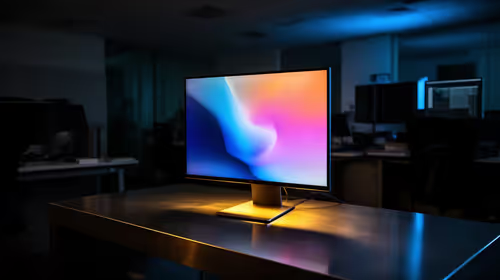
The ASUS Zenbook 14 OLED earns attention because an OLED panel changes how dark scenes, contrast and colour appear, not because the label alone guarantees a better laptop. A striking screen can be meaningful for the right work, yet the decision still has to account for reflections, brightness, software needs and the support available if a specialised panel develops a fault.
Quick Answer
An ASUS Zenbook 14 OLED makes sense when deep blacks, strong contrast and rich colour support the way you watch, create or work. OLED pixels emit their own light, allowing dark parts of an image to stay genuinely dark without a separate backlight. In a bright South African room, however, panel reflections and usable brightness deserve as much attention as the contrast specification.
\ud83c\udfa8 Understand what OLED changes
An OLED display controls light at the pixel level. That can make night scenes, shadow detail and high-contrast images feel more convincing than on a conventional backlit panel. It can also make a dark interface look particularly clean in a dim room. The benefit is visual, not a guarantee that every task will become faster or that every panel has identical colour behaviour.
Consider the content you spend the most time viewing. Someone working with photography, video or visual design may value the panel differently from a person who mostly reads documents and spreadsheets. The processor, memory, keyboard and storage still need to suit the workload. A premium display cannot compensate for an unsuitable overall configuration.
\ud83d\udcf6 Test the room, not just the showroom image
Strong contrast does not cancel sunlight. A glossy display may reflect a window, overhead light or a bright shirt, and that reflection can be more distracting than a specification sheet suggests. Think about the desk position at home, lecture venue or office. Shifting the screen out of direct light can matter more than a small adjustment in brightness.
Panel brightness, screen finish and your usual environment should be judged together. A dark film scene may look superb indoors, while a bright document near a sunny window asks a different question. This is why a comparison should include the places where the laptop will actually be used, rather than relying solely on an OLED badge.
\ud83d\udee1\ufe0f Use panel-care features deliberately
Static elements such as toolbars, game interfaces and desktop icons can remain on screen for long periods. OLED panels have care features intended to manage that risk, but they work best alongside ordinary habits: let the display sleep when you leave it, vary content where possible and avoid keeping a very bright static image on screen for hours without reason.
Power use can vary with the image. A mostly dark video and a bright page do not illuminate an OLED panel in the same way, so blanket battery claims are rarely useful. Use the screen settings that make your work comfortable, then build charging expectations around the workload rather than around a single advertised figure.
\ud83e\udde9 Fit the laptop into the wider desk
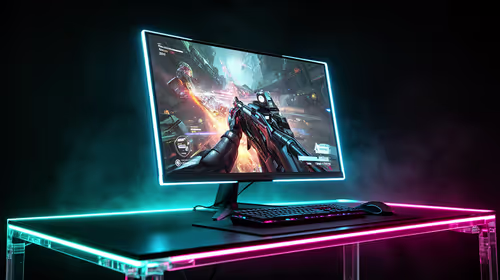
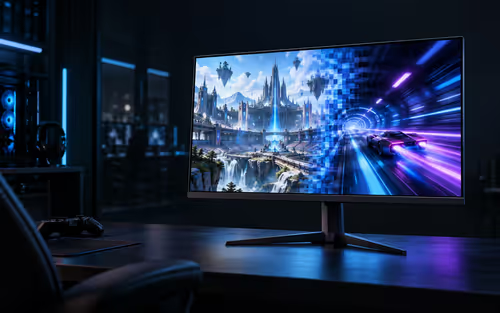
An OLED laptop is not the only route to a better visual workspace. If the machine spends most of its time at a desk, an external OLED monitor can be worth considering alongside the notebook's portability. Check resolution, connection type and desk space before assuming a second display will be convenient.
For the laptop itself, compare exact configurations through ASUS laptop specials. Focus on the complete combination of screen, memory, storage and ports. That keeps the display upgrade connected to what the computer must do after the first week.
Frequently Asked Questions
What does OLED improve on a Zenbook 14?
Each pixel can produce its own light, which allows deep blacks and strong contrast without a separate backlight.
Is an OLED laptop automatically easier to see in daylight?
No. Contrast helps, but reflections and the exact brightness of the panel still influence visibility beside a sunny window.
Does OLED always save battery power?
Power use changes with the image and screen settings. Bright pages can behave differently from dark video or a dark interface.
What is image retention on an OLED display?
Long-lived static elements can leave temporary or lasting traces. Built-in care features and varied content are sensible precautions.
Why does local warranty support matter for an OLED laptop?
Panel repair is specialised and potentially expensive, so it is useful to establish a locally honoured support route before buying.
Ready to decide whether OLED fits your everyday workspace?
Compare ASUS laptop and display options around your lighting, creative work and desk connections.