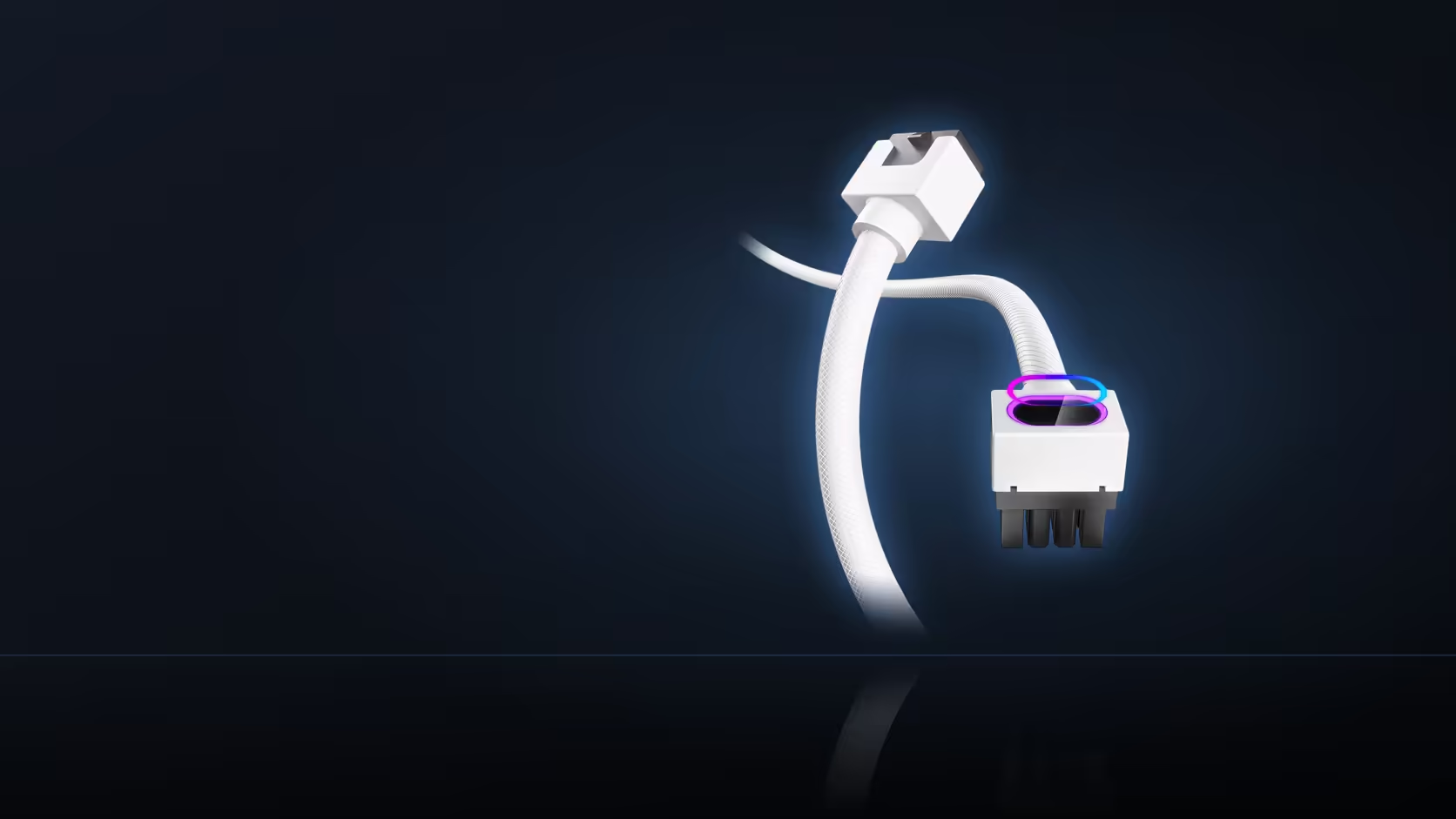
Forty thousand bend cycles sounds like a robust, reassuring number right up until you realise it answers a completely different question from the one that actually decides whether a Hydrus head physically fits your particular board in the first place.
Quick Answer
The jacket being rated for over 40,000 bends describes how the cable holds up, not whether the head clears your board. They are separate questions. On the side-exit versions AsiaHorse flags compatibility as limited, and no durability figure changes that.
🔄 What the bend figure actually describes
That 40,000-plus rating speaks specifically to how many flex cycles the jacket material is rated to survive over its working life - a statement about long-term durability and aging under repeated bending, not a statement about whether the connector's physical shape will clear whatever components happen to sit near your specific socket.
⚖️ Why the two questions have to stay genuinely separate
A cable rated for exceptional durability that simply cannot physically seat due to a clearance conflict is still entirely unusable in that build, regardless of how impressive its bend rating happens to be - fit has to be confirmed as its own independent question, verified on its own terms, rather than assumed to be covered somehow by an unrelated durability specification quoted elsewhere in the listing.
⚠️ Which specific products actually carry the fit warning
The side-exit versions are where AsiaHorse explicitly notes that board compatibility is limited, directly asking buyers to check clearance around their own 24-pin socket before committing to a purchase - this is a fit-specific caveat, and it exists entirely separately from anything the bend-cycle rating claims about the cable's durability.
⬇️ Why the straight-down version escapes this particular warning
The straight-down version does not carry the same compatibility note, and for good reason: its head drops toward the tray rather than cutting sideways across the board, so it never competes for the same contested space a turning head does - the geometry itself is simply less prone to running into neighbouring components in the first place.
🔧 When a high bend rating genuinely does matter, and the right order to check things
A high bend-cycle rating becomes genuinely relevant specifically for a cable that will be physically moved or re-routed during future work - a board swap, a case change, any rebuild that involves handling the cable repeatedly - since repeated routing and re-flexing is precisely the kind of real-world stress that a flex rating is designed to describe and predict. It is also worth knowing the rating itself does not vary meaningfully between different Hydrus variants - the same 40,000-plus figure appears consistently across the family's descriptions, meaning jacket durability is a shared specification across the whole range rather than something specific to any one particular variant. Given all of this, the sensible order to check things before ordering is: clearance first, since that determines whether the piece can even be used at all in your build; then the direction the head exits, since that determines which specific variant you actually need to order; and only after both of those are settled does it make sense to look at specification details like bend rating, which describe how the cable performs once it is already confirmed to fit. cable solutions carries the wider range this durability spec applies across, and other accents worth checking in that same clearance-first order sit at NZXT case lighting.
Frequently Asked Questions
What does the bend figure describe?
How many flex cycles the jacket is rated to survive, which speaks to how the cable ages rather than to how it fits.
Why keep the two apart?
Because a durable cable that cannot seat is still unusable, so fit has to be confirmed independently of any durability claim.
Which product carries the fit warning?
The side-exit versions, where AsiaHorse notes board compatibility is limited and asks you to check clearance around the 24-pin socket.
Does the straight version carry the same note?
It does not, because it drops straight down away from the board instead of cutting sideways across it, leaving it needing far less room.
Is a high bend rating useful at all?
It matters for a cable that will be moved during future work, since repeated routing is exactly what a flex rating addresses.
Does the rating vary between versions?
The figure appears across the Hydrus descriptions, so the jacket specification is shared rather than specific to one variant.
What should be checked before buying?
Clearance first, then the direction the head exits, and only then the specification details that describe how the cable is built.
Separating durability claims from fit questions?
Have a look at Evetech's power supply range and check clearance before reading any bend-cycle specification.