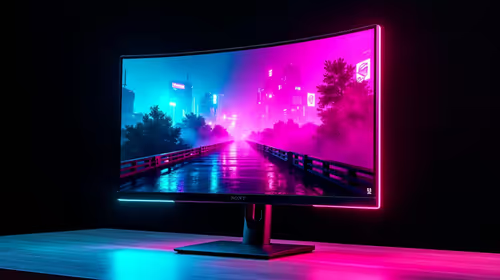
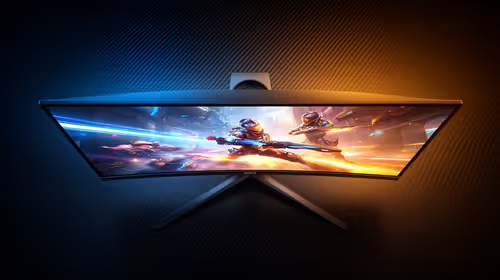
South African competitive players need a monitor that spends the budget on repeatable speed rather than decorative extras. Best 280Hz monitor features for competitive gamers include native resolution, clean pixel response, adaptive sync, practical ergonomics and a price that leaves the PC balanced. The Alienware AW2726DL brings those priorities together at R4,499 with a 27-inch QHD IPS panel.
Quick Answer
Prioritise stable 280Hz operation, clean response tuning, FreeSync Premium and a stand that holds the screen at a natural eye line. QHD sharpness and IPS colour make the same monitor useful beyond esports. At R4,499, the AW2726DL adds 1ms GTG, HDR10, 93% DCI-P3 and four-way stand adjustment without reducing the purchase to one speed number.
⚡ Demand usable speed
A 280Hz refresh interval is about 3.57ms, but the PC must produce frames evenly for that cadence to matter. Test performance in crowded rounds, not an empty map. A sustainable cap with tidy frame times often feels more controlled than a higher average interrupted by spikes.
Pixel response must keep pace. The AW2726DL specifies 1ms GTG, yet overdrive should still be checked for soft trails and bright inverse ghosts. Use the same pan at multiple frame rates because adaptive-sync play does not stay at one fixed value.
Compare speed-focused displays in the gaming monitor catalogue, taking resolution and real response behaviour into account.
🔄 Keep variable frames coherent
FreeSync Premium coordinates refresh with frame delivery, reducing tearing as performance moves. Enable it in both the monitor and compatible graphics software, then choose a cap that remains inside a stable range for the title.
Adaptive sync does not fix shader compilation or CPU stalls. Watch a frame-time graph when movement jumps. If reducing graphics effects helps sharply, the GPU was under pressure; if nothing changes, investigate the processor, background tasks or game engine.
Network latency belongs to another layer. A monitor can show a locally rendered frame quickly, yet it cannot shorten the route to a game server. Separate visual smoothness, input response and network delay when diagnosing a poor round. Otherwise an internet symptom can provoke needless display changes.
The PC monitor deals page helps decide whether more money belongs in the display or the system that feeds it. A balanced machine uses more of the panel every match.
🎯 Keep clarity and comfort in the shortlist
At 27 inches, 2560x1440 provides finer target edges and more desktop space than Full HD, though it increases GPU load. IPS supports consistent viewing across small head movements, and 93% DCI-P3 with HDR10 broadens use for richer content outside competition.
Ergonomics protects concentration. The AW2726DL's height, tilt, swivel and pivot stand lets you align the panel without twisting the neck. Cable slack should support the movement, and room lighting should avoid reflections across dark game areas.
Visibility settings should preserve information rather than bleach the picture. Raise shadow detail only until darker objects remain readable, keep sharpness restrained and check that team colours stay distinct. Save the result as a competition preset so an HDR session or film profile cannot quietly carry over into ranked play.
Durability of the setup matters too. Confirm the selected 280Hz mode survives a restart, a driver update and both fullscreen and borderless games. Record the cable, graphics port, response mode, sync state and frame cap. This short baseline turns a future reset into a five-minute restoration.
Use the monitor best-sellers shelf as market context, then return to measured frame performance and desk fit. South African buyers should treat the R4,499 price as one part of a complete setup cost, not a reason to add automatic upgrades.
A final shortlist should explain each feature in one sentence. Refresh shortens update cadence, response protects edge clarity, FreeSync handles variation, QHD improves detail, and the stand fixes positioning. Anything without a job can move down the priority list.
Frequently Asked Questions
Is 280Hz useful if a game runs at 200 FPS?
Yes, the display still offers a fast ceiling and FreeSync Premium can coordinate variable delivery. Higher sustained rates use more of its refresh capacity.
Does QHD hurt competitive performance?
It increases graphics workload relative to Full HD. Reduce expensive visual effects and measure the result before changing native resolution.
Why does stand adjustment matter in esports?
A stable eye line and centred posture reduce unnecessary movement and help concentration remain consistent through longer practice sessions.
Is HDR10 essential for competitive gaming?
No. It benefits suitable content, while competitive play may favour a clear SDR profile and steadier performance. Treat it as versatility rather than the core speed feature.
Ready to rank competitive features by the work they do in a real match?
Explore Evetech's 280Hz monitor choices and build the shortlist around stable frames, clean edges and a desk position you can repeat.