


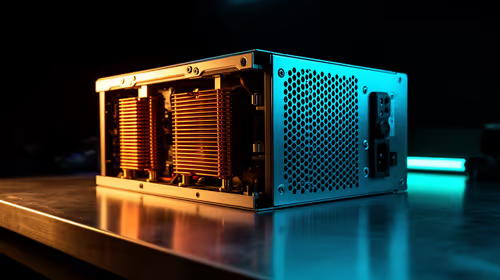
1000W PSU Planning for RTX 5090 Builds in SA
1000W for RTX 5090 needs a full-build check, not a simple yes. Review GPU guidance, CPU draw, transient load, connectors, PSU quality, and upgrade plans before deciding.
Read moreA 2.4GHz dongle gives lower, steadier latency than Bluetooth and suits competitive gaming, while Bluetooth trades a little responsiveness for battery life and a free USB port. Evetech's wireless range covers both connection types across mice, keyboards and headsets.
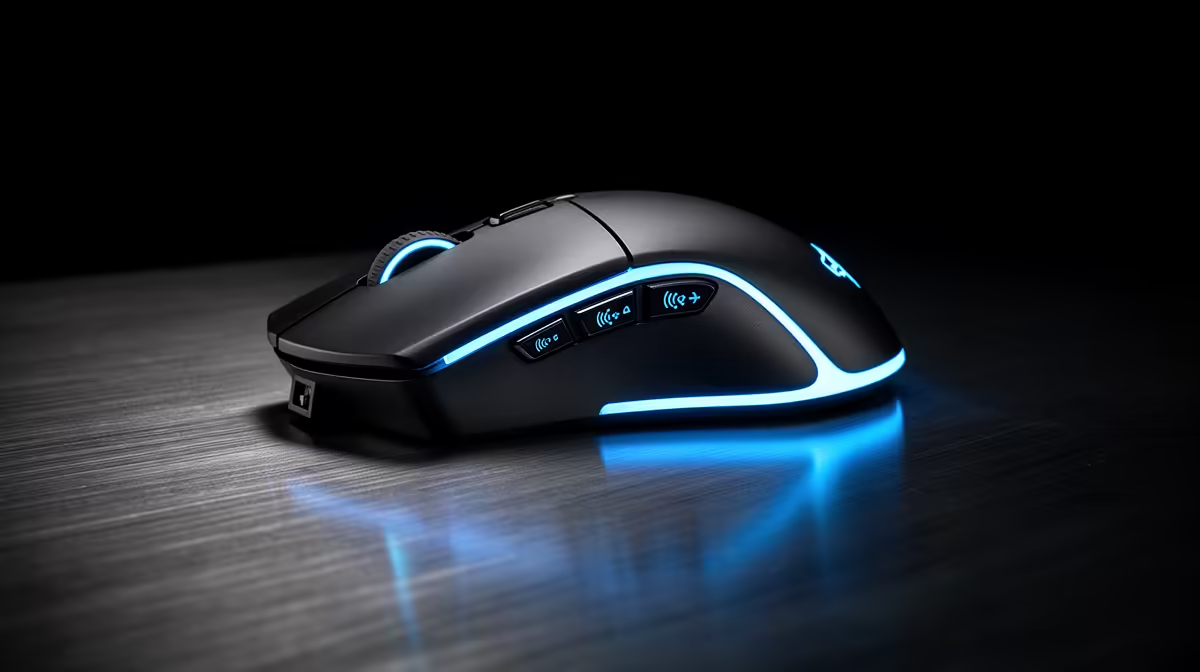
Your mouse can pair over Bluetooth for a workday, then switch to its USB receiver when the game starts. Both connections have a place. For Bluetooth vs 2.4GHz gaming, choose the receiver when timing and a steady polling rate matter; choose Bluetooth when you want fewer dongles and easy switching between devices.
Use the 2.4GHz receiver for competitive games, fast mouse movement and a headset where audio delay bothers you. Bluetooth suits casual play, office use and a laptop with limited USB ports. In July 2026, R699 marked the median across Evetech's in-stock gaming mice, so test both modes on a dual-wireless device before paying to replace it.
A dedicated receiver lets the maker control its radio link and polling behaviour. Place it on an extension near the mouse or keyboard, away from USB 3 storage and the metal rear of the PC. That setup gives it the cleanest chance to hold a steady connection.
Save your highest polling rate and game DPI to the receiver profile where the software supports onboard memory. Evetech's peripheral best-seller page includes devices that advertise both connection modes; check which features remain available on each one.
Bluetooth works well when you move one keyboard between a desktop, tablet and work laptop. It frees a USB port and often gives a device access to a lower-power mode. Wake time and polling behaviour vary by model, so try the exact device before trusting a specification table.
For a strategy game, couch session or chat keyboard, the response difference may never bother you. A fast shooter or rhythm game exposes it sooner. Let the game type decide the mode instead of treating one radio as a badge of quality.
Charge the device, use the same game scene and keep sensitivity plus polling settings constant. Move in wide circles, make quick direction changes and listen for headset delay. Then switch connection mode and repeat.
If the receiver stutters, move it onto the desk before blaming 2.4GHz. If Bluetooth drops, remove old pairings and test with other nearby radios quiet. Evetech's gaming-accessory range gives you other options after both modes receive a fair setup.
A gaming receiver tends to offer lower, steadier latency and a higher polling mode than the device's Bluetooth connection.
It saves a USB port and makes switching between computers, tablets and phones easier.
It may not. Slow games and controller play can feel fine, while aim-heavy titles reveal delay sooner.
Many dual- or tri-mode peripherals can. Check whether profiles and lighting settings carry across modes.
It can at a high polling rate, but battery behaviour depends on the device, lighting and sleep settings.
Use the dedicated 2.4GHz receiver on an extension near the device, with a wired mode as the fallback.
Choosing one peripheral for work and gaming? Compare dual-wireless gear at Evetech, then reserve Bluetooth for device switching and place the gaming receiver where it has a clean radio path.
A gaming receiver tends to offer lower, steadier latency and a higher polling mode than the device's Bluetooth connection.
It saves a USB port and makes switching between computers, tablets and phones easier.
It may not. Slow games and controller play can feel fine, while aim-heavy titles reveal delay sooner.
Many dual- or tri-mode peripherals can. Check whether profiles and lighting settings carry across modes.
It can at a high polling rate, but battery behaviour depends on the device, lighting and sleep settings.
Use the dedicated 2.4GHz receiver on an extension near the device, with a wired mode as the fallback.
1000W for RTX 5090 needs a full-build check, not a simple yes. Review GPU guidance, CPU draw, transient load, connectors, PSU quality, and upgrade plans before deciding.
Read more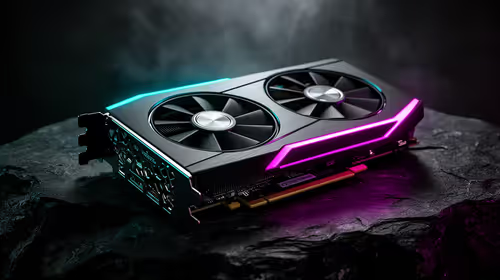
RTX 5080 Super with a 750W PSU is more comfortable than lower wattage if the unit is quality. SA builders should still confirm GPU guidance, CPU draw, connector type, airflow, and upgrade room.
Read more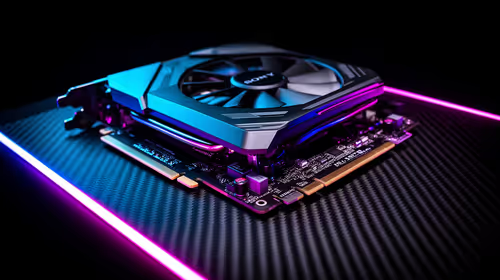
How to fix FPS drops after a RX 9070 XT starts with driver cleanup, chipset updates, thermals, and power checks. For SA gaming PCs, confirm PCIe seating, monitor refresh, frame caps, and per-game graphics settings before replacing parts.
Read more
How to fix low FPS Windows 11 Wi-Fi 7 issues starts by checking whether the problem is frame rate or network lag. Test ping, drivers, power settings, Ethernet, and game FPS before adjusting visuals.
Read more
AM5 is smart for SA builders because it supports newer Ryzen CPUs, DDR5 memory, and a longer upgrade path. Compare board cost, cooling, gaming needs, and local part availability before choosing your next PC platform.
Read more
AM5 gives Randburg gaming builders a longer upgrade path. For SA buyers, DDR5 support, newer board features, and future CPU options can justify the platform. Weigh board cost, cooler support, BIOS maturity, and upgrade timing before choosing.
Read more
RTX 5090 on a 550W PSU leaves almost no practical room for OC plans. Treat the setup as constrained, with CPU draw, power spikes, cable quality, thermals, and stability checks more important than chasing extra clocks.
FPS drops on a Ryzen 9 9950X3D build often have a fixable cause. Check settings, drivers, thermals, background tasks, network conditions, and bottlenecks before assuming a part must be replaced.

The difference between PCIe 5.0 and PCIe 4.0 for SA gamers is mostly bandwidth headroom. Compare GPU slot needs, NVMe speed, motherboard support, and upgrade timing before paying extra for a newer platform.

Gaming PC stuck pixel checks in South Africa should confirm the monitor fault first. Use colour tests, screenshot comparison, cable swaps, display menu checks, and clear photos before deciding on support.

AMD's current driver now lists a Radeon RX 9050 4GB, while product coverage details a narrowed memory system. SA buyers should weigh the low VRAM ceiling against current local Radeon options.

Samsung Display has demonstrated a 16-inch 2.5K OLED laptop panel running at 300Hz. SA buyers should wait for a named notebook, full panel specifications and a local price before planning an upgrade.

Microsoft says some Windows 11 game crashes after recent updates are linked to RGB-related drivers. Affected SA gamers should confirm the update and driver before using the published registry workaround.

Thermalright's Fan Frame Vision-1 adds a 640x172 status screen to a standard 120mm fan. SA builders should check clearance, USB routing and local support before treating it as an easy upgrade.
1000W for RTX 5090 needs a full-build check, not a simple yes. Review GPU guidance, CPU draw, transient load, connectors, PSU quality, and upgrade plans before deciding.

Wi-Fi 6E vs Wi-Fi 6 matters for 4K video editing when files move across a network. The real-world difference between Wi-Fi 6E and Wi-Fi 6 for video editing in 4K depends on NAS access, cloud uploads, router range, and SA creator workflows.
RTX 5080 Super with a 750W PSU is more comfortable than lower wattage if the unit is quality. SA builders should still confirm GPU guidance, CPU draw, connector type, airflow, and upgrade room.
Wi-Fi 6E vs Wi-Fi 6 for Video Editing in 4K comes down to router support, latency, client devices, band support, and home network layout. SA buyers should match the choice to their setup instead of assuming one option always wins.