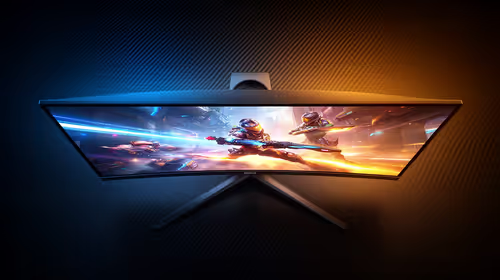
A gaming PC can reach 500fps at 1440p in some competitive titles and settings, but not as a universal result. The right answer to 500fps at QHD depends on the game engine, scene, processor, graphics card, memory and preset. The ASUS XG27AQDPG provides the 500Hz QHD display target for R23,899.
Quick Answer
Benchmark each title at native 2560x1440 with the processor and GPU under consideration. Light esports games at competitive settings can reach very high frame rates on suitable systems, while demanding releases may remain well below 500fps. Track lows and frame times as well as averages. A 500Hz monitor does not force the PC to render 500fps, and adaptive sync supports variable output below the ceiling.
🧠 Separate engine and hardware limits
Some games are limited by CPU simulation or draw-call work before the graphics card reaches full use. Others remain GPU-heavy at QHD. Monitor CPU threads, GPU utilisation and clock behaviour during the same test scene.
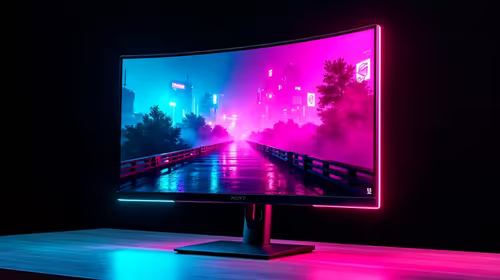
The gaming monitor range helps keep the QHD display target visible when comparing PC performance.
📊 Choose representative benchmarks
Use the current game version, native resolution and a known preset. A training room can render much faster than a full match, so include crowded action, effects and player movement. Record the average, one-percent lows and frame-time graph.
Repeat after a cold restart and after the system has warmed up. Cooling or background software can change sustained results.
🎛️ Reduce settings selectively
Lower shadows, effects or other expensive options one at a time, then measure the gain. Keep textures and visibility controls that matter to competition when the hardware can support them. Avoid dropping resolution before identifying which effect causes the bottleneck.
⚡ Understand what 500Hz displays
At its maximum, the XG27AQDPG can begin a refresh every 2ms. If the game produces 300fps, the panel still operates as a 500Hz-capable screen but receives fewer unique completed frames. The 0.03ms GTG response supports rapid panel transitions without creating additional game output.
🔄 Use variable refresh intelligently
Choose G-SYNC Compatible on NVIDIA or FreeSync Premium Pro on AMD to coordinate refresh timing when performance varies. Select the path for the installed GPU and compare uncapped output with a stable measured cap. A clean sub-500fps range can provide a better competitive experience than unstable peaks.
🔌 Confirm the signal route
The ASUS offers HDMI 2.1 and DisplayPort 1.4. Match the GPU output and verify 2560x1440 at the chosen refresh in the operating system and game. A cable problem should not be mistaken for a performance limit.
The OLED monitor collection adds panel context, while the curved monitor category handles screen shape as another decision.
💵 Plan the complete build
Include the R23,899 display, processor platform, graphics card, power supply and cooling in the same budget. A stronger GPU cannot always solve a CPU-limited title. Buy for the game mix and acceptable settings rather than a theoretical universal 500fps claim.
🧪 Validate a 500fps result
When a benchmark reaches 500fps, confirm that the test is at native QHD and uses the intended game version. Record the processor, GPU, memory, driver, preset and map. Then inspect one-percent lows and frame-time consistency; a 500fps average with repeated deep drops does not describe a constant 2ms delivery interval.
Repeat during a full match or representative replay. Watch CPU thread behaviour, GPU utilisation and temperatures. If performance declines after the system warms up, solve the cooling or power issue before treating the opening run as sustainable.
Finally, verify that the XG27AQDPG is actually selected at 500Hz. A high frame counter on a lower-refresh output does not prove the display path. This validation converts a headline result into evidence that the entire QHD system can reproduce.
Use the validated configuration as a regression test after game patches. Repeat the same representative route and compare lows, frame times and hardware utilisation. A new engine workload can change the 500fps result even when the QHD monitor and PC hardware remain identical.
Frequently Asked Questions
Does a 500Hz monitor force a PC to render 500fps?
No. Monitor refresh capability and game frame production are separate.
Why do results differ so much between games?
Engines, scenes, CPU load, GPU load and graphics options differ.
Should I test average frame rate only?
No. Include lows and frame-time consistency.
Can lower graphics settings help reach the target?
Yes, when the changed setting reduces the active bottleneck.
What happens when performance remains below 500fps?
The monitor still works, and adaptive refresh can coordinate variable output below the maximum.
What display cost belongs in a 500fps build plan?
Include R23,899 for the XG27AQDPG.
Ready to replace a universal 500fps claim with title-specific evidence?
Compare Evetech's 500Hz displays and benchmark the exact QHD scenes that define your build.