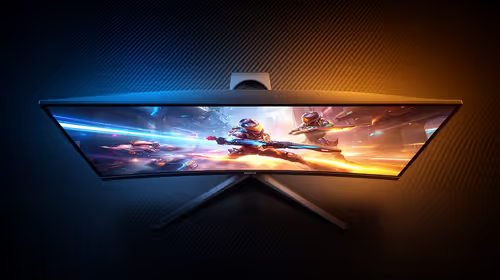
Running a game at 3440 x 1440 and displaying it at 240Hz are two different achievements. A gaming PC can output the resolution while delivering anything from modest to extremely high frame rates, depending on the title, settings, processor and graphics card.
Quick Answer
Yes, a capable gaming PC can run modern games at UWQHD on a 240Hz monitor, but demanding releases will not usually remain near 240fps at maximum settings. Competitive games with lighter rendering loads have a better chance of using much of the refresh headroom. The practical target is a stable, responsive frame-rate range with good image quality, supported by variable refresh when output changes.
Count the rendering load correctly
The 3440 x 1440 format contains about 4.95 million pixels per frame. Standard 2560 x 1440 contains roughly 3.69 million, so UWQHD adds around one third more pixels before lighting, effects or ray tracing are considered. That extra width is useful, but it gives the graphics card more work.
Use the gaming monitor collection to compare the resolution and refresh combinations available. A 240Hz label states the panel ceiling, not a promise that every computer or game will create 240 frames each second.
Separate competitive and cinematic targets
Fast esports titles are often designed to scale to high output. Sensible competitive presets, reduced shadows and controlled effects can free performance while keeping textures and object detail legible. A large single-player game may look and feel excellent at a much lower frame rate, especially when its visual complexity is part of the appeal.
Create two profiles instead of forcing one setting recipe on everything. Use a low-latency competitive profile for games where motion and response dominate, then a visual profile for adventures where HDR, atmosphere and detail matter more.
Check both GPU and CPU limits
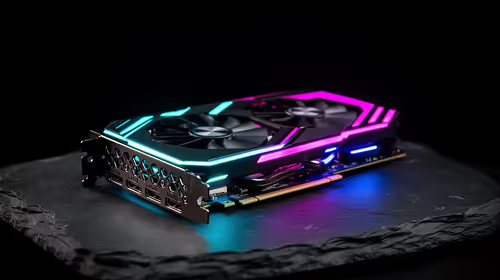
At higher resolution, the graphics card commonly becomes the limiting component. At very high frame rates, the processor must also prepare game logic and draw calls quickly enough. Lower the render resolution temporarily: if performance rises sharply, the GPU was carrying the heavier load; if it barely changes, a CPU or engine limit is more likely.
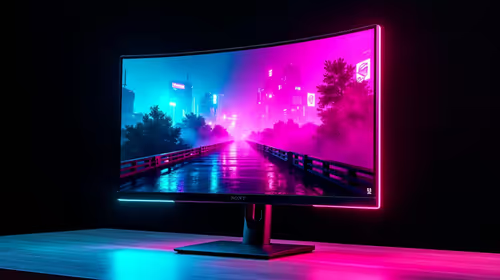
The Alienware AW3426DWM offers 240Hz, 1ms GTG and AMD FreeSync Premium at R8,999. FreeSync Premium can coordinate changing output with refresh, reducing tearing without pretending that missing frames have been generated.
Tune for useful consistency
Watch one-percent lows and frame-time graphs rather than celebrating a short peak. A controlled 150fps with even delivery frequently feels cleaner than output that jumps between 110 and 230fps. Cap the frame rate at a level the system can hold if that improves pacing, heat or fan noise.
Upscaling can reduce internal rendering load in supported games, but inspect fine foliage, interface text and motion artefacts. Dynamic resolution is another option when a consistent response matters more than fixed pixel precision.
Make the wider format part of the plan
The 1500R curve suits a centred 34-inch view, and the curved monitor category helps compare similar desk formats. Confirm proper 21:9 support in favourite games; unsupported scenes may show black bars without indicating a monitor fault.
The AW3426DWM is VA rather than OLED. Buyers weighing pixel response, black level and panel behaviour can inspect the OLED monitor range as a separate technology comparison. DisplayHDR 400, Dolby Vision and 95% DCI-P3 broaden this VA model's picture use beyond competitive play.
Validate power and cooling over time
A short benchmark may hide clock reductions that appear after the case warms up. Repeat the chosen UWQHD profile for at least thirty minutes while observing GPU temperature, processor temperature, clocks and fan noise. If performance degrades, improve airflow or reduce power demand before buying faster display hardware. Stable long-session output is the figure that should be matched to refresh, because that is what the player experiences after the opening round.
Frequently Asked Questions
Does 240Hz require 240fps at all times?
No. The high ceiling leaves room for fast games, while variable refresh supports smoother presentation across changing frame rates.
Is UWQHD harder to run than ordinary QHD?
Yes. Its wider 3440 x 1440 image contains about 34% more pixels than 2560 x 1440.
Which setting should be reduced first?
Start with costly effects such as heavy shadows, volumetrics and ray tracing, then test image quality and frame-time improvement after each change.
Can a frame cap help?
Yes. A cap set near a sustainable level can make delivery more even and reduce unnecessary power draw.
Ready to balance UWQHD detail with real frame delivery?
Benchmark your favourite games at 3440 x 1440, build separate competitive and cinematic profiles, and compare displays around the performance your PC can sustain.