


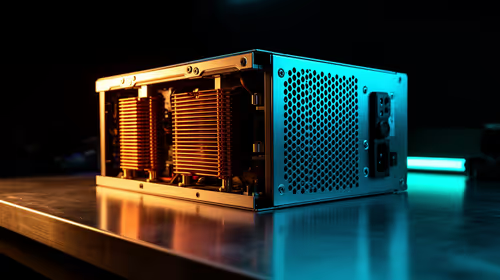
1000W PSU Planning for RTX 5090 Builds in SA
1000W for RTX 5090 needs a full-build check, not a simple yes. Review GPU guidance, CPU draw, transient load, connectors, PSU quality, and upgrade plans before deciding.
Read moreCurrent handhelds run most 2026 releases at lowered settings and 720p-to-900p rather than the ultra presets shown in trailers, and that gap will widen as new AAA titles push harder. Treat a handheld as a portable way to play, not a match for a dedicated gaming PC.
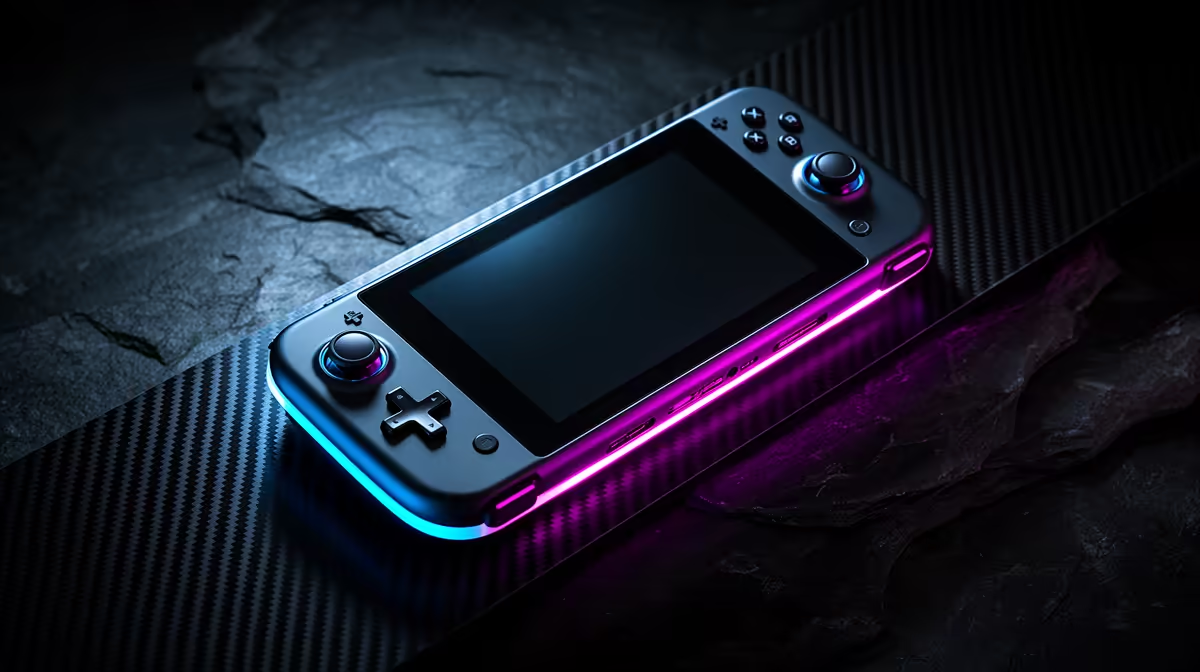
Trailer settings and a handheld screen tell very different performance stories. The honest answer on 2026 games on handhelds depends on resolution, frame-rate targets and how much visual compromise still feels good to you.
Current handheld PCs can run many large 2026 games, but each title needs checking. Expect low or medium settings, internal resolutions around 720p to 900p, upscaling and a 30fps or 40fps target in demanding releases. Lighter games can run faster and sharper. Some new titles will be poor fits because of CPU load, memory needs, anti-cheat or tiny interface text. Buy for named games that work today, not a promise that every release will remain playable.
A stable frame time matters more than a peak counter. Thirty consistent frames per second can feel good in a story game. A competitive shooter may need more. Watch a full gameplay section with combat and busy areas, not a quiet tutorial.
Handheld screens make upscaling more forgiving. Rendering below 1080p and rebuilding the image can look clean at arm's length. Ultra textures and heavy ray tracing spend power on details that are hard to see on a small panel.
Frame generation can smooth motion when the base frame rate is healthy. It cannot rescue severe stutter, input delay or a processor that cannot prepare frames. Treat it as one tool rather than a compatibility guarantee.
At R9,999 as of July 2026, ASUS's 16GB ROG Ally with Ryzen Z2A and a 512GB SSD targets a different performance level from MSI's 32GB/1TB Claw 8 AI+ at R18,999. A price gap can buy a stronger processor, more memory, more storage or a better screen. It does not make every game twice as playable.
Check the exact processor and memory configuration on current handheld gaming consoles, then compare it with popular PC products.
Look for benchmarks at the wattage you will use on battery. A 30W plugged-in result does not describe a train journey. Confirm launcher and controller support as well as frame rate.
Indies, older AAA games, racing titles and controller-led action often suit the format. You can cap the frame rate, lower power draw and get a session that feels made for portable play.
The hardest new releases can expose the limits. When minimum PC requirements rise beyond the handheld's fixed memory or graphics capability, lowering resolution may not solve it. Streaming from your own stronger PC is another option when the network is good, but that changes the offline promise.
That is the wrong target for most demanding titles. Low or medium settings offer a better image, frame-rate and battery balance.
On a small screen, a good upscaler can make it look convincing. Text and fine detail vary by game.
Fixed hardware keeps the same ceiling while new games can demand more. Updates may help individual titles, but future compatibility is never guaranteed.
Compare exact handheld configurations against measured performance in the big games you want to play.
That is the wrong target for most demanding titles. Low or medium settings offer a better image, frame-rate and battery balance.
On a small screen, a good upscaler can make it look convincing. Text and fine detail vary by game.
Fixed hardware keeps the same ceiling while new games can demand more. Updates may help individual titles, but future compatibility is never guaranteed.
1000W for RTX 5090 needs a full-build check, not a simple yes. Review GPU guidance, CPU draw, transient load, connectors, PSU quality, and upgrade plans before deciding.
Read more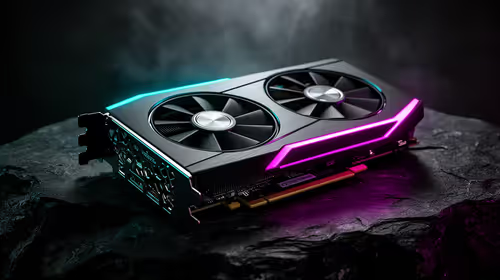
RTX 5080 Super with a 750W PSU is more comfortable than lower wattage if the unit is quality. SA builders should still confirm GPU guidance, CPU draw, connector type, airflow, and upgrade room.
Read more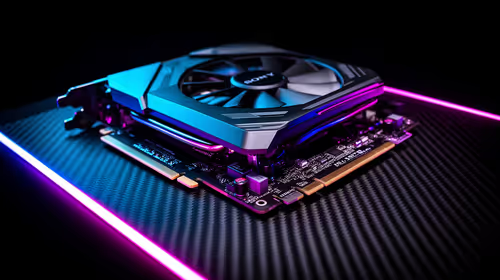
How to fix FPS drops after a RX 9070 XT starts with driver cleanup, chipset updates, thermals, and power checks. For SA gaming PCs, confirm PCIe seating, monitor refresh, frame caps, and per-game graphics settings before replacing parts.
Read more
How to fix low FPS Windows 11 Wi-Fi 7 issues starts by checking whether the problem is frame rate or network lag. Test ping, drivers, power settings, Ethernet, and game FPS before adjusting visuals.
Read more
AM5 is smart for SA builders because it supports newer Ryzen CPUs, DDR5 memory, and a longer upgrade path. Compare board cost, cooling, gaming needs, and local part availability before choosing your next PC platform.
Read more
AM5 gives Randburg gaming builders a longer upgrade path. For SA buyers, DDR5 support, newer board features, and future CPU options can justify the platform. Weigh board cost, cooler support, BIOS maturity, and upgrade timing before choosing.
Read more
RTX 5090 on a 550W PSU leaves almost no practical room for OC plans. Treat the setup as constrained, with CPU draw, power spikes, cable quality, thermals, and stability checks more important than chasing extra clocks.
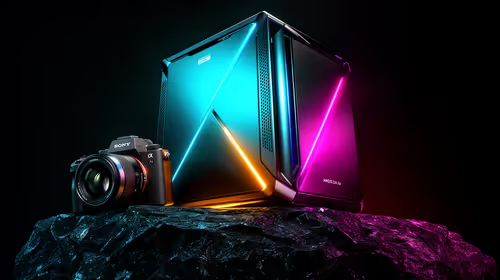
FPS drops on a Ryzen 9 9950X3D build often have a fixable cause. Check settings, drivers, thermals, background tasks, network conditions, and bottlenecks before assuming a part must be replaced.

The difference between PCIe 5.0 and PCIe 4.0 for SA gamers is mostly bandwidth headroom. Compare GPU slot needs, NVMe speed, motherboard support, and upgrade timing before paying extra for a newer platform.

Gaming PC stuck pixel checks in South Africa should confirm the monitor fault first. Use colour tests, screenshot comparison, cable swaps, display menu checks, and clear photos before deciding on support.

AMD's current driver now lists a Radeon RX 9050 4GB, while product coverage details a narrowed memory system. SA buyers should weigh the low VRAM ceiling against current local Radeon options.

Samsung Display has demonstrated a 16-inch 2.5K OLED laptop panel running at 300Hz. SA buyers should wait for a named notebook, full panel specifications and a local price before planning an upgrade.

Microsoft says some Windows 11 game crashes after recent updates are linked to RGB-related drivers. Affected SA gamers should confirm the update and driver before using the published registry workaround.
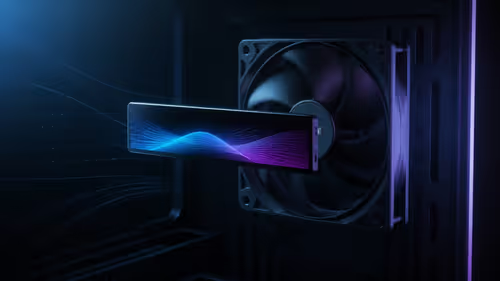
Thermalright's Fan Frame Vision-1 adds a 640x172 status screen to a standard 120mm fan. SA builders should check clearance, USB routing and local support before treating it as an easy upgrade.
1000W for RTX 5090 needs a full-build check, not a simple yes. Review GPU guidance, CPU draw, transient load, connectors, PSU quality, and upgrade plans before deciding.

Wi-Fi 6E vs Wi-Fi 6 matters for 4K video editing when files move across a network. The real-world difference between Wi-Fi 6E and Wi-Fi 6 for video editing in 4K depends on NAS access, cloud uploads, router range, and SA creator workflows.
RTX 5080 Super with a 750W PSU is more comfortable than lower wattage if the unit is quality. SA builders should still confirm GPU guidance, CPU draw, connector type, airflow, and upgrade room.
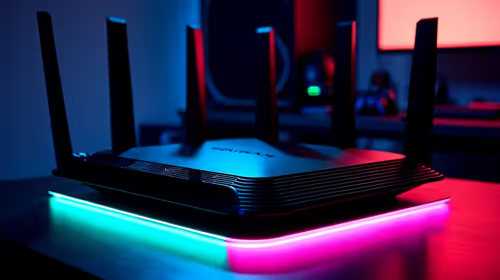
Wi-Fi 6E vs Wi-Fi 6 for Video Editing in 4K comes down to router support, latency, client devices, band support, and home network layout. SA buyers should match the choice to their setup instead of assuming one option always wins.