A processor name cannot answer whether a laptop will handle creation and heavy multitasking, because applications, graphics, memory, storage and project files share the result. The Core Ultra 9 386H creative performance question needs a repeatable workload. The MSI Prestige 16 Flip AI+ supplies that processor at R37,999 with 32GB memory.
Quick Answer
The Core Ultra 9 386H Prestige can be tested for demanding creation and multitasking, but no benchmark or software result is available from the name alone. At R37,999, it includes 32GB LPDDR5X, 1TB NVMe and a 90-TOPS AI PC platform. Run the exact application mix and verify graphics before deciding.
🧭 Define heavy work with files and outputs
List active applications, project sizes, background services and the final output. Choose one normal combined session and one difficult delivery-day sequence. Record elapsed time, responsiveness, errors and output quality.
Repeat the sequence after a restart to reduce the effect of caching or an unusual background task.
🧭 Find the constrained resource
The working-memory pool totals 32GB and uses LPDDR5X. Meanwhile, a 1TB NVMe drive holds projects, caches and applications. Monitor both throughout the heaviest credible overlap. A slow stage may come from memory pressure, storage, graphics or software rather than CPU compute.
Confirm the Prestige's graphics configuration before GPU-led creative tasks. Use Evetech's MSI professional range to compare complete systems.
🧭 Verify AI acceleration independently
The 90-TOPS AI PC designation may serve supported features. Select one AI-assisted operation, confirm its processing route and compare it at fixed settings. Do not combine its result with the broader multitasking score.
An AI feature that depends on a network service answers a different question from local processing. Document that path.
🧭 Include display and dock workloads
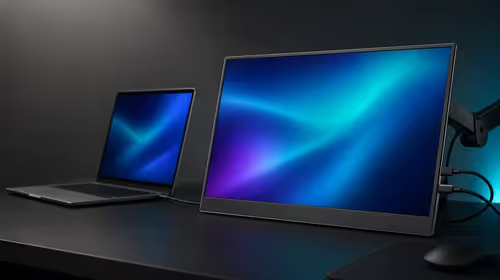
The Prestige drives a 16-inch 2.8K 120Hz OLED touchscreen internally. External displays or storage over Thunderbolt 4 should be added one at a time with verified devices and cables.
Use Evetech's creator laptop selection for alternative workloads. Measure plugged and unplugged behaviour separately; no battery duration follows from the Core Ultra 9 label.
Model the worst overlap, not an artificial stress test
Recreate the busiest credible hour: perhaps a video call, reference browser, large document and creative application active together. Use familiar files and normal output settings. Watch when interaction becomes delayed and identify which stage owns the delay. A synthetic load that never occurs in practice can exaggerate the wrong resource.
Run the same hour twice, once with unnecessary background tools closed. The difference helps separate permanent capacity needs from a cluttered software environment.
Judge recovery as part of heavy work
Multitasking value includes how the system returns after sleep, reconnects external devices and reopens a project following an application fault. Save work, disconnect the tested desk chain and restore it in the order used every day. Record missing displays, inaccessible storage or changed window placement.
Include recovery time in the final result. A fast export can lose its advantage if the surrounding session demands repeated repair.
Establish an acceptable response boundary
Before the test, define which pauses are tolerable during typing, preview, switching applications and saving. Note any operation that can run unattended and separate it from interaction that must feel immediate. This prevents one long export from unfairly dominating a multitasking decision while still exposing delays that interrupt creative judgement.
Compare the boundary across identical projects, not through memory of different machines.
Report the result by stage
Summarise opening, editing, switching, preview and final output separately. A single "fast" or "slow" label hides where the system helped and where it waited. Add the exact graphics identity once identified, since GPU-dependent work cannot be compared fairly without it. This stage report also makes a future application update easier to assess.
Frequently Asked Questions
Does Core Ultra 9 prove heavy multitasking performance?
No. It identifies the processor. The full result depends on applications, graphics, capacity, settings and project files.
Is 32GB enough for a demanding creative session?
It supplies substantial memory, but peak use varies. Monitor the exact application combination and largest normal project.
Can 90 TOPS replace graphics performance?
No. AI compute and graphics resources serve different software paths. Verify both where the application needs them.
Should docked performance be tested separately?
Yes. External displays, storage, docks and cables can change the complete system path.
Ready to test the Core Ultra 9 against a real delivery day?
Compare Evetech creator and MSI laptops with the same application mix, project files, outputs and connected devices.