


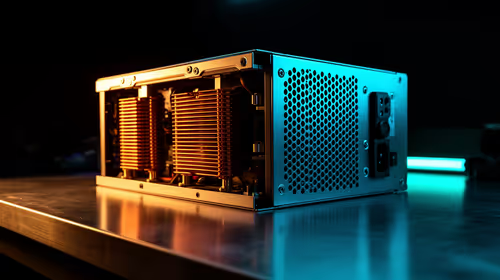
1000W PSU Planning for RTX 5090 Builds in SA
1000W for RTX 5090 needs a full-build check, not a simple yes. Review GPU guidance, CPU draw, transient load, connectors, PSU quality, and upgrade plans before deciding.
Read moreA CPU bottleneck occurs when processor work prevents the graphics card from receiving frames fast enough for the target experience. Diagnose it with repeatable tests, because settings, memory, background tasks and engine behaviour can resemble the same symptom.
A bottleneck is not the busiest number on a monitoring overlay; it is the part preventing the next frame from being completed in time for the target experience. Find and fix CPU bottlenecks in modern games with repeatable scenes and controlled setting changes. The R7,199 Ryzen 7 5800X3D is useful only when processor work is the constraint it replaces.
Suspect a CPU bottleneck when lowering graphics pressure leaves performance capped and one or more time-sensitive processor threads delay frame delivery. Keep the scene, resolution and background workload controlled, then test one fix at a time. The R7,199 5800X3D can help supported AM4 systems with processor limits, but a GPU cap may leave FPS unchanged.
Record average FPS, frame times, graphics-card load and processor behaviour through the same game route. Total CPU utilisation can be misleading because a critical game thread may be saturated while other cores are less active. Look for a repeatable relationship between CPU work and delayed frames.
Reduce selected graphics pressure and run the route again. If FPS rises, the GPU carried part of the limit. If it remains constrained while graphics hardware has headroom, the processor side becomes a stronger suspect.
Background tasks, recording tools, updates and overlays can consume CPU time or disturb frame delivery. Memory capacity or configuration can create similar stutter, and a frame cap can hide available performance. Test with normal software and a controlled clean state.
Cooling matters too. A badly mounted or restricted cooler can affect consistent behaviour. The 105W 5800X3D has no included cooler, so Evetech's CPU cooling range should be assessed against AM4 fit and the chassis.
The Ryzen 7 supplies eight Zen 3 cores, 16 threads and 100MB cache. Cache-sensitive games may respond, while graphics-heavy titles can remain limited elsewhere. Browse Evetech's AMD processor range only after the motherboard model and BIOS support are known.
A discrete GPU remains required for display output. The CPU cannot perform the card's rendering work, and its boost ceiling of 4.5GHz does not guarantee a particular FPS.
Change one factor and repeat the original route. Examine the average together with frame-time consistency, and record temperatures and settings. If a new CPU leaves FPS unchanged, recheck the graphics limit, game cap, memory and background state before assuming the installation failed.
Evetech's wider processor category can frame other routes when the R7,199 AM4 option is not the right answer.
Resolution should be handled carefully during diagnosis. Lowering graphics load can reveal processor headroom, but the final test belongs at the resolution and quality the player intends to use. A CPU improvement that appears only in a diagnostic configuration may not justify the budget for that user.
Frame-time graphs can reveal repeated delays that an average conceals. Match those moments to CPU, GPU and background activity where possible, then test the suspected cause. Avoid declaring a bottleneck from a single busy instant.
Keep the old processor until the result is stable. If the new configuration remains unclear after firmware, cooling, memory and graphics checks, a controlled retest with the known CPU can help separate installation effects from the original system limit.
When the bottleneck is confirmed, choose the least disruptive fix that reaches the target. That may be a CPU, a game setting, background-task control or a graphics change. Re-run the normal play configuration afterwards so the diagnostic solution proves useful outside the test.
Repeatable frame delays alongside processor-side pressure and unused graphics headroom are useful signs. Compare the same scene under controlled settings.
A time-critical thread can hold back a game while several cores remain less busy. The total percentage can hide that uneven workload.
The exact options vary by game. Change one documented setting at a time and measure the same scene rather than applying a generic list.
Updates, launchers, recording and other applications can compete for processor, memory or storage resources and disturb frame timing.
It can help when a supported AM4 system is demonstrably CPU-limited in relevant games and the graphics card has capacity to use quicker frame preparation.
The GPU, frame cap, game setting, memory or software environment may still be the active limit. Recheck the original test conditions.
Repeat the baseline with one change, then compare average FPS, frame-time behaviour, temperatures and stability. Keep the configuration documented.
Ready to replace guesswork with a repeatable bottleneck test? Compare Evetech's processor and cooler choices, then place the R7,199 Ryzen 7 only where CPU evidence supports it.
Repeatable frame delays alongside processor-side pressure and unused graphics headroom are useful signs. Compare the same scene under controlled settings.
A time-critical thread can hold back a game while several cores remain less busy. The total percentage can hide that uneven workload.
The exact options vary by game. Change one documented setting at a time and measure the same scene rather than applying a generic list.
Updates, launchers, recording and other applications can compete for processor, memory or storage resources and disturb frame timing.
It can help when a supported AM4 system is demonstrably CPU-limited in relevant games and the graphics card has capacity to use quicker frame preparation.
The GPU, frame cap, game setting, memory or software environment may still be the active limit. Recheck the original test conditions.
Repeat the baseline with one change, then compare average FPS, frame-time behaviour, temperatures and stability. Keep the configuration documented.
1000W for RTX 5090 needs a full-build check, not a simple yes. Review GPU guidance, CPU draw, transient load, connectors, PSU quality, and upgrade plans before deciding.
Read more
RTX 5080 Super with a 750W PSU is more comfortable than lower wattage if the unit is quality. SA builders should still confirm GPU guidance, CPU draw, connector type, airflow, and upgrade room.
Read more
How to fix FPS drops after a RX 9070 XT starts with driver cleanup, chipset updates, thermals, and power checks. For SA gaming PCs, confirm PCIe seating, monitor refresh, frame caps, and per-game graphics settings before replacing parts.
Read more
How to fix low FPS Windows 11 Wi-Fi 7 issues starts by checking whether the problem is frame rate or network lag. Test ping, drivers, power settings, Ethernet, and game FPS before adjusting visuals.
Read more
AM5 is smart for SA builders because it supports newer Ryzen CPUs, DDR5 memory, and a longer upgrade path. Compare board cost, cooling, gaming needs, and local part availability before choosing your next PC platform.
Read more
AM5 gives Randburg gaming builders a longer upgrade path. For SA buyers, DDR5 support, newer board features, and future CPU options can justify the platform. Weigh board cost, cooler support, BIOS maturity, and upgrade timing before choosing.
Read more
RTX 5090 on a 550W PSU leaves almost no practical room for OC plans. Treat the setup as constrained, with CPU draw, power spikes, cable quality, thermals, and stability checks more important than chasing extra clocks.
FPS drops on a Ryzen 9 9950X3D build often have a fixable cause. Check settings, drivers, thermals, background tasks, network conditions, and bottlenecks before assuming a part must be replaced.

The difference between PCIe 5.0 and PCIe 4.0 for SA gamers is mostly bandwidth headroom. Compare GPU slot needs, NVMe speed, motherboard support, and upgrade timing before paying extra for a newer platform.

Gaming PC stuck pixel checks in South Africa should confirm the monitor fault first. Use colour tests, screenshot comparison, cable swaps, display menu checks, and clear photos before deciding on support.

AMD's current driver now lists a Radeon RX 9050 4GB, while product coverage details a narrowed memory system. SA buyers should weigh the low VRAM ceiling against current local Radeon options.

Samsung Display has demonstrated a 16-inch 2.5K OLED laptop panel running at 300Hz. SA buyers should wait for a named notebook, full panel specifications and a local price before planning an upgrade.

Microsoft says some Windows 11 game crashes after recent updates are linked to RGB-related drivers. Affected SA gamers should confirm the update and driver before using the published registry workaround.

Thermalright's Fan Frame Vision-1 adds a 640x172 status screen to a standard 120mm fan. SA builders should check clearance, USB routing and local support before treating it as an easy upgrade.
1000W for RTX 5090 needs a full-build check, not a simple yes. Review GPU guidance, CPU draw, transient load, connectors, PSU quality, and upgrade plans before deciding.

Wi-Fi 6E vs Wi-Fi 6 matters for 4K video editing when files move across a network. The real-world difference between Wi-Fi 6E and Wi-Fi 6 for video editing in 4K depends on NAS access, cloud uploads, router range, and SA creator workflows.
RTX 5080 Super with a 750W PSU is more comfortable than lower wattage if the unit is quality. SA builders should still confirm GPU guidance, CPU draw, connector type, airflow, and upgrade room.
Wi-Fi 6E vs Wi-Fi 6 for Video Editing in 4K comes down to router support, latency, client devices, band support, and home network layout. SA buyers should match the choice to their setup instead of assuming one option always wins.