


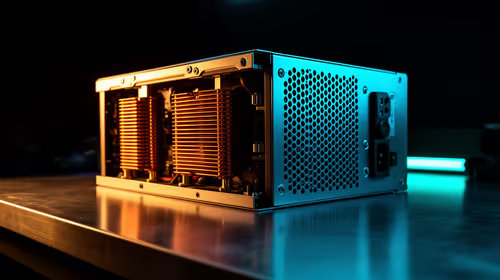
1000W PSU Planning for RTX 5090 Builds in SA
1000W for RTX 5090 needs a full-build check, not a simple yes. Review GPU guidance, CPU draw, transient load, connectors, PSU quality, and upgrade plans before deciding.
Read moreClimate-controlled seats add ventilation or heating; standard seats rely on passive construction and room conditions. The R16,599 AutoFull M6 Pro+ 2.0 includes both ventilation and heating through an air-conditioned seat.

Climate-controlled and standard seats differ in how they manage the local sitting environment. A climate-controlled vs standard gaming chair choice should separate active modes from passive materials and room conditions.

Climate-controlled seats add active ventilation or heating, while standard seats rely on passive construction. The R16,599 AutoFull M6 Pro+ 2.0 includes both active modes through its air-conditioned seat. This does not identify upholstery, temperature range, fan performance or universal comfort.
Ventilation manages seat airflow and heating adds warmth. Ask how each mode operates on the exact chair, including controls and power. Do not assume levels, noise or automatic settings.
Browse Evetech's AutoFull gaming chair range after listing which room conditions create a repeated need.
A standard chair may use passive design or materials to influence airflow, but the term standard does not define upholstery. Likewise, an active climate seat does not reveal the M6 Pro+ material.
Compare material, active operation and personal response in separate columns. A feature name cannot guarantee that one user always feels cooler or warmer.
The M6 Pro+ provides dynamic lumbar, foldable 6D armrests and a 160-degree recline with a 3D neck pillow. These position functions remain relevant regardless of climate mode.
Place both seat types inside a complete-package comparison using Evetech's gaming-chair category for local shoppers.
Climate earns value when ventilation or heating will be operated often. A standard seat may be better value for a buyer who needs neither function and prioritises different adjustments.
The 150kg maximum establishes capacity, not fit or construction. Keep dimensions, materials, health outcomes and durability outside the climate comparison until checked directly.
Compare the two seat types under a matched routine. Use the same room, clothing, task length and movement breaks, then note whether the active function changes the experience enough to justify its extra operating step. A passive seat asks nothing of the user once positioned; a climate function only delivers value when the owner remembers and chooses to run it.
Add an ownership column before making a Rand decision. For the active chair, verify power routing, controls, care requirements and any operating guidance. For the standard alternative, check the exact upholstery or construction rather than inferring airflow from appearance. Service support and cleaning needs can influence day-to-day use even though they do not describe thermal performance.
Revisit the comparison in the conditions that drive the purchase. A warm-room result should not automatically decide winter value, and a brief showroom trial cannot represent a long desk routine. Keep support settings constant while evaluating the seat, then assess lumbar, arms and recline separately. That sequence reveals whether the premium addresses a recurring need or merely adds an occasional option.
Use a weighted result rather than declaring one seat type universally better. Give points for the thermal approach only when it addresses the buyer's recurring conditions and operating preferences. Score measured fit and useful support on separate lines. A standard design may win through simplicity, while an active design may justify its extra step for another room; the context determines the conclusion.
Keep the completed comparison for a later seasonal review. The winner may change when room conditions and usage patterns change.
Climate-controlled seats use active modes, whereas standard seats depend on passive construction and the room.
The seat can actively ventilate or heat its contact area.
No. Active seat operation does not identify the chair's exact covering or structural materials.
No. Room conditions, clothing, contact time and personal response continue to matter.
The remaining package covers moving lumbar contact, folding arm positions, a deep backrest range and neck support.
Compare the price with the frequency of climate use plus the value of the chair's position adjustments.
Ready to choose between active modes and a simpler seat? Compare Evetech's gaming chairs after separating climate operation, material, body fit and adjustment value.
Climate-controlled seats use active modes, whereas standard seats depend on passive construction and the room.
The seat can actively ventilate or heat its contact area.
No. Active seat operation does not identify the chair's exact covering or structural materials.
No. Room conditions, clothing, contact time and personal response continue to matter.
The remaining package covers moving lumbar contact, folding arm positions, a deep backrest range and neck support.
Compare the price with the frequency of climate use plus the value of the chair's position adjustments.
1000W for RTX 5090 needs a full-build check, not a simple yes. Review GPU guidance, CPU draw, transient load, connectors, PSU quality, and upgrade plans before deciding.
Read more
RTX 5080 Super with a 750W PSU is more comfortable than lower wattage if the unit is quality. SA builders should still confirm GPU guidance, CPU draw, connector type, airflow, and upgrade room.
Read more
How to fix FPS drops after a RX 9070 XT starts with driver cleanup, chipset updates, thermals, and power checks. For SA gaming PCs, confirm PCIe seating, monitor refresh, frame caps, and per-game graphics settings before replacing parts.
Read more
How to fix low FPS Windows 11 Wi-Fi 7 issues starts by checking whether the problem is frame rate or network lag. Test ping, drivers, power settings, Ethernet, and game FPS before adjusting visuals.
Read more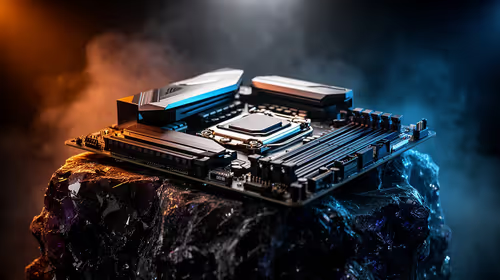
AM5 is smart for SA builders because it supports newer Ryzen CPUs, DDR5 memory, and a longer upgrade path. Compare board cost, cooling, gaming needs, and local part availability before choosing your next PC platform.
Read more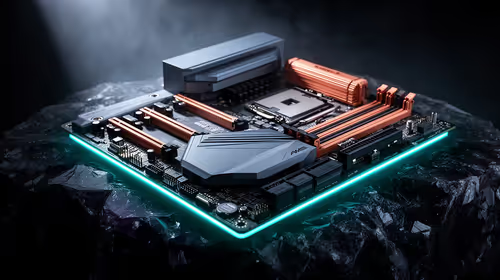
AM5 gives Randburg gaming builders a longer upgrade path. For SA buyers, DDR5 support, newer board features, and future CPU options can justify the platform. Weigh board cost, cooler support, BIOS maturity, and upgrade timing before choosing.
Read more
RTX 5090 on a 550W PSU leaves almost no practical room for OC plans. Treat the setup as constrained, with CPU draw, power spikes, cable quality, thermals, and stability checks more important than chasing extra clocks.
FPS drops on a Ryzen 9 9950X3D build often have a fixable cause. Check settings, drivers, thermals, background tasks, network conditions, and bottlenecks before assuming a part must be replaced.

The difference between PCIe 5.0 and PCIe 4.0 for SA gamers is mostly bandwidth headroom. Compare GPU slot needs, NVMe speed, motherboard support, and upgrade timing before paying extra for a newer platform.

Gaming PC stuck pixel checks in South Africa should confirm the monitor fault first. Use colour tests, screenshot comparison, cable swaps, display menu checks, and clear photos before deciding on support.

AMD's current driver now lists a Radeon RX 9050 4GB, while product coverage details a narrowed memory system. SA buyers should weigh the low VRAM ceiling against current local Radeon options.

Samsung Display has demonstrated a 16-inch 2.5K OLED laptop panel running at 300Hz. SA buyers should wait for a named notebook, full panel specifications and a local price before planning an upgrade.

Microsoft says some Windows 11 game crashes after recent updates are linked to RGB-related drivers. Affected SA gamers should confirm the update and driver before using the published registry workaround.
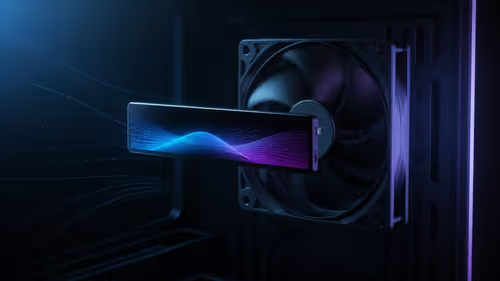
Thermalright's Fan Frame Vision-1 adds a 640x172 status screen to a standard 120mm fan. SA builders should check clearance, USB routing and local support before treating it as an easy upgrade.
1000W for RTX 5090 needs a full-build check, not a simple yes. Review GPU guidance, CPU draw, transient load, connectors, PSU quality, and upgrade plans before deciding.

Wi-Fi 6E vs Wi-Fi 6 matters for 4K video editing when files move across a network. The real-world difference between Wi-Fi 6E and Wi-Fi 6 for video editing in 4K depends on NAS access, cloud uploads, router range, and SA creator workflows.
RTX 5080 Super with a 750W PSU is more comfortable than lower wattage if the unit is quality. SA builders should still confirm GPU guidance, CPU draw, connector type, airflow, and upgrade room.
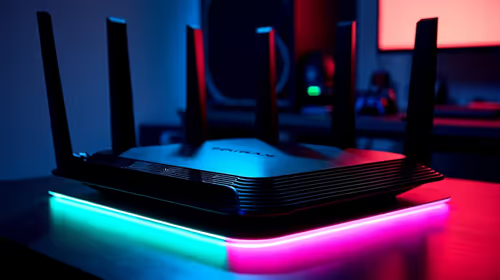
Wi-Fi 6E vs Wi-Fi 6 for Video Editing in 4K comes down to router support, latency, client devices, band support, and home network layout. SA buyers should match the choice to their setup instead of assuming one option always wins.