


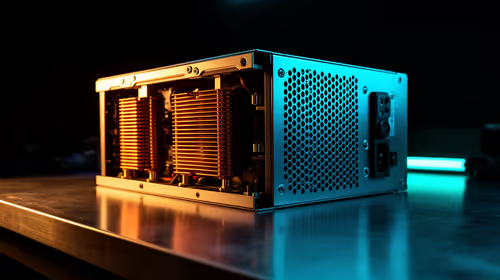
1000W PSU Planning for RTX 5090 Builds in SA
1000W for RTX 5090 needs a full-build check, not a simple yes. Review GPU guidance, CPU draw, transient load, connectors, PSU quality, and upgrade plans before deciding.
Read moreGood ping varies by genre: tactical shooters want well under 100ms, racing and fighting benefit from an even tighter margin, while turn-based and sim titles stay comfortable above 150ms. Judge a game by its genre threshold, not one blanket number.
A ping number has no meaning until you place it beside the game's timing demands and your own consistency. Good ping by game genre gives you a useful scale for shooters, fighters, racers and slower strategy titles.
Good ping depends on the game, but stability always matters. Under 30ms is excellent for fast local play. Around 30 to 60ms feels good in most genres. From 60 to 100ms, many games remain playable while tactical shooters and fighters begin exposing the delay. Above 100ms, slower MMOs, co-op, strategy and turn-based games can still work. Treat these as rough bands, then check jitter, packet loss and the title's own netcode.
Tactical shooters, fighting games and close online racing benefit from the lowest stable route available. Reaction windows, peeks, blocks and contact make every extra round trip visible.
Aim below 60ms when local or nearby servers make it possible. A steady 70ms can still be playable, while 40ms jumping to 140ms is a worse competitive tool.
Use the game's region selector and actual match statistics. Do not turn one universal number into a pass mark for every title.
Action RPGs, arena games and many cooperative titles can work through 60 to 100ms when prediction is good. Reactive dodges and host quality can change the result.
Traditional tab-target MMOs can tolerate a steady overseas route because rotations and global cooldowns give timing room. Competitive MMO modes can feel harsher than story content.
Turn-based strategy, card games and asynchronous play can stay comfortable above 150ms. The command arrives later without changing a split-second duel.
Packet loss still matters. A disconnected turn or failed save is frustrating even when the genre does not need low latency.
Watch ping variation, loss, frame time and display mode. Use Ethernet for the baseline and test during the hours you play.
Browse routers and networking hardware for stable home connections. The popular accessories range can help complete a compatible wired setup.
Play three normal sessions on Ethernet and write down the server, mode, ping range and any loss warning. Add one note about how the controls felt. That gives you a personal ceiling for the exact game.
Repeat when the house is busy. If 55ms becomes 120ms during an upload, the route did not move; the home queue added delay. If the number stays steady and the controls still feel late, inspect frame time, controller response and display processing.
Use the rough bands to choose what to test first. Let repeated play decide what you keep.
Write down the worst stable result you still enjoyed. That is more useful than somebody else's ideal number.
No. It is a disadvantage in fast competitive play and can feel fine in slower, turn-based or predictive systems.
No. Packet loss and large swings can make the lower average feel worse than a steady route.
Jitter, packet loss, frame time, display delay and queue health all shape the result.
Match your measured ping to the game's timing model, then test stability in the exact mode you plan to play.
No. It is a disadvantage in fast competitive play and can feel fine in slower, turn-based or predictive systems.
No. Packet loss and large swings can make the lower average feel worse than a steady route.
Jitter, packet loss, frame time, display delay and queue health all shape the result.
1000W for RTX 5090 needs a full-build check, not a simple yes. Review GPU guidance, CPU draw, transient load, connectors, PSU quality, and upgrade plans before deciding.
Read more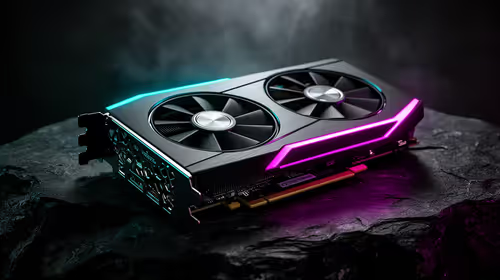
RTX 5080 Super with a 750W PSU is more comfortable than lower wattage if the unit is quality. SA builders should still confirm GPU guidance, CPU draw, connector type, airflow, and upgrade room.
Read more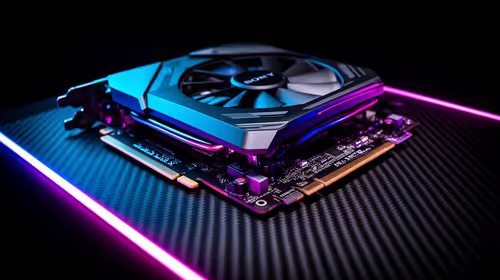
How to fix FPS drops after a RX 9070 XT starts with driver cleanup, chipset updates, thermals, and power checks. For SA gaming PCs, confirm PCIe seating, monitor refresh, frame caps, and per-game graphics settings before replacing parts.
Read more
How to fix low FPS Windows 11 Wi-Fi 7 issues starts by checking whether the problem is frame rate or network lag. Test ping, drivers, power settings, Ethernet, and game FPS before adjusting visuals.
Read more
AM5 is smart for SA builders because it supports newer Ryzen CPUs, DDR5 memory, and a longer upgrade path. Compare board cost, cooling, gaming needs, and local part availability before choosing your next PC platform.
Read more
AM5 gives Randburg gaming builders a longer upgrade path. For SA buyers, DDR5 support, newer board features, and future CPU options can justify the platform. Weigh board cost, cooler support, BIOS maturity, and upgrade timing before choosing.
Read more
RTX 5090 on a 550W PSU leaves almost no practical room for OC plans. Treat the setup as constrained, with CPU draw, power spikes, cable quality, thermals, and stability checks more important than chasing extra clocks.
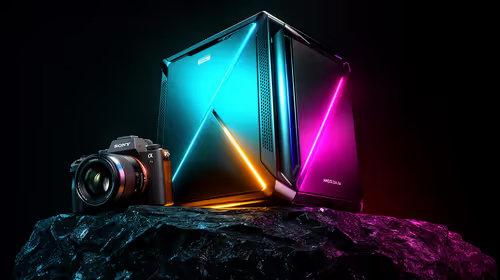
FPS drops on a Ryzen 9 9950X3D build often have a fixable cause. Check settings, drivers, thermals, background tasks, network conditions, and bottlenecks before assuming a part must be replaced.

The difference between PCIe 5.0 and PCIe 4.0 for SA gamers is mostly bandwidth headroom. Compare GPU slot needs, NVMe speed, motherboard support, and upgrade timing before paying extra for a newer platform.

Gaming PC stuck pixel checks in South Africa should confirm the monitor fault first. Use colour tests, screenshot comparison, cable swaps, display menu checks, and clear photos before deciding on support.

AMD's current driver now lists a Radeon RX 9050 4GB, while product coverage details a narrowed memory system. SA buyers should weigh the low VRAM ceiling against current local Radeon options.

Samsung Display has demonstrated a 16-inch 2.5K OLED laptop panel running at 300Hz. SA buyers should wait for a named notebook, full panel specifications and a local price before planning an upgrade.

Microsoft says some Windows 11 game crashes after recent updates are linked to RGB-related drivers. Affected SA gamers should confirm the update and driver before using the published registry workaround.
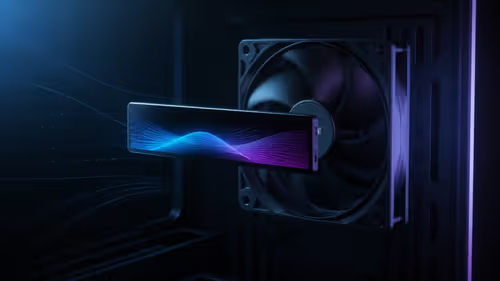
Thermalright's Fan Frame Vision-1 adds a 640x172 status screen to a standard 120mm fan. SA builders should check clearance, USB routing and local support before treating it as an easy upgrade.
1000W for RTX 5090 needs a full-build check, not a simple yes. Review GPU guidance, CPU draw, transient load, connectors, PSU quality, and upgrade plans before deciding.

Wi-Fi 6E vs Wi-Fi 6 matters for 4K video editing when files move across a network. The real-world difference between Wi-Fi 6E and Wi-Fi 6 for video editing in 4K depends on NAS access, cloud uploads, router range, and SA creator workflows.
RTX 5080 Super with a 750W PSU is more comfortable than lower wattage if the unit is quality. SA builders should still confirm GPU guidance, CPU draw, connector type, airflow, and upgrade room.
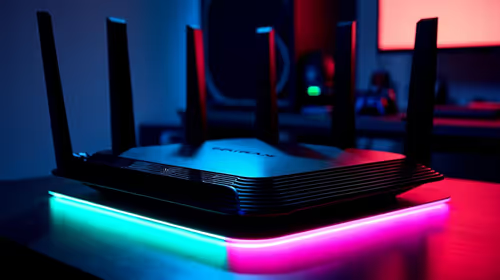
Wi-Fi 6E vs Wi-Fi 6 for Video Editing in 4K comes down to router support, latency, client devices, band support, and home network layout. SA buyers should match the choice to their setup instead of assuming one option always wins.