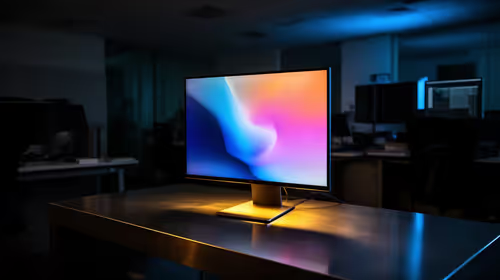
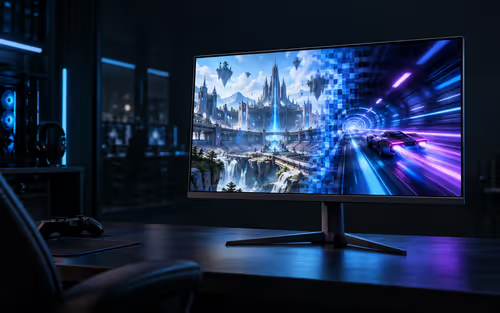
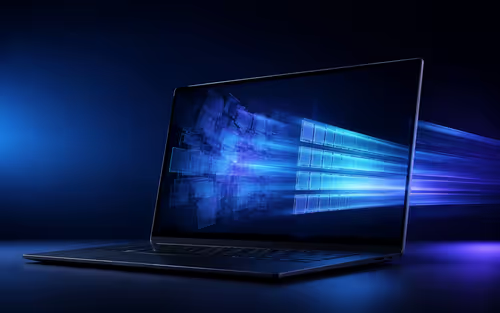
A Dell touchscreen laptop is most useful when a hand reaching for the display saves a real step. Marking a document, signing a form, presenting to a small group or navigating a visual app can feel more direct with touch. If the screen will simply mirror what you already do with a trackpad, it may add cost and reflective glass without changing the day.
Quick Answer
Choose a Dell touch design by deciding whether you need a conventional laptop with touch or a convertible hinge that can take tablet-style positions. Confirm active-pen support separately, because touch input alone does not promise it. A R199 entry dock can be a modest part of a fixed desk arrangement, but the laptop ports still decide what that desk can do.
✅ Begin with the gesture, not the feature list
Write down the moments where touch would be used. A lecturer may annotate slides, an architect may review diagrams with a client, and a student may scroll readings while standing at a lab bench. Those are different needs from occasional web browsing, and they can point to different screen sizes, hinges and pen requirements.
A fixed-hinge touchscreen remains a laptop first. It often makes sense for quick taps and signatures while preserving a familiar typing position. A 2-in-1 earns its moving parts when tent, presentation or folded positions will be used regularly. Hold a convertible in the modes you expect to use; the attached keyboard and overall weight can make it feel unlike a dedicated tablet.
The Dell laptop range is useful for comparing real configurations, but do not assume a family label means every option has the same panel or input features. Read the specifications for the exact configuration that matches the work routine.
📶 Check glare where the laptop will live
Touch displays frequently have a glossy surface. That can make photographs and video appear vivid, yet a South African office with strong daylight or a student room near a sunny window can turn reflections into a daily annoyance. Test black text on a pale document, a video call and a dark screen in similar light before committing.
Brightness, resolution and colour are related but separate. A high-resolution panel can make fine text look neat, while adequate brightness can matter more when moving between rooms. If image work is part of the role, view known colours and inspect how the screen responds at the scaling level used in the relevant applications.
🧩 Pen input needs its own confirmation
Do not buy a stylus on the assumption that every touchscreen is a drawing screen. Active-pen support, pressure response, palm rejection and the compatible pen standard vary by model. A finger can navigate a panel that does not support the writing experience needed for handwritten notes or detailed marking.
For an existing workflow, use the AI laptop finder to narrow requirements such as screen format and everyday workload, then validate pen compatibility in the final specification. That separates discovery from the final technical check.
🔌 Keep the screen feature from complicating the desk
Touch is mainly a portable-use feature, while a desk may still need external monitors, a keyboard, storage and wired networking. The docking station selection can help create a one-cable routine, but check power delivery and display support against the actual Dell configuration. The touch panel does not tell you whether the USB-C port handles the required workload.
For local ownership, ask how screen and hinge repairs are handled under the warranty. South African support clarity matters because a damaged touch layer can require a more specialised repair than an external mouse or ordinary peripheral.
Frequently Asked Questions
Is every Dell touchscreen laptop convertible?
No. Some use a standard hinge and add touch to a conventional laptop design, while a 2-in-1 has positions beyond the normal typing angle.
What work improves with a touchscreen?
Direct navigation, light annotation, signatures and presenting can become quicker when they already occur often. A keyboard-and-trackpad workflow may gain little from the extra layer.
Does every Dell touch display support a pen?
No. Confirm the screen, pen protocol and intended stylus for the exact model rather than relying on the word touchscreen.
How should I assess glare?
Use the display beside a bright window and under the lighting of your own workspace. Reflections can make a good panel unpleasant in a particular room.
Does touch make a laptop more fragile?
The extra display layer adds complexity, and a convertible adds a moving hinge. A protective sleeve and careful handling remain sensible for any machine that travels.
Ready to choose touch for a useful reason?
Compare Dell laptop designs against the screen, pen and desk setup you will actually use.