


1000W PSU Planning for RTX 5090 Builds in SA
1000W for RTX 5090 needs a full-build check, not a simple yes. Review GPU guidance, CPU draw, transient load, connectors, PSU quality, and upgrade plans before deciding.
Read moreDGX OS is Nvidia's Ubuntu-based Linux distribution built for its DGX AI systems, bundling GPU drivers, CUDA and container tools for data scientists. It is not aimed at gaming pc users; it targets Nvidia's enterprise hardware running machine learning workloads.
The name makes DGX OS sound like a special version of Windows for an unusually powerful graphics card. It is nothing of the sort. NVIDIA built it for DGX systems: enterprise machines used to train, test and run AI, machine-learning and analytics workloads.
DGX OS is NVIDIA's customised Ubuntu Linux installation for its DGX supercomputers. It combines a tested operating-system base with NVIDIA drivers, system-specific configuration, monitoring tools and access to the CUDA and container software used in AI environments. It is not a gaming OS and is not a reason to replace Windows on a normal gaming PC. For scale, Evetech listed an AMD Ryzen 5 5500/Intel Arc A380 gaming PC at R11,969 as of July 2026; that consumer machine and a DGX system serve fundamentally different jobs.
Ubuntu supplies the Linux foundation. NVIDIA then adds and validates the pieces needed to operate DGX hardware as a supported AI platform. These include an NVIDIA-optimised kernel, GPU-driver options, hardware diagnostics, monitoring utilities and system-specific configurations.
The result is less about a new desktop experience and more about reducing integration work. A data-centre team does not want to discover halfway through a training run that its kernel, driver, networking stack and container runtime were assembled from an incompatible mix of versions. DGX OS gives that team a known starting point.
CUDA is part of the wider software story, but there is an important nuance: NVIDIA's DGX documentation says CUDA Toolkit availability depends on the DGX OS release and system type. It is safer to think of DGX OS as providing the supported route to NVIDIA's compute stack, not as a frozen bundle in which every tool is always pre-installed.
DGX hardware is designed around parallel compute, large AI models, high-speed data movement and multi-GPU operation. Gaming PCs are designed around interactive performance, display output, game compatibility and normal desktop use. Both may use NVIDIA technology, but the overlap does not make their operating systems interchangeable.
Installing DGX software will not unlock hidden gaming performance. Game support, anti-cheat compatibility, graphics settings and peripheral software remain stronger reasons to choose a mainstream gaming environment. Anyone shopping the gaming-PC deals or PC best-sellers should choose hardware around the games and applications they will actually run, not around the DGX label.
DGX OS 6 is based on Ubuntu 22.04. NVIDIA customises and validates it for supported DGX systems.
No. It targets AI, machine-learning and analytics workloads on NVIDIA DGX hardware.
The DGX OS image is intended for supported DGX systems. NVIDIA documents a DGX software stack for Ubuntu, but that does not turn an ordinary PC into supported DGX hardware.
It depends on the release and DGX model. NVIDIA provides access to qualified CUDA versions, while some server installations make the toolkit optional.
AI researchers, data scientists and infrastructure teams operating DGX workstations, servers or clusters.
NVIDIA distributes DGX OS for DGX customers under its software terms. The practical cost is tied to the supported DGX platform and enterprise environment, not a consumer desktop licence.
It adds NVIDIA-tested drivers, configurations, diagnostics and platform tools for DGX hardware, reducing the integration work required from the system administrator.
Need a PC for gaming or local AI experiments? Start with the workload, software and GPU memory you actually need. Evetech's gaming-PC range is built for consumer desktop use; DGX OS belongs to a different, enterprise-class platform.
DGX OS 6 is based on Ubuntu 22.04. NVIDIA customises and validates it for supported DGX systems.
No. It targets AI, machine-learning and analytics workloads on NVIDIA DGX hardware.
The DGX OS image is intended for supported DGX systems. NVIDIA documents a DGX software stack for Ubuntu, but that does not turn an ordinary PC into supported DGX hardware.
It depends on the release and DGX model. NVIDIA provides access to qualified CUDA versions, while some server installations make the toolkit optional.
AI researchers, data scientists and infrastructure teams operating DGX workstations, servers or clusters.
NVIDIA distributes DGX OS for DGX customers under its software terms. The practical cost is tied to the supported DGX platform and enterprise environment, not a consumer desktop licence.
It adds NVIDIA-tested drivers, configurations, diagnostics and platform tools for DGX hardware, reducing the integration work required from the system administrator.
1000W for RTX 5090 needs a full-build check, not a simple yes. Review GPU guidance, CPU draw, transient load, connectors, PSU quality, and upgrade plans before deciding.
Read more
RTX 5080 Super with a 750W PSU is more comfortable than lower wattage if the unit is quality. SA builders should still confirm GPU guidance, CPU draw, connector type, airflow, and upgrade room.
Read more
How to fix FPS drops after a RX 9070 XT starts with driver cleanup, chipset updates, thermals, and power checks. For SA gaming PCs, confirm PCIe seating, monitor refresh, frame caps, and per-game graphics settings before replacing parts.
Read more
How to fix low FPS Windows 11 Wi-Fi 7 issues starts by checking whether the problem is frame rate or network lag. Test ping, drivers, power settings, Ethernet, and game FPS before adjusting visuals.
Read more
AM5 is smart for SA builders because it supports newer Ryzen CPUs, DDR5 memory, and a longer upgrade path. Compare board cost, cooling, gaming needs, and local part availability before choosing your next PC platform.
Read more
AM5 gives Randburg gaming builders a longer upgrade path. For SA buyers, DDR5 support, newer board features, and future CPU options can justify the platform. Weigh board cost, cooler support, BIOS maturity, and upgrade timing before choosing.
Read more
RTX 5090 on a 550W PSU leaves almost no practical room for OC plans. Treat the setup as constrained, with CPU draw, power spikes, cable quality, thermals, and stability checks more important than chasing extra clocks.
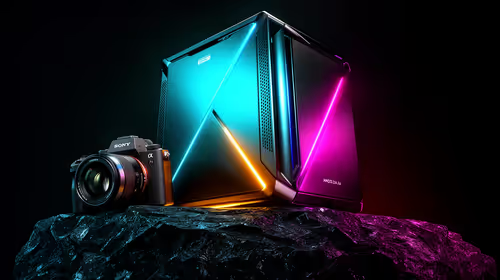
FPS drops on a Ryzen 9 9950X3D build often have a fixable cause. Check settings, drivers, thermals, background tasks, network conditions, and bottlenecks before assuming a part must be replaced.

The difference between PCIe 5.0 and PCIe 4.0 for SA gamers is mostly bandwidth headroom. Compare GPU slot needs, NVMe speed, motherboard support, and upgrade timing before paying extra for a newer platform.

Gaming PC stuck pixel checks in South Africa should confirm the monitor fault first. Use colour tests, screenshot comparison, cable swaps, display menu checks, and clear photos before deciding on support.

AMD's current driver now lists a Radeon RX 9050 4GB, while product coverage details a narrowed memory system. SA buyers should weigh the low VRAM ceiling against current local Radeon options.

Samsung Display has demonstrated a 16-inch 2.5K OLED laptop panel running at 300Hz. SA buyers should wait for a named notebook, full panel specifications and a local price before planning an upgrade.

Microsoft says some Windows 11 game crashes after recent updates are linked to RGB-related drivers. Affected SA gamers should confirm the update and driver before using the published registry workaround.
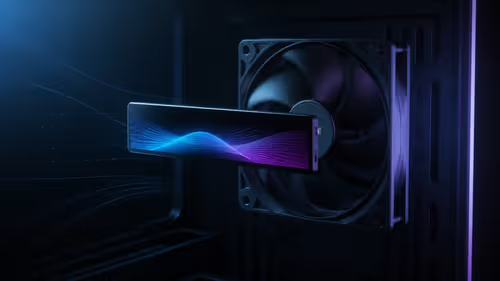
Thermalright's Fan Frame Vision-1 adds a 640x172 status screen to a standard 120mm fan. SA builders should check clearance, USB routing and local support before treating it as an easy upgrade.
1000W for RTX 5090 needs a full-build check, not a simple yes. Review GPU guidance, CPU draw, transient load, connectors, PSU quality, and upgrade plans before deciding.

Wi-Fi 6E vs Wi-Fi 6 matters for 4K video editing when files move across a network. The real-world difference between Wi-Fi 6E and Wi-Fi 6 for video editing in 4K depends on NAS access, cloud uploads, router range, and SA creator workflows.
RTX 5080 Super with a 750W PSU is more comfortable than lower wattage if the unit is quality. SA builders should still confirm GPU guidance, CPU draw, connector type, airflow, and upgrade room.
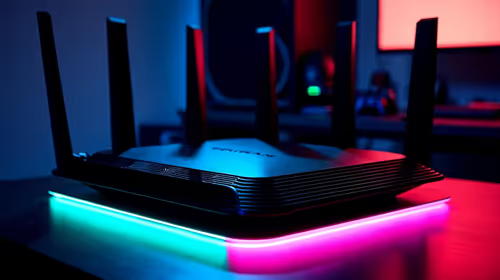
Wi-Fi 6E vs Wi-Fi 6 for Video Editing in 4K comes down to router support, latency, client devices, band support, and home network layout. SA buyers should match the choice to their setup instead of assuming one option always wins.