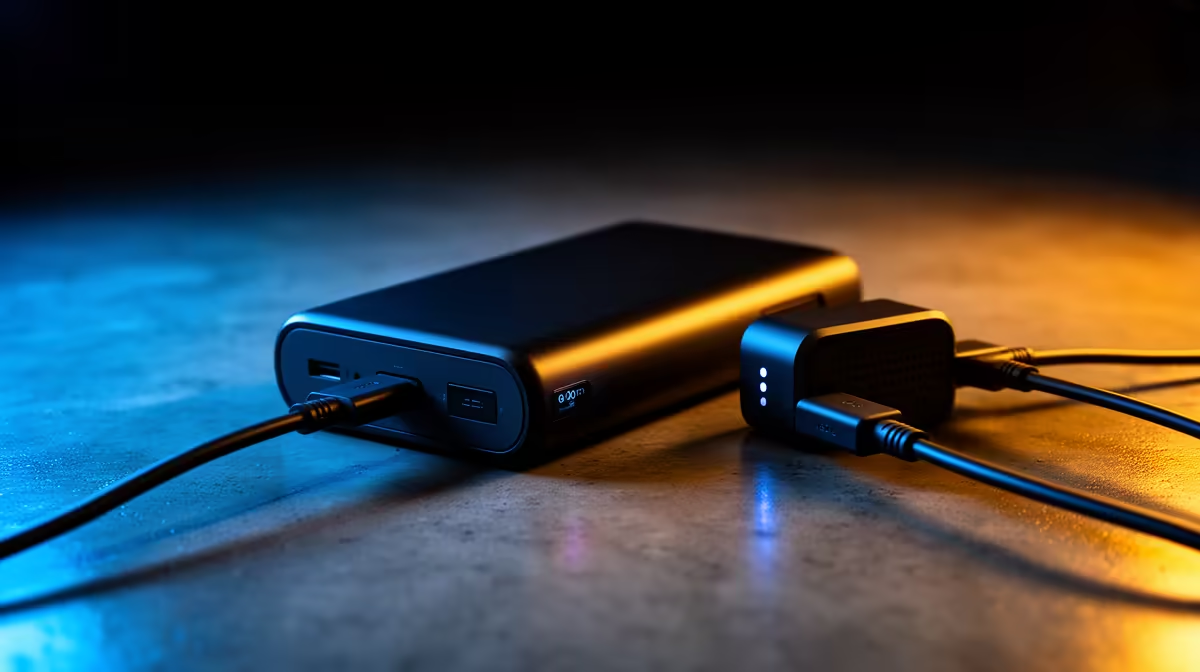
A power bank can match a router's voltage and still reboot it during the switch between input and battery. Using a power bank as a router UPS requires supported pass-through operation, correct output and a real interruption test.
Quick Answer
A power bank can keep selected routers running only when voltage, power, connector, polarity, negotiation, and pass-through behaviour all match. USB-C Power Delivery support on the bank does not mean the router accepts USB-C input. Many routers use fixed-voltage DC barrel connectors.
Compare the router power requirements across the networking range, then check cables and backup accessories among accessories best sellers. A purpose-built mini UPS can provide seamless transfer when its exact outputs suit the equipment; the product type alone is no guarantee.
Match the electrical details
Read the router adapter label and manual for input voltage, current, polarity, and connector. If an ONT or mesh node is also required, record each device separately.
A USB-C trigger cable can request a fixed PD voltage from a compatible bank and convert only when designed to do so. An incorrect trigger, barrel size, or polarity can damage the router. Use a supported exact solution rather than combining anonymous adapters.
Check whether the bank supplies enough continuous power and whether it turns off under a low router load. Some banks stop output when they think no device is connected.
Prove pass-through before relying on it
Pass-through charging means the bank can receive power while supplying a load under stated conditions. It does not guarantee UPS-style no-break transfer. Some models interrupt output when mains appears or disappears.
Connect a non-critical compatible test device or the router under safe controlled conditions. Remove input power through the supported method and watch for reboot, link drop, heat, or output shutdown. Repeat when mains returns.
Check whether simultaneous charging and discharging is permitted for continuous use. Heat and battery wear can rise. Keep the bank ventilated and stop using it after swelling, leakage, unusual smell, damage, or unsafe temperature.
Calculate runtime from usable energy
Battery-bank capacity labels may use internal cell voltage. Conversion to the router's output voltage loses energy. Use model-level usable-energy data where available and verify through a measured runtime test.
Include ONT, gateway, switches, and mesh nodes needed for the actual internet path. Powering the router alone cannot keep fibre online when the ONT is off.
Label the bank, trigger cable, output mode, and router it serves. Similar barrel plugs can carry different voltages, so storage discipline is part of the safety plan.
FAQ
Can any USB-C bank power a router?
No. The bank output modes, router input, cable or trigger, voltage, current, polarity, and connector must all match.
Will a power bank switch without rebooting the router?
Only a tested model and connection can answer. Pass-through may include an interruption. Run a controlled input-loss and return test.
Is a mini UPS safer?
It can be a cleaner purpose-built route when its exact outputs, batteries, transfer, connectors, and protections suit the devices. Verify model-level compatibility and runtime.
Read every router power requirement, use an approved matching cable path, and test both loss and return of mains before trusting a power bank as backup.