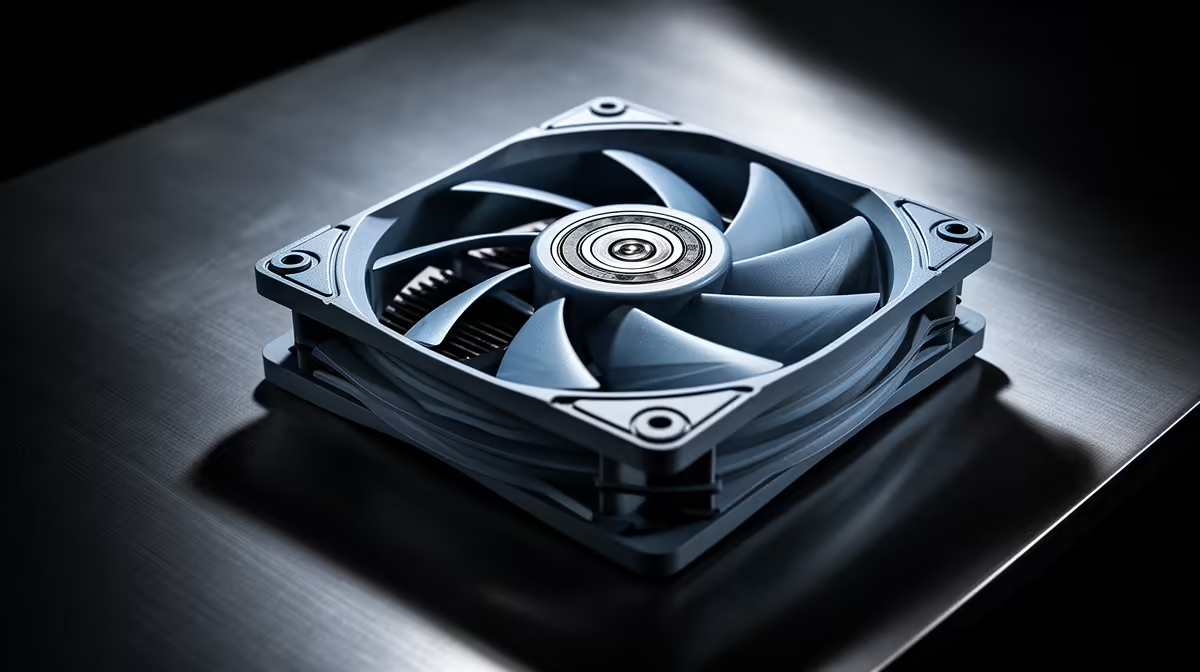
Noise is a real spec, measured in dBA. A quiet build lives or dies by fan and pump noise, not by raw cooling alone. For premium buyers, this is where a few hundred rand spent well keeps the CPU fast and the room calm.
Quick Answer
Yes, noise level matters: a 65 W chip is happy on a R250 to R500 tower, a 105 W chip wants a strong R600 to R1,200 dual-tower or 240 mm AIO, and a 170 W flagship needs a 280 to 360 mm AIO (R1,800 to R3,500). Match the cooler's rated TDP and height to your CPU and case, and check it clears tall RAM.
How much cooling you actually need
Pick by CPU power draw: a Ryzen 5 or Core i5 (around 65 to 88 W) runs cool and quiet on a good R350 to R600 air tower. A Ryzen 7/9 or Core i7/i9 (105 to 170 W) needs a dual-tower air cooler or a 240 to 360 mm AIO to avoid throttling under sustained load. Overbuying a 360 mm AIO for a 65 W chip just adds cost and pump noise for no real temperature win.
Fit, mounting and noise for premium buyers
For premium buyers, check three numbers before you buy: cooler height versus case clearance (commonly 155 to 170 mm for ATX towers), RAM clearance, and rated noise in dBA. A secure mount with fresh, evenly spread thermal paste drops temperatures more than people expect, so do not rush it. For a quiet result, target fans rated under 30 dBA at load and set a gentle fan curve in the BIOS so they only ramp when the CPU is genuinely hot.
FAQ
Air cooler or AIO for my CPU?
Air is cheaper, quieter long-term and has no pump to fail; a good dual-tower handles up to ~200 W. An AIO frees space around the socket and looks cleaner, and suits 360 mm sizes for flagship chips.
How do I know if my cooler fits?
Check the cooler's height against your case's listed CPU clearance, and confirm RAM and top-port clearance. SFF cases often cap height near 70 mm, so they need low-profile coolers.
Does thermal paste really matter?
Yes. A poor application can cost several degrees, while a clean, even layer lets the cooler perform to spec. Reapply if you ever remove the cooler, and never reuse old dried paste.
gentle fan curve in the BIOS so fans idle low and only ramp above 70 C. It cuts noise without raising temperatures in any real workload.