


1000W PSU Planning for RTX 5090 Builds in SA
1000W for RTX 5090 needs a full-build check, not a simple yes. Review GPU guidance, CPU draw, transient load, connectors, PSU quality, and upgrade plans before deciding.
Read moreRainbow Six Siege has explored South African hosting tied to Microsoft's Azure data centres in the region, though matchmaking availability can vary by playlist and current population. Confirm the active region list in-game rather than relying on older announcements.
A local data centre announcement does not guarantee every Siege playlist will place you there today. Confirm Rainbow Six Siege South African servers from current in-game routing, then compare latency across the modes and hours you use.
Rainbow Six Siege has used South African hosting, but an old Azure announcement cannot prove the data centre serving every July 2026 match. Read the data-centre name or code shown by the current game and check the match ping. Playlist population and service changes can place different players on different routes. If the client shows a South African centre with local latency, you have the practical yes for that session. If it names Europe or another location, troubleshoot the selection and queue with current Ubisoft guidance.
Open Siege and locate the connection or data-centre display exposed by the current interface. Ubisoft can move this detail between menus and overlays.
Record the name, ping and packet-loss behaviour in a popular playlist. Test again outside peak time. A local-looking number with a named South African code is better evidence than an old article.
Do not edit configuration files to force a centre from a copied guide. The control may be unsupported, outdated or different across platforms.
Rank, mode, platform pool, party and time affect who can be matched. A thin playlist can wait longer or use a broader route according to the current system.
Test solo and with the usual party. Make sure everybody has updated the game and review cross-play settings where supported.
If one playlist routes poorly, compare a standard mode before blaming the whole regional service.
Use Ethernet and pause uploads. Track both average ping and variation during a round. A router can reduce wireless and queueing problems, but it cannot reactivate Ubisoft capacity.
Browse networking and router options for stable wired and wireless coverage. Pick any missing lead or interface part from the current accessories list after checking your platform ports.
Take a screenshot of the data-centre code and network statistics without exposing player chat or account details. Add the platform, playlist, party size and time.
Repeat once on Ethernet after restarting the client. If the same overseas centre appears, check Ubisoft service status and open a support case with the two results.
For an ISP report, include the destination code and route change rather than saying Siege feels bad. A traceroute can add context, though diagnostic hops do not prove the exact game traffic path.
Keep the evidence after the issue resolves. It gives you a known-good local code and ping for the next comparison.
South African hosting has existed, but use the current in-game centre code and ping to confirm the service for your match.
Playlist population, party, service state, ISP routing or a different selected centre can change the path.
Avoid old unofficial edits. Follow the current Ubisoft and platform controls exposed for your version.
Record Siege's current data-centre code in two playlists, then troubleshoot the route shown rather than relying on a launch-era server list.
South African hosting has existed, but use the current in-game centre code and ping to confirm the service for your match.
Playlist population, party, service state, ISP routing or a different selected centre can change the path.
Avoid old unofficial edits. Follow the current Ubisoft and platform controls exposed for your version.
1000W for RTX 5090 needs a full-build check, not a simple yes. Review GPU guidance, CPU draw, transient load, connectors, PSU quality, and upgrade plans before deciding.
Read more
RTX 5080 Super with a 750W PSU is more comfortable than lower wattage if the unit is quality. SA builders should still confirm GPU guidance, CPU draw, connector type, airflow, and upgrade room.
Read more
How to fix FPS drops after a RX 9070 XT starts with driver cleanup, chipset updates, thermals, and power checks. For SA gaming PCs, confirm PCIe seating, monitor refresh, frame caps, and per-game graphics settings before replacing parts.
Read more
How to fix low FPS Windows 11 Wi-Fi 7 issues starts by checking whether the problem is frame rate or network lag. Test ping, drivers, power settings, Ethernet, and game FPS before adjusting visuals.
Read more
AM5 is smart for SA builders because it supports newer Ryzen CPUs, DDR5 memory, and a longer upgrade path. Compare board cost, cooling, gaming needs, and local part availability before choosing your next PC platform.
Read more
AM5 gives Randburg gaming builders a longer upgrade path. For SA buyers, DDR5 support, newer board features, and future CPU options can justify the platform. Weigh board cost, cooler support, BIOS maturity, and upgrade timing before choosing.
Read more
RTX 5090 on a 550W PSU leaves almost no practical room for OC plans. Treat the setup as constrained, with CPU draw, power spikes, cable quality, thermals, and stability checks more important than chasing extra clocks.
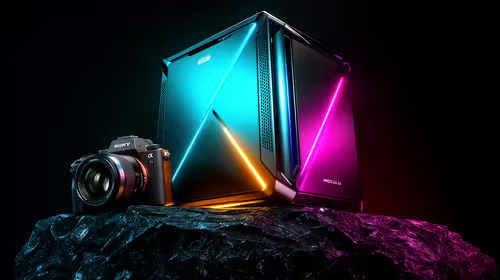
FPS drops on a Ryzen 9 9950X3D build often have a fixable cause. Check settings, drivers, thermals, background tasks, network conditions, and bottlenecks before assuming a part must be replaced.

The difference between PCIe 5.0 and PCIe 4.0 for SA gamers is mostly bandwidth headroom. Compare GPU slot needs, NVMe speed, motherboard support, and upgrade timing before paying extra for a newer platform.

Gaming PC stuck pixel checks in South Africa should confirm the monitor fault first. Use colour tests, screenshot comparison, cable swaps, display menu checks, and clear photos before deciding on support.

AMD's current driver now lists a Radeon RX 9050 4GB, while product coverage details a narrowed memory system. SA buyers should weigh the low VRAM ceiling against current local Radeon options.

Samsung Display has demonstrated a 16-inch 2.5K OLED laptop panel running at 300Hz. SA buyers should wait for a named notebook, full panel specifications and a local price before planning an upgrade.

Microsoft says some Windows 11 game crashes after recent updates are linked to RGB-related drivers. Affected SA gamers should confirm the update and driver before using the published registry workaround.
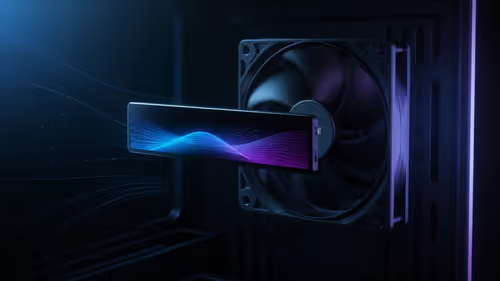
Thermalright's Fan Frame Vision-1 adds a 640x172 status screen to a standard 120mm fan. SA builders should check clearance, USB routing and local support before treating it as an easy upgrade.
1000W for RTX 5090 needs a full-build check, not a simple yes. Review GPU guidance, CPU draw, transient load, connectors, PSU quality, and upgrade plans before deciding.

Wi-Fi 6E vs Wi-Fi 6 matters for 4K video editing when files move across a network. The real-world difference between Wi-Fi 6E and Wi-Fi 6 for video editing in 4K depends on NAS access, cloud uploads, router range, and SA creator workflows.
RTX 5080 Super with a 750W PSU is more comfortable than lower wattage if the unit is quality. SA builders should still confirm GPU guidance, CPU draw, connector type, airflow, and upgrade room.
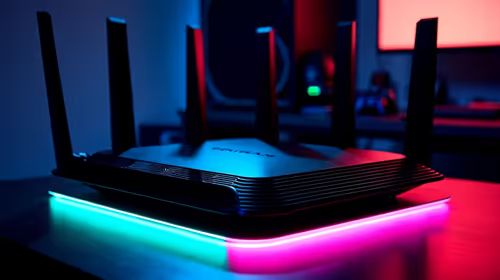
Wi-Fi 6E vs Wi-Fi 6 for Video Editing in 4K comes down to router support, latency, client devices, band support, and home network layout. SA buyers should match the choice to their setup instead of assuming one option always wins.