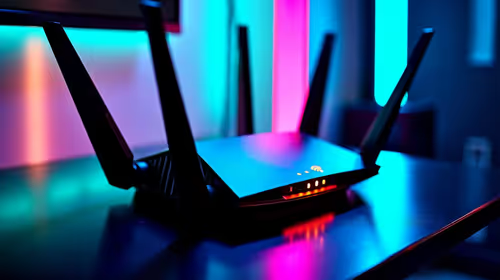
An extra router band can give mesh backhaul or busy clients a separate radio, but it cannot create more internet capacity. Dual-band vs tri-band routers should be compared through household traffic, layout and the exact band design.
Quick Answer
Dual-band and tri-band describe available radio bands, but tri-band designs differ. Some add another 5GHz radio; newer models may add 6GHz. The extra band can separate busy wireless clients or provide mesh backhaul. It does not guarantee lower gaming ping. Count your compatible devices, coverage and simultaneous traffic, then test whether one radio is congested.
Use Evetech's networking catalogue to compare the exact radio layout and wired backhaul support. For cabling or a supporting device, check current accessory best sellers. Band count needs model-level detail.
Understand the bands you are buying
A common dual-band router offers 2.4GHz and 5GHz. A tri-band model may provide two 5GHz radios or 2.4GHz, 5GHz and 6GHz. Client compatibility, range and regional rules determine which devices can use them.
6GHz can offer cleaner spectrum and wide channels at shorter practical range, while older devices cannot see it. A second 5GHz radio can divide clients or serve mesh backhaul according to the design.
Count active devices, not registrations
Forty remembered devices do not equal forty busy devices. Record which PCs, consoles, televisions, phones and cameras transfer at the same time during your gaming hour.
One wired gaming PC and a quiet phone can work well on dual-band. A wireless mesh, several high-quality streams and compatible gaming devices may benefit from another radio.
Smart sensors can add airtime through retries without moving much data. Inspect signal and radio use rather than using device count as a purchase trigger.
Band steering needs testing
Automatic steering can place compatible clients on a suitable band. It can also move a device at an awkward moment or keep a sticky client attached to a distant node.
Test the gaming device from its normal position. Pin it to a clean band only when the router supports that design and the result remains stable. Ethernet is still preferable for a fixed competitive station.
Mesh changes the value of a third band
A wireless mesh can use one radio for communication between nodes or share a client band for backhaul, according to the model. A dedicated backhaul radio may preserve more client airtime, while wired backhaul can remove that need.
Read the exact mesh topology and test through the satellite node. Tri-band on the main router does not guarantee that every node has the same radios or uses them in the same way.
Place nodes where they still receive a strong link, rather than in the dead zone. More bands cannot recover a weak backhaul through concrete walls.
For a small flat with one central router and wired gaming PC, dual-band may already cover the real load. Spend only when another band solves a measured radio or mesh conflict.
FAQ
Does tri-band mean lower ping?
No. It can reduce wireless contention. Internet routing and a clean dual-band setup may produce the same baseline.
How many devices justify it?
No fixed number. Count simultaneous wireless traffic, mesh backhaul and compatible clients during the busy hour.
Which band should a PC use?
Use Ethernet where practical. Otherwise test the clean compatible band with the strongest stable signal and lowest variation.
Identify the exact third radio, measure simultaneous wireless load, and buy tri-band only when it separates a proven client or backhaul bottleneck.