


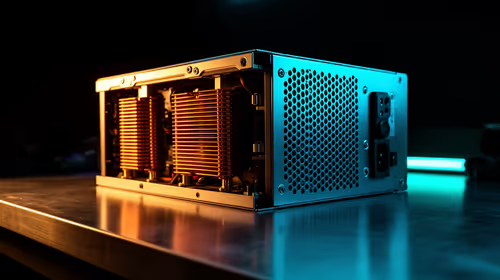
1000W PSU Planning for RTX 5090 Builds in SA
1000W for RTX 5090 needs a full-build check, not a simple yes. Review GPU guidance, CPU draw, transient load, connectors, PSU quality, and upgrade plans before deciding.
Read moreFCLK is the Infinity Fabric clock and UCLK is the memory controller clock on Ryzen, and a 1:1 ratio with memory clock generally gives the lowest latency before diminishing returns set in. Evetech notes most Ryzen builds land that sweet spot near DDR5-6000.
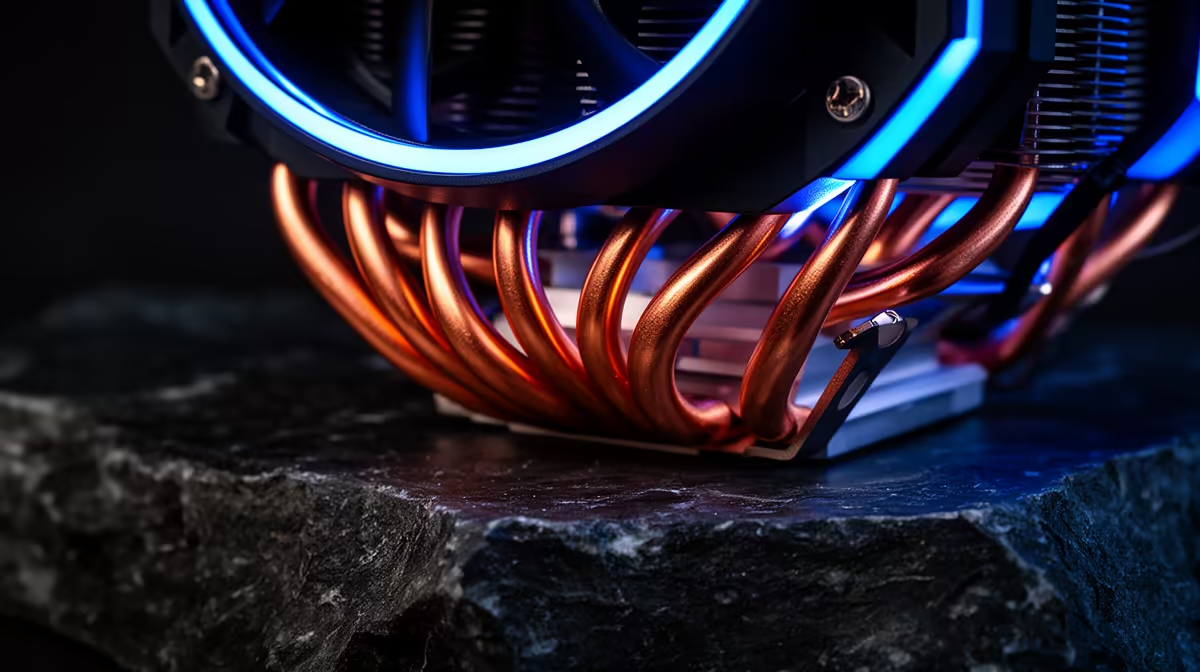
Ryzen memory tuning involves more clocks than the DDR5 number printed on the kit. FCLK and UCLK ratios explain why a balanced controller and fabric setup can beat a higher memory frequency with added latency.
On Ryzen, FCLK is the Infinity Fabric clock and UCLK is the memory-controller clock. MCLK is the physical memory clock behind the DDR data rate. On current DDR5 Ryzen platforms, UCLK can run one-to-one or one-to-two with MCLK, while FCLK is tuned as a separate clock. The old rule that FCLK, UCLK and MCLK must all stay one-to-one comes from DDR4-era Ryzen and should not be copied onto every AM5 build.
A DDR5-6000 kit transfers at 6,000 mega transfers per second and has a 3,000MHz memory clock. A UCLK value around 3,000MHz represents one-to-one operation with MCLK. A UCLK around 1,500MHz represents one-to-two.
FCLK may sit near another value chosen by the platform. Firmware, CPU generation and memory settings decide the working range. Read current motherboard guidance for the exact processor rather than forcing an internet sweet spot.
Keeping UCLK equal to MCLK can reduce the controller-latency penalty at data rates the CPU can handle. At high DDR5 speeds, switching UCLK to half rate may let the memory reach a larger bandwidth figure with more latency.
That creates a crossover, not a universal winner. Test memory latency, bandwidth and the applications you use. A game sensitive to memory delay can favour the lower ratio, while another workload may use added bandwidth.
Raising FCLK can help some transfers and hurt stability beyond the CPU's comfortable point. Symptoms can include corrected hardware errors, USB faults, audio crackle or application crashes.
Start with Auto. Save a baseline of clocks and voltages, then change one clock in small steps. Check Windows Event Viewer for hardware errors and run memory plus mixed CPU tests.
Keep SoC and memory-controller voltages within current AMD and motherboard guidance. A value copied from another CPU can add heat without making your sample stable.
Do not assume a boot proves success. Sleep, idle and several days of ordinary work can expose a weak fabric setting.
EXPO applies a rated set of memory timings and voltage, but the CPU memory controller is part of the result. Two processors of the same model can have different margins.
Use the DDR5 memory range to match capacity and profile support. Check the memory best-seller page for current kits, then confirm the board memory list where available.
No. FCLK drives Infinity Fabric, UCLK drives the memory controller and MCLK is the physical memory clock.
No. Current DDR5 Ryzen platforms treat FCLK separately, while UCLK can use a ratio with MCLK.
Yes. Confirm the selected values and stability before tuning one clock at a time.
Record FCLK, UCLK and MCLK at Auto, verify the actual ratios and tune only after a clean memory-stability baseline.
No. FCLK drives Infinity Fabric, UCLK drives the memory controller and MCLK is the physical memory clock.
No. Current DDR5 Ryzen platforms treat FCLK separately, while UCLK can use a ratio with MCLK.
Yes. Confirm the selected values and stability before tuning one clock at a time.
1000W for RTX 5090 needs a full-build check, not a simple yes. Review GPU guidance, CPU draw, transient load, connectors, PSU quality, and upgrade plans before deciding.
Read more
RTX 5080 Super with a 750W PSU is more comfortable than lower wattage if the unit is quality. SA builders should still confirm GPU guidance, CPU draw, connector type, airflow, and upgrade room.
Read more
How to fix FPS drops after a RX 9070 XT starts with driver cleanup, chipset updates, thermals, and power checks. For SA gaming PCs, confirm PCIe seating, monitor refresh, frame caps, and per-game graphics settings before replacing parts.
Read more
How to fix low FPS Windows 11 Wi-Fi 7 issues starts by checking whether the problem is frame rate or network lag. Test ping, drivers, power settings, Ethernet, and game FPS before adjusting visuals.
Read more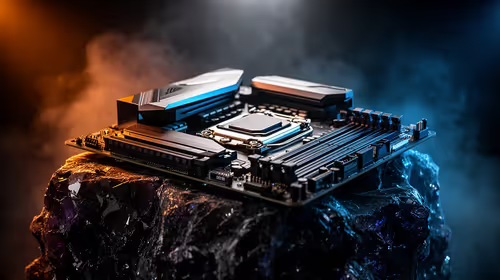
AM5 is smart for SA builders because it supports newer Ryzen CPUs, DDR5 memory, and a longer upgrade path. Compare board cost, cooling, gaming needs, and local part availability before choosing your next PC platform.
Read more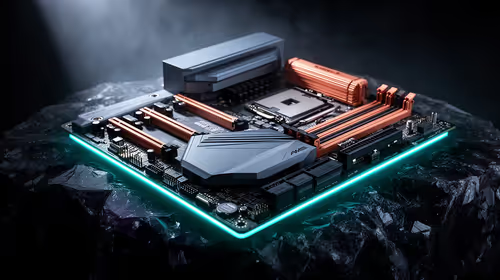
AM5 gives Randburg gaming builders a longer upgrade path. For SA buyers, DDR5 support, newer board features, and future CPU options can justify the platform. Weigh board cost, cooler support, BIOS maturity, and upgrade timing before choosing.
Read more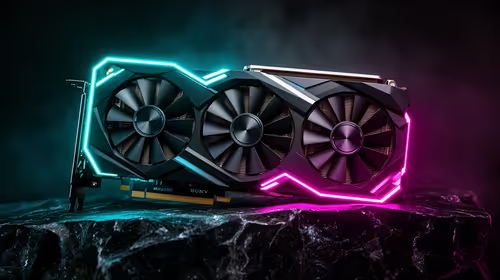
RTX 5090 on a 550W PSU leaves almost no practical room for OC plans. Treat the setup as constrained, with CPU draw, power spikes, cable quality, thermals, and stability checks more important than chasing extra clocks.

FPS drops on a Ryzen 9 9950X3D build often have a fixable cause. Check settings, drivers, thermals, background tasks, network conditions, and bottlenecks before assuming a part must be replaced.

The difference between PCIe 5.0 and PCIe 4.0 for SA gamers is mostly bandwidth headroom. Compare GPU slot needs, NVMe speed, motherboard support, and upgrade timing before paying extra for a newer platform.

Gaming PC stuck pixel checks in South Africa should confirm the monitor fault first. Use colour tests, screenshot comparison, cable swaps, display menu checks, and clear photos before deciding on support.

AMD's current driver now lists a Radeon RX 9050 4GB, while product coverage details a narrowed memory system. SA buyers should weigh the low VRAM ceiling against current local Radeon options.

Samsung Display has demonstrated a 16-inch 2.5K OLED laptop panel running at 300Hz. SA buyers should wait for a named notebook, full panel specifications and a local price before planning an upgrade.

Microsoft says some Windows 11 game crashes after recent updates are linked to RGB-related drivers. Affected SA gamers should confirm the update and driver before using the published registry workaround.
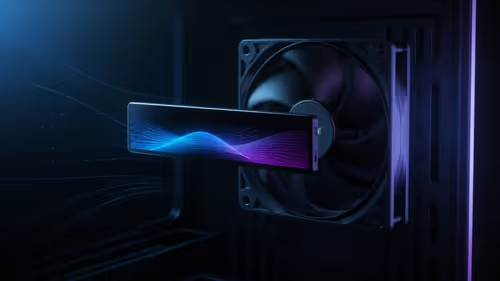
Thermalright's Fan Frame Vision-1 adds a 640x172 status screen to a standard 120mm fan. SA builders should check clearance, USB routing and local support before treating it as an easy upgrade.
1000W for RTX 5090 needs a full-build check, not a simple yes. Review GPU guidance, CPU draw, transient load, connectors, PSU quality, and upgrade plans before deciding.

Wi-Fi 6E vs Wi-Fi 6 matters for 4K video editing when files move across a network. The real-world difference between Wi-Fi 6E and Wi-Fi 6 for video editing in 4K depends on NAS access, cloud uploads, router range, and SA creator workflows.
RTX 5080 Super with a 750W PSU is more comfortable than lower wattage if the unit is quality. SA builders should still confirm GPU guidance, CPU draw, connector type, airflow, and upgrade room.
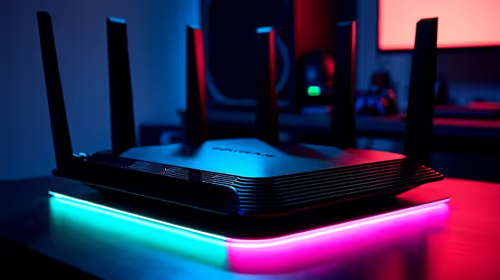
Wi-Fi 6E vs Wi-Fi 6 for Video Editing in 4K comes down to router support, latency, client devices, band support, and home network layout. SA buyers should match the choice to their setup instead of assuming one option always wins.