Quick Answer
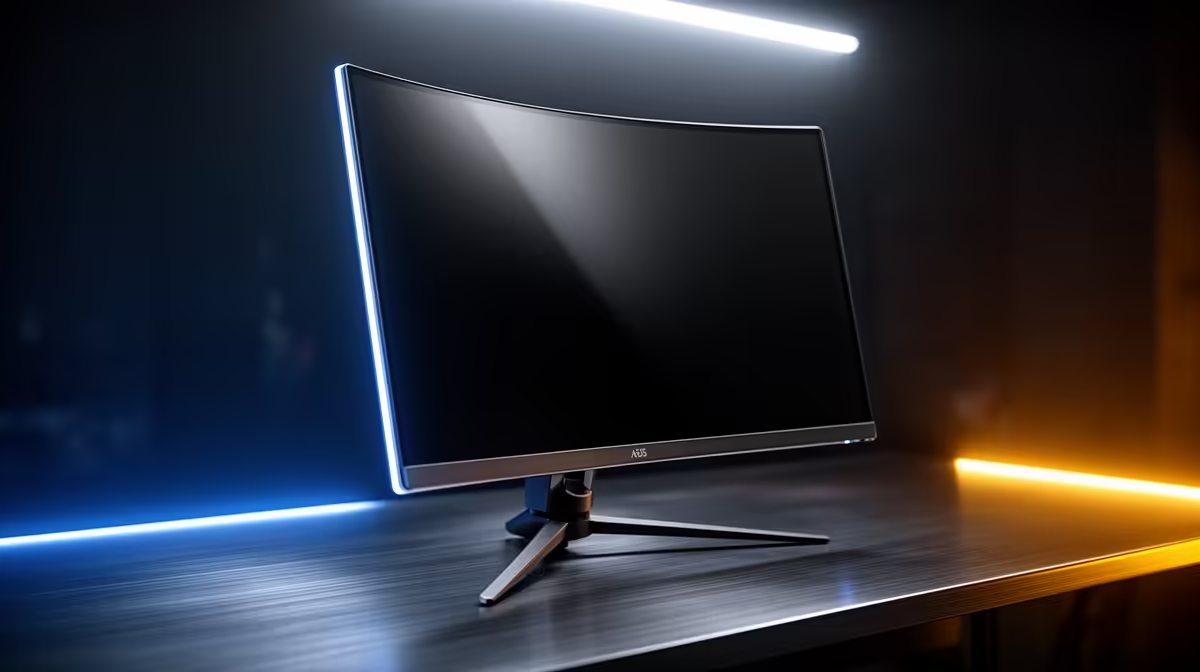
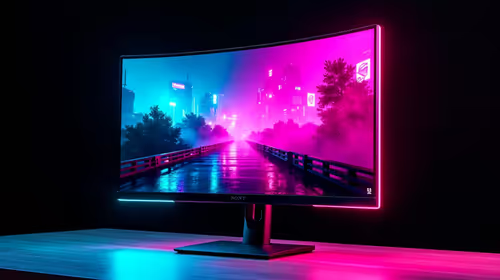
For budget upgraders, adaptive sync is worth paying for when your GPU's frame rate swings below your monitor's refresh, which is common on a budget card; FreeSync on a 1080p 144Hz panel (around R2,800 to R3,500) smooths those dips and stops tearing. Since most budget gaming monitors include FreeSync at no real premium, it is an easy yes.
Why adaptive sync helps a budget GPU most
A budget GPU like an RTX 4060 or RX 7600 often runs between 60 and 144 fps depending on the title, and those swings cause tearing or stutter on a fixed-refresh screen. FreeSync matches the monitor's refresh to the GPU's output between roughly 48Hz and the panel max, smoothing the experience exactly where a budget card needs it.
FreeSync is essentially free on budget panels
Most 1080p 144Hz gaming monitors around R2,800 to R3,500 include FreeSync as standard, and it works with both AMD and most NVIDIA GPUs (as G-Sync Compatible). So you are not paying a premium for adaptive sync at this tier; it comes with the panel. That makes it a clear win for a budget upgrader.
Match the monitor to a budget build
Pair a 1080p 144Hz FreeSync panel with an RTX 4060 for around 100 fps in many titles with tear-free, smooth motion. Enable FreeSync in both the monitor's menu and your GPU control panel. For an SA budget upgrade, this combo delivers the biggest visual jump for the money.
FAQ
Is adaptive sync worth it on a budget?
Yes. FreeSync smooths the frame-rate swings a budget GPU produces and comes free on most 1080p 144Hz panels around R2,800 to R3,500.
Does FreeSync work with NVIDIA cards?
Yes. Most FreeSync monitors are G-Sync Compatible, so they work with NVIDIA GPUs once enabled in the driver control panel.
What monitor for a budget RTX 4060?
A 1080p 144Hz FreeSync panel around R2,800 to R3,500 pairs well, giving around 100 fps with tear-free motion in many titles.
pays off most between 48 and your panel's max refresh. For budget upgraders, a 1080p or 1440p 144Hz panel with FreeSync around R2,800 to R4,500 is the value sweet spot.